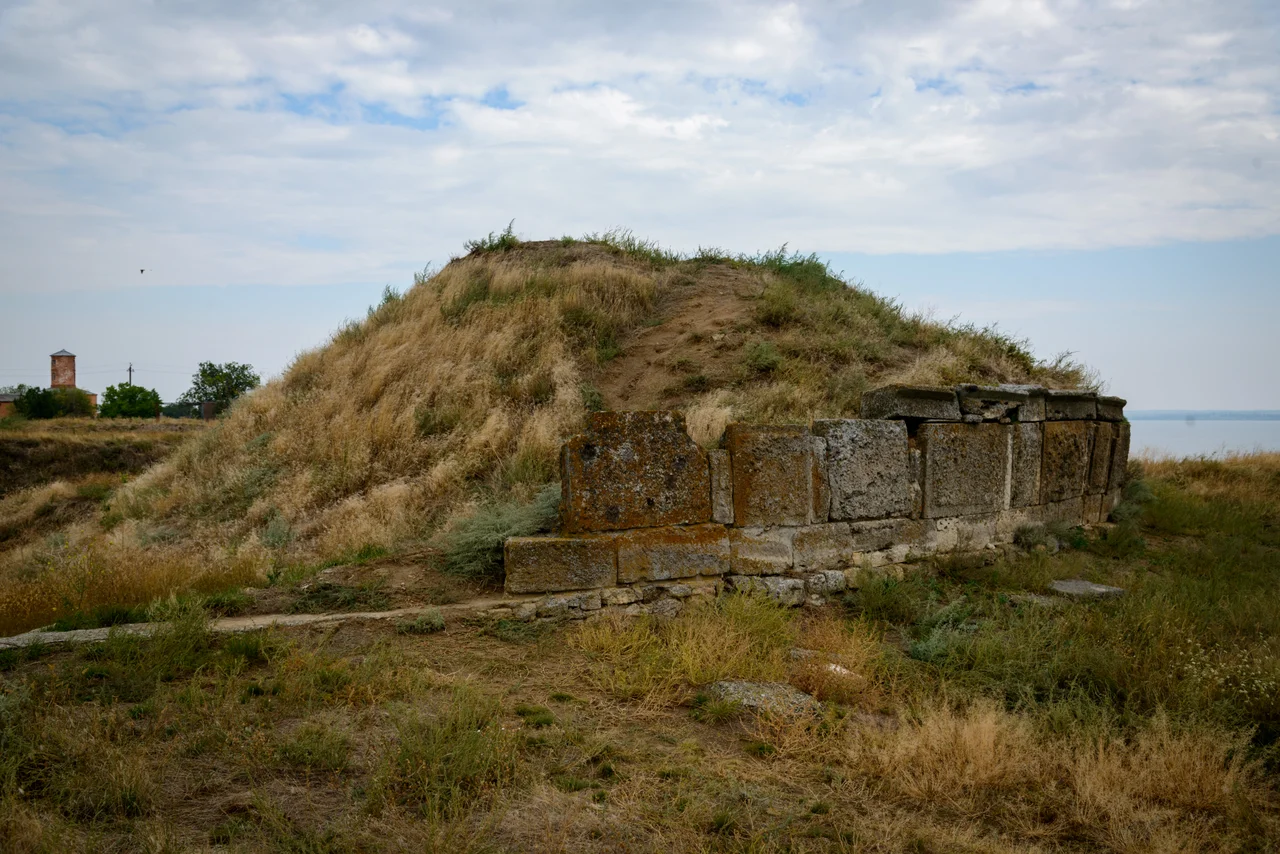

Pontic Olbia
The Greeks called it Olbia, a word that means happy or wealthy, and for a while the name fit. On a bluff above the Southern Bug estuary, near the modern village of Parutyne, colonists from the Ionian city of Miletus built one of the northernmost outposts of the classical Greek world in the seventh century BC. What survives today is an archaeological reserve of some fifty hectares, roughly the outline of an isosceles triangle a mile long, where the wind off the water crosses foundations that were old when Rome was young. This was a frontier city, Greek in language and gods but ringed by Scythian steppe, and its long slow story runs from prosperity to plunder to abandonment.
Dolphins and Gorgons
Olbia's harbor was one of the great trading posts of the Black Sea, an emporium shipping grain, fish, and enslaved people south to Greece and bringing fine Attic goods north into Scythia. Those enslaved men and women, bought and sold as cargo, were as real as the merchants who profited from them; one of the most poignant finds on the site is a private letter scratched on a lead tablet around 500 BC, complaining about someone's attempt to claim ownership of an enslaved man. The city's money was as distinctive as its trade. In the fifth century BC Olbia cast bronze in strange forms, round tokens stamped with the snake-haired face of a Gorgon and, most memorably, coins shaped like leaping dolphins, a design thought to descend from sacrificial tokens once used in the temple of Apollo Delphinios.
Where Two Worlds Touched
Olbia was a genuine meeting point between the Greek world and the peoples of the steppe, and something of that exchange survives in the ground. The scholar M. L. West argued that early Greek religion, and especially the mysterious Orphic tradition with its ideas of the soul and the afterlife, may have been shaped by shamanistic practice from the great grasslands of Central Asia, and a striking quantity of Orphic graffiti unearthed at Olbia suggests the colony was one of the places where those currents met. After the town adopted a democratic constitution in the fourth century BC, it even coordinated with its mother-city Miletus against a general of Alexander the Great named Zopyrion. For a frontier settlement, Olbia sat surprisingly close to the center of the ancient world's ideas.
Sacked, Restored, Abandoned
Prosperity did not last. By the late second century BC the city had declined and accepted the overlordship of the Scythian king Skilurus. It revived briefly under the great enemy of Rome, Mithridates Eupator, only to be sacked by the Getae under their king Burebista, a blow that ended its economic prominence for good. Rome later restored Olbia on a smaller scale, and the philosopher Dio of Prusa visited and described a diminished but proud town, often called Borysthenes after the nearby river. Incorporated into the Roman province of Lower Moesia, the settlement was finally abandoned in the fourth century AD after being burned in the Gothic Wars. Because no one built over it again, the ruins remained rich, though today the Black Sea itself is eroding the ancient shoreline, and archaeologists race the water to recover what the centuries left behind.
From the Air
Pontic Olbia lies at about 46.70 degrees north, 31.90 degrees east, on the west bank of the Southern Bug estuary near the village of Parutyne. From the air the triangular outline of the ancient city walls and the excavated grid stand out on the bluff above the water. Nearest airport is Mykolaiv International (UKON) to the northeast; Kherson (UKOH) lies to the southeast and Odesa International (UKOO) further west along the coast.
Nearby Stories
- Black Sea Shipyard 13 km away
- Black Sea Biosphere Reserve 15 km away
- Kuialnyk Estuary 44 km away
- Dzharylhach 54 km away
- Skadovsk 76 km away
- Granite-Steppe Lands of Buh 109 km away
- ArcelorMittal Kryvyi Rih 132 km away
- Danube Delta 193 km away