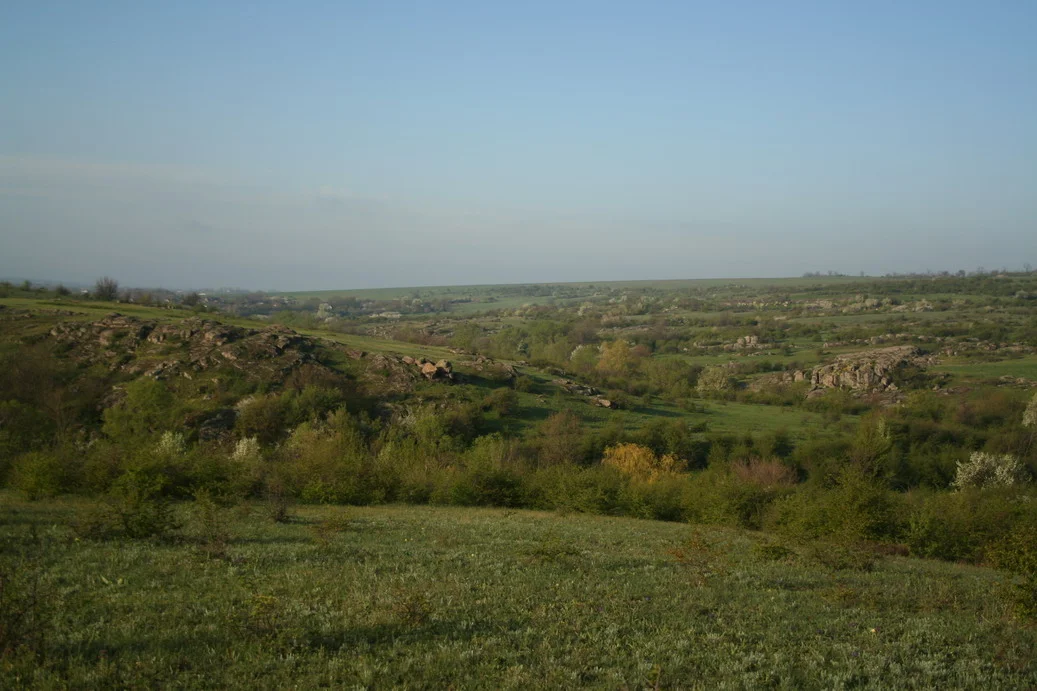

Granite-Steppe Lands of Buh
The rock beneath your feet here is almost unimaginably old. This is the exposed edge of the Ukrainian crystalline shield, some of the most ancient stone on the planet, and the Southern Buh river has spent ages cutting straight down into it. The result is a landscape that feels out of place in the flat farmland of southern Ukraine: a canyon of gray granite where the river tumbles over rapids, its banks rising in bare igneous cliffs. The Granite-Steppe Lands of Buh, a regional landscape park in northwest Mykolaiv Oblast, protects 70 kilometers of this valley. What looks like open steppe is really the worn-down stump of a mountain range older than almost anything else you could stand on.
The Bones of Vanished Mountains
These granite outcrops are the last remnants of mountains that once ran for a thousand kilometers across what is now Ukraine, from the Ovruch ridge in the north all the way toward the Sea of Azov in the southeast. Time did the rest. Over unfathomable spans, the slow grind of erosion stripped the peaks away and left only their crystalline foundations, the hardest core that could not be worn down. For the last 60 million years this stretch of land has stood above the waters that flooded so much of the surrounding country, which is part of why its rock lies so plainly exposed today rather than buried under later sediment. Where the Southern Buh meets that ancient massif, it cannot flow smoothly; it breaks into rapids, carving a rare rocky river valley and a network of ravine-like side canyons through a region otherwise blanketed in deep, flat black soil. The effect is startling: a slice of highland drama dropped into the middle of the plains.
Steppe, Stone, and Rare Life
The park is a refuge for life that struggles to survive elsewhere in a farmed landscape. Rich black chernozem, the famously fertile soil of Ukraine, covers most of the territory, but along the valley slopes something older persists: fragments of true rocky steppe and grasslands, clinging to ground too stony to plow. That resilience shows in the numbers. Roughly 900 species of vascular plants grow here, 26 of them listed in Ukraine's Red Book of threatened species. The park shelters at least 9,000 kinds of insects and around 300 vertebrate animals, with dozens of each also on the Red Book. In 2008 this concentration of wild beauty earned the Granite-Steppe Lands a place among the Seven Natural Wonders of Ukraine.
Thirty Thousand Years of People
People have been drawn to this river gorge for a very long time. Between the villages of Mihiya and Oleksandrivka, archaeologists have found nearly a hundred monuments forming an almost unbroken chain from the Paleolithic, some 30,000 years ago, down to the dawn of the Slavic peoples. Cimmerians, Trypillians, Sarmatians, Romans, and early Slavs all left traces along these banks. In more recent centuries the valley held Buh Gard, once the seat of a district of the Zaporizhian Cossack Host, a fortified riverside home to the fierce frontier warriors of the steppe. That heritage carries a wound: in 2006, construction of the Tashlyk hydroelectric station flooded part of the historic Buh Gard tract. A landscape that had preserved 30,000 years of human memory lost a chapter of it to rising water, a reminder of how fragile even the oldest places can be.
A Gardener's Foresight
Not every human mark here is a scar. In the 19th century, a landowner named Viktor Skarzhynsky planted an arboretum on ground that would one day fall within the park, gathering trees where the wild steppe had held few, an early gesture of stewardship in a region better known for plowing than for planting. That impulse to protect this place turns out to run deep. Its reputation spread beyond Ukraine as early as the 1920s, and generations of naturalists have argued for its safekeeping. Standing on a granite ledge above the rapids today, with wildflowers in the cracks and the river roaring below, you can feel why. This is a landscape that rewards attention, an outdoor museum of deep time and rare life, and the people who fought to preserve it understood that some places are worth far more left as they are.
From the Air
The park follows the Southern Buh valley near 47.9028 N, 31.0855 E in northwest Mykolaiv Oblast, between the towns of Pervomaisk and Voznesensk. From 2,000 to 4,000 feet the granite canyon and its river rapids cut a distinct dark seam through the surrounding farmland and steppe. Nearest airports include Mykolaiv International (UKON) to the south and Uman-area fields to the north; the river gorge itself is the clearest visual landmark.
Nearby Stories
- Yelanets Steppe Nature Reserve 20 km away
- Strategic Missile Forces Museum 33 km away
- Khutir Nadiia 42 km away
- Battle of Peregonovka 44 km away
- Fortress of St. Elizabeth 81 km away
- Nebelivka 83 km away
- Dykyi Sad Archaeological Site 98 km away
- Tiraspol 113 km away