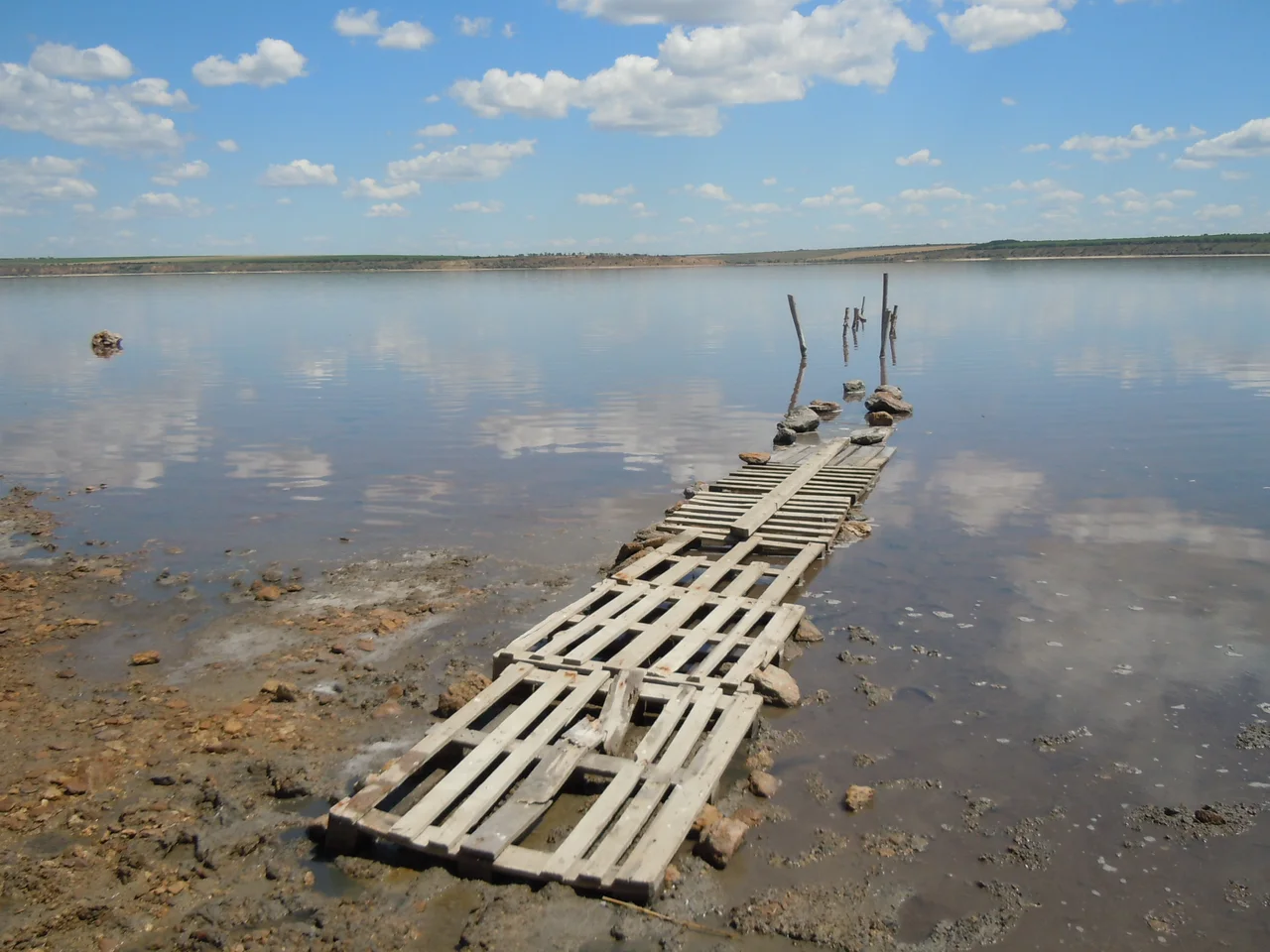

Kuialnyk Estuary
North of Odesa, the land does something strange: it dips below the sea it never quite touches. Here, beside the Kuialnyk Estuary, sits the lowest point in all of Ukraine, five meters beneath sea level, and yet no waves reach it. A sandbar up to three kilometers wide seals this long, shallow lagoon off from the Black Sea, leaving behind a body of water that answers to no tide, only to sun and drought. On a hot summer afternoon the shallows can climb past 28 degrees Celsius, warm as bathwater, and thick with salt.
How the Sea Locked a Bay Behind Sand
The estuary was not always a lagoon. Long ago, this was simply the mouth of the Velykyi Kuialnyk River, opening into a gulf of the Black Sea. Over centuries, sand carried by both river and sea piled up across the entrance until a barrier formed and the gulf was cut off from open water, becoming what geographers call an estuary. That sealing happened around the fourteenth century, notably later than at the neighboring Khadzhibey Estuary, and you can read the difference in the sandbars themselves: Kuialnyk's barrier is about three times narrower than its neighbor's, a small clue to which bay the sea abandoned first. Roughly 28 kilometers long and more than three wide, the lagoon averages only about a meter deep, a vast shallow mirror laid across the coastal plain.
Saltier Than the Ocean
What makes Kuialnyk remarkable is its restlessness. Cut off from the sea, its water level and its saltiness rise and fall with the weather, and the swings are extreme. Between 1878 and 1968, observers recorded salinity ranging from 29 parts per thousand, close to ordinary seawater, all the way up to 269, staggeringly briny, several times saltier than any ocean. In the saltiest years, salt simply fell out of the water and crusted the bottom. In the driest years, when the Velykyi Kuialnyk River shrank to nothing, the lagoon itself lost nearly half its surface. Twice, in 1907 and again in 1925, people intervened to keep it from vanishing altogether, channeling seawater in to refill the dying estuary and buy it more time.
Black Mud and the Cure
That intense chemistry is also why people come. Along the southeast shore sits the Kuialnytskyi mud resort, one of the oldest of its kind on the Black Sea, where visitors coat themselves in the estuary's dark, mineral-heavy silt in the hope of easing aches and ailments. The comparison writes itself: like a smaller, sun-warmed Dead Sea, Kuialnyk offers water so dense with dissolved minerals that the body feels the difference. Beaches line the banks, and in high summer the warm shallows draw bathers to a lagoon that is at once a health spa, a geological curiosity, and the lowest ground a person can stand on in Ukraine, a quiet, salt-rimmed hollow that has spent centuries teetering between too much water and too little.
A Name That Means Thick
Even the estuary's name carries the memory of what the water becomes. Kuialnyk comes from the Crimean Tatar word kuyanlyk, meaning thick, an apt description for a lagoon whose brine can grow so concentrated that it seems to congeal in the summer heat. Older maps and records knew it by a different name, Andriivskyi Lyman, before Kuialnyk stuck. It belongs to a whole family of coastal lagoons north of Odesa, the group known collectively as the Odesa estuaries, each one a former river mouth pinched off from the sea by the same patient work of drifting sand. Yet Kuialnyk stands apart among them, deeper in salt, lower in the land, its name a small linguistic fossil left behind by the Crimean Tatar people who once described exactly what a traveler still finds here: water thick enough to feel on the skin.
From the Air
Centered near 46.6644 N, 30.7131 E, just north of Odesa. From 2,500 to 4,000 feet the long, pale ribbon of the estuary and its broad sandbar stand out sharply against the surrounding plain, running roughly parallel to the Black Sea coast. Odesa International Airport (UKOO) lies a short distance south.
Nearby Stories
- Berezan' Runestone 12 km away
- Lower Dniester National Nature Park 29 km away
- Tendra Spit 32 km away
- Mykolaiv Observatory 52 km away
- Black Sea Biosphere Reserve 90 km away
- Black Sea Shipyard 93 km away
- Danube Delta 146 km away
- Uman 202 km away