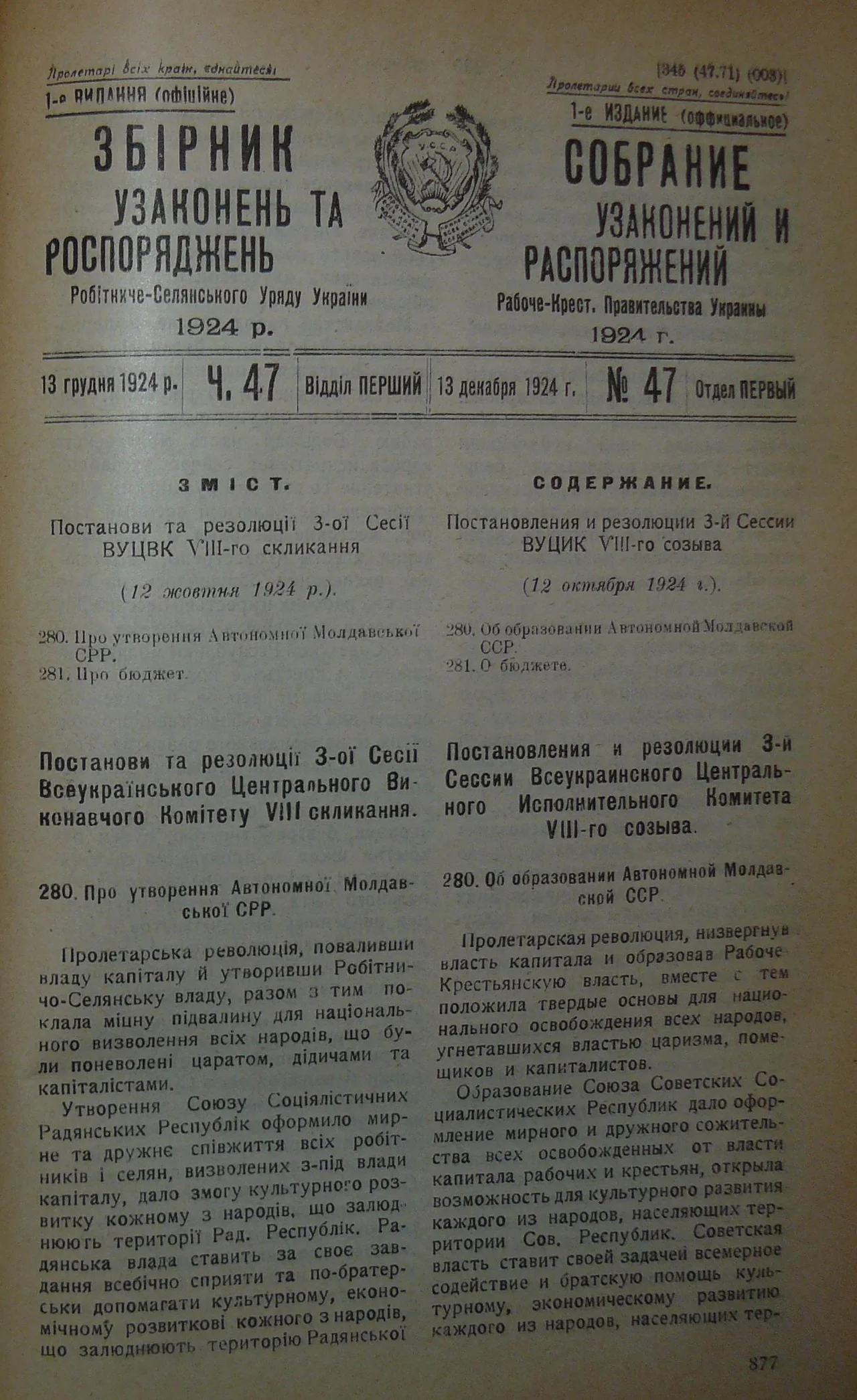

Moldavian Autonomous Soviet Socialist Republic
It was a country designed to point at another country. When Soviet planners drew the Moldavian Autonomous Soviet Socialist Republic onto the map in 1924, they were not simply organizing a population; they were building what one memorandum frankly called a bridgehead, a strip of land along the eastern bank of the Dniester meant to project Soviet influence across the river toward Romanian-held Bessarabia. For sixteen years this improvised republic governed the territory of today's Transnistria and a swath of what is now Ukraine, first from Balta and then from Tiraspol. Its short life was shaped by grand geopolitical ambition and, for the people caught inside it, by famine and fear.
A Republic Made to a Purpose
The idea's most active champion was Grigory Kotovsky, a revolutionary and native of Bessarabia, who in February 1924 co-signed a memorandum to the Bolshevik leadership urging the creation of a Moldavian autonomy on Ukrainian soil. The logic was openly strategic. Bessarabia had been lost to Romania in 1918, and Soviet planners hoped a Moldavian republic on the Dniester would radicalize pro-Soviet feeling across the river and bolster Moscow's claim to the territory. Propaganda cast the venture in shining terms, one contemporary voice describing the future republic as a lighthouse spreading 'the light of freedom and human dignity.' Organized first as an oblast in March 1924, it comprised four districts with Moldavian majorities, and in October it was elevated to a full autonomous republic within the Ukrainian SSR. Curiously, its declared capital was named as the 'temporarily occupied' city of Kishinev, which lay inside Romania and which the republic never actually controlled.
Hunger on the Dniester
For ordinary people, the republic's early years were defined by upheaval and suffering. Collectivization here moved even faster than in the rest of Ukraine and was reported complete by the summer of 1931, a speed achieved at human cost: roughly two thousand families were deported to Kazakhstan. Then came the famine of 1932 and 1933, the same catastrophe known in Ukraine as the Holodomor, and tens of thousands of peasants starved. Desperate people tried to flee across the Dniester into Romania, knowing they might be shot for the attempt. On 23 February 1932, near the village of Olanesti, forty of them were killed, an incident survivors carried into the European press. The Soviet authorities dismissed the dead as subverted 'kulak elements.' Behind that dry official phrase were families who had chosen the risk of a bullet over the certainty of hunger.
Ruled From Tiraspol, Then Dissolved
The seat of government wandered before it settled. A provisional capital was established at Balta, a town that was only about two and a half percent Moldavian, and in 1929 it moved to Tiraspol, where it remained. From here the republic waged its war of words: in 1930 a radio station began broadcasting Romanian-language programming across the river, aimed squarely at Bessarabia, and a taller mast raised in 1936 extended its reach, prompting Romania to build its own counter-station. The republic's purpose was finally realized in 1940. After the Molotov-Ribbentrop Pact cleared the way, the Soviet Union occupied Bessarabia, and on 2 August 1940 the autonomous republic was dissolved, its westernmost part folded together with Bessarabian counties to form the new Moldavian SSR. The bridgehead had served its function, and once the far bank was taken, it was no longer needed.
From the Air
The historical Moldavian ASSR was governed from Tiraspol, at roughly 46.84 N, 29.64 E on the Dniester River, in what is now Transnistria and adjacent Ukraine. From the air the Dniester winding through flat farmland marks the old republic's western spine. Transnistria has no airport; the nearest is Chisinau International (LUKK) in Moldova, about 70 km west.
Nearby Stories
- Odesa Catacombs 31 km away
- Kuialnyk Estuary 42 km away
- Lower Dniester National Nature Park 43 km away
- Granite-Steppe Lands of Buh 109 km away
- Battle of Vaslui 113 km away
- Bug Gard National Nature Park 139 km away
- Battle of Baia 225 km away
- Lake Sfânta Ana 258 km away