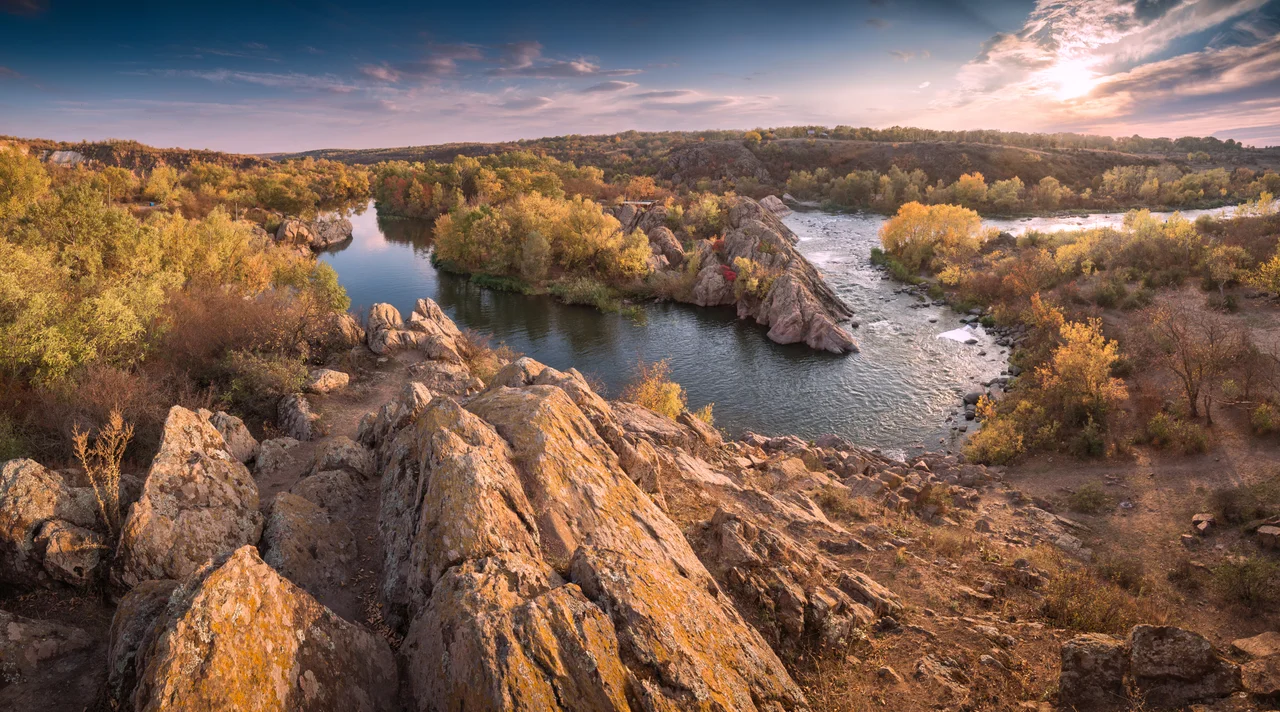

Bug Gard National Nature Park
The name holds a small piece of forgotten daily life. A gard was a fishing weir, a barrier of stakes and stone that the Cossacks once set across a river to trap fish in the current. That such a humble structure gave its name to an entire national park says something about how deeply people once lived along the Southern Bug. Today the Bug Gard National Nature Park protects the wild canyon where this river tumbles off the Ukrainian uplands and down into the open steppe, about 140 kilometers before its waters reach the Black Sea. It is a place where geology, wildlife, and human memory all press up against one another in a narrow gorge of ancient granite.
A River Cutting Through Deep Time
Here the Southern Bug slices into the southern edge of the Ukrainian Shield, a vast block of Archean basement rock among the oldest stone on Earth. Where an ordinary river would meander lazily across the plain, this one is forced through a relatively narrow canyon studded with granite outcrops, ledges, rapids, and midstream islands. The park marks a threshold in the landscape itself: upstream lies the forested upland plateau, downstream opens the treeless steppe, and in between the river makes its dramatic drop. Local landmarks capture the drama in their names, from the fall colors of Arbuzynka Canyon to a stretch of white water known as the Witch's Rapids, each a reminder that this is one of the few true river gorges in southern Ukraine.
Where Forest Meets Steppe
Bug Gard sits at the western edge of the Pontic-Caspian steppe, the immense grassland belt that once stretched from here deep into Central Asia and served for millennia as the great highway of nomads and horsemen. Its climate is one of extremes, a humid continental pattern with mild summers and cold, snowy winters and only 450 to 500 millimeters of rain a year, enough to swing sharply between seasons. Yet precisely because the park straddles the boundary between upland forest and lowland grassland, its biodiversity is remarkably rich. Scientists have recorded some 900 species of plants and around 300 species of vertebrates within its bounds. On the plateau above, patches of woodland survive; on the steep fall zone down to the river, rocky terrain thick with brush and sedges gives way to true steppe vegetation clinging to the granite. Life crowds into the transition, thriving at the seam where two very different worlds press together.
Long Watched, Finally Protected
This valley's value was recognized long before it became a park. Its unique landscape was known beyond Ukraine's borders as early as 1920, and in 1929 a Leningrad journal listed it among sites in urgent need of protection, naming it among the 250 most important natural objects in the entire Soviet Union. Formal safeguarding came much later. The national park overlaps with the older Granite-Steppe Lands of Buh regional landscape park, but national status brings a stronger set of legal protections to the fragile canyon. The park is scattered across several tracts and is not a place for casual wandering; most visitors come with organized tours or arrange their stay in advance, following ecotrails that let them witness the rapids and cliffs without loving the place to death. After a century of admiration, the gorge is at last being guarded.
Into the Gorge
For those who make the arrangements, the reward is a stretch of Ukraine that feels like nowhere else in the country's south. Ecotrails thread along the canyon rim and down to the water, past dramatically named formations and stretches of white water where the Southern Bug crashes over the granite. In autumn the side canyons blaze with color; on a still dawn, mist hangs over the rapids and the cliffs glow in the low light. This is prime terrain for kayakers testing themselves against the current and for hikers and photographers chasing the play of stone and water. Because access is managed rather than open, the wildness stays intact, and the visitor who arrives on the park's terms gets to meet the gorge much as the Cossacks and their gard-builders once knew it, loud, rocky, and gloriously alive.
From the Air
The park's main tracts follow the Southern Bug canyon near 48.0397 N, 30.9467 E in northern Mykolaiv Oblast, roughly 140 km upstream from the Black Sea. From 2,000 to 4,000 feet the granite gorge, its rapids, and its wooded islands stand out as a dark, winding seam where the forested uplands give way to open steppe. Nearest airports include Mykolaiv International (UKON) to the south; the river canyon is the strongest visual landmark for orientation.
Nearby Stories
- Battle of Peregonovka 26 km away
- Aktove Canyon 28 km away
- Khutir Nadiia 28 km away
- Yelanets Steppe Nature Reserve 28 km away
- Battle of Uman 43 km away
- Nebelivka 63 km away
- Fortress of St. Elizabeth 65 km away
- Tiraspol 129 km away