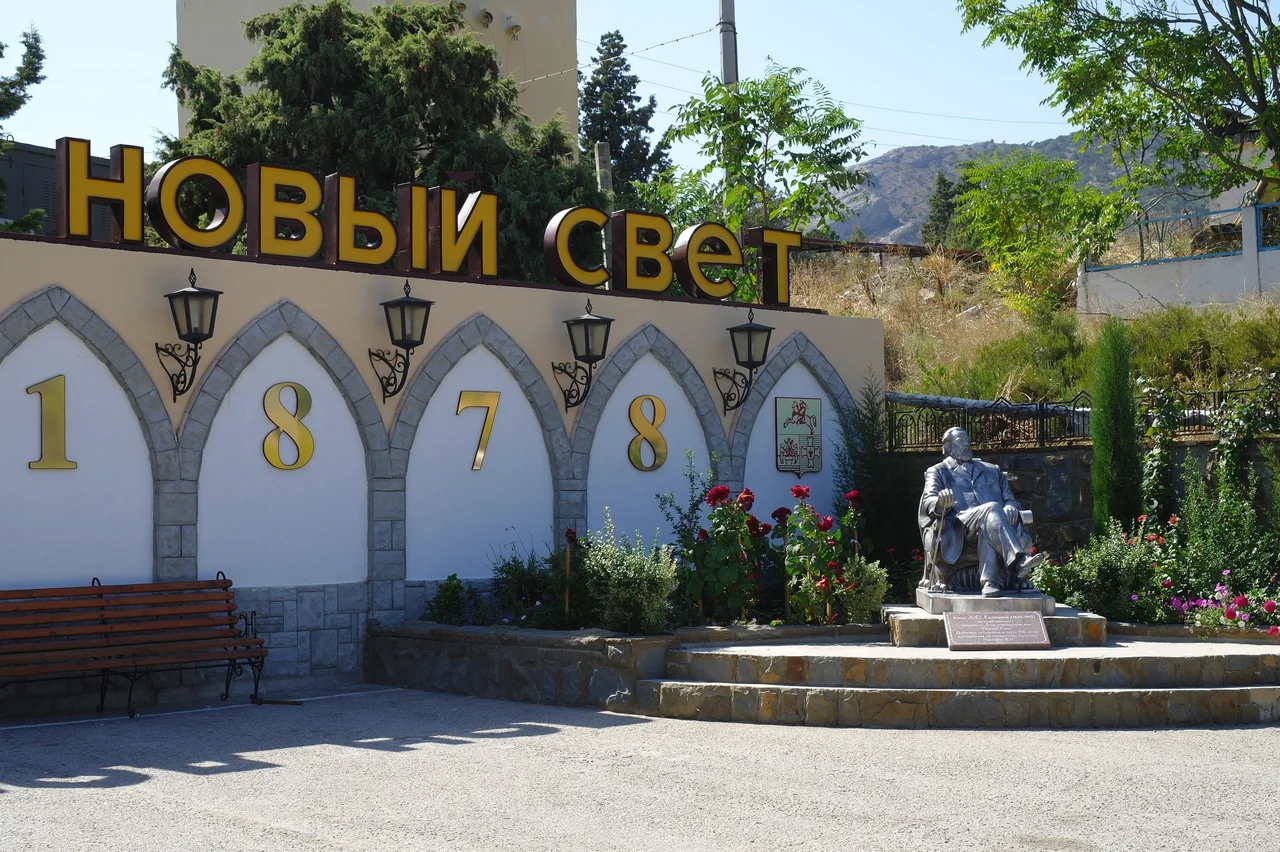

Novyi Svit Winery
In 1896, at the coronation of Nicholas II, the last tsar of Russia, the glasses raised in the imperial hall were filled not with French champagne but with a sparkling wine from an obscure cove on the Crimean coast. The man who made it, Prince Lev Golitsyn, had spent close to twenty years and much of his fortune proving that Russia could produce a wine to rival anything from Reims or Épernay. Four years after that coronation, his creation won a Grand Prix at the World Exhibition in Paris, and the gamble was vindicated. The story of that wine begins in a place he named Novyi Svit, the New World, where the rock itself was hollowed out to make it.
A Prince's Obsession
Golitsyn founded the estate in 1878, drawn to this southern edge of Crimea because it sits on the same latitude as southern France, warm enough and sunlit enough to ripen the grapes he had in mind. He was not a man who did things halfway. He carved three kilometers of cellars into the coastal rock, tunnels cool and constant enough to age wine for years without a single machine to regulate them. On the terraces above the water he planted Chardonnay, Riesling, Pinot Meunier, and Pinot noir, the classic grapes of Champagne. Then came the hard part. For a full decade he refined his method, fermenting the wine in the bottle for three years at a steady fifteen degrees, adjusting and tasting and beginning again until the result satisfied him.
The Coronation and the Grand Prix
The reward came in stages. In 1896 the wine was served at the coronation of Nicholas II, an endorsement that placed a Crimean vintage at the center of the empire's grandest ceremony. That same year Golitsyn earned the right to display his family coat of arms on the bottles, a mark of imperial favor. But the moment that carried his name beyond Russia came in 1900, when his sparkling wine took a Grand Prix at the Paris World Exhibition. To win in Paris, at the height of Champagne's prestige, with a wine from a cove almost no one outside Russia could find on a map, was the kind of victory that turns a private obsession into a legend. The prince had set out to prove a point, and the judges of Paris agreed.
The Slow Method That Endures
What Golitsyn built has outlasted empires. The winery still makes its sparkling wine by the traditional method, the same laborious process used in Champagne. Each bottle ferments for three years, and the delicate work of riddling, the gradual turning and tilting that coaxes the sediment down into the neck, is still done by a single pair of hands. Every coupage, the blend that defines a batch, comes solely from the grapes of a single year's harvest, with no reaching back to older reserves to smooth over a weak vintage. It is a stubborn, unhurried way to make wine, and it is precisely the way the prince intended. More than a century after his death, the cellars he cut into the Crimean rock are still doing exactly what he built them to do.
From the Air
The Novyi Svit winery sits at 44.83°N, 34.91°E on the southeastern Crimean coast, its cellars cut into the hills above a sheltered Black Sea cove. From about 6,000 feet the terraced vineyards and the curving bays of Novyi Svet stand out beside the town of Sudak to the east. Nearest airport is Simferopol (UKFF), roughly 60 nautical miles northwest.
Nearby Stories
- Partenit 12 km away
- Valley of Ghosts 19 km away
- Aeroflot Flight 6515 32 km away
- Crimean Nuclear Power Station 33 km away
- Ayu-Dag 53 km away
- Battle of the Kerch Peninsula 53 km away
- Juma-Jami Mosque 84 km away
- 1976 Anapa Mid-Air Collision 142 km away