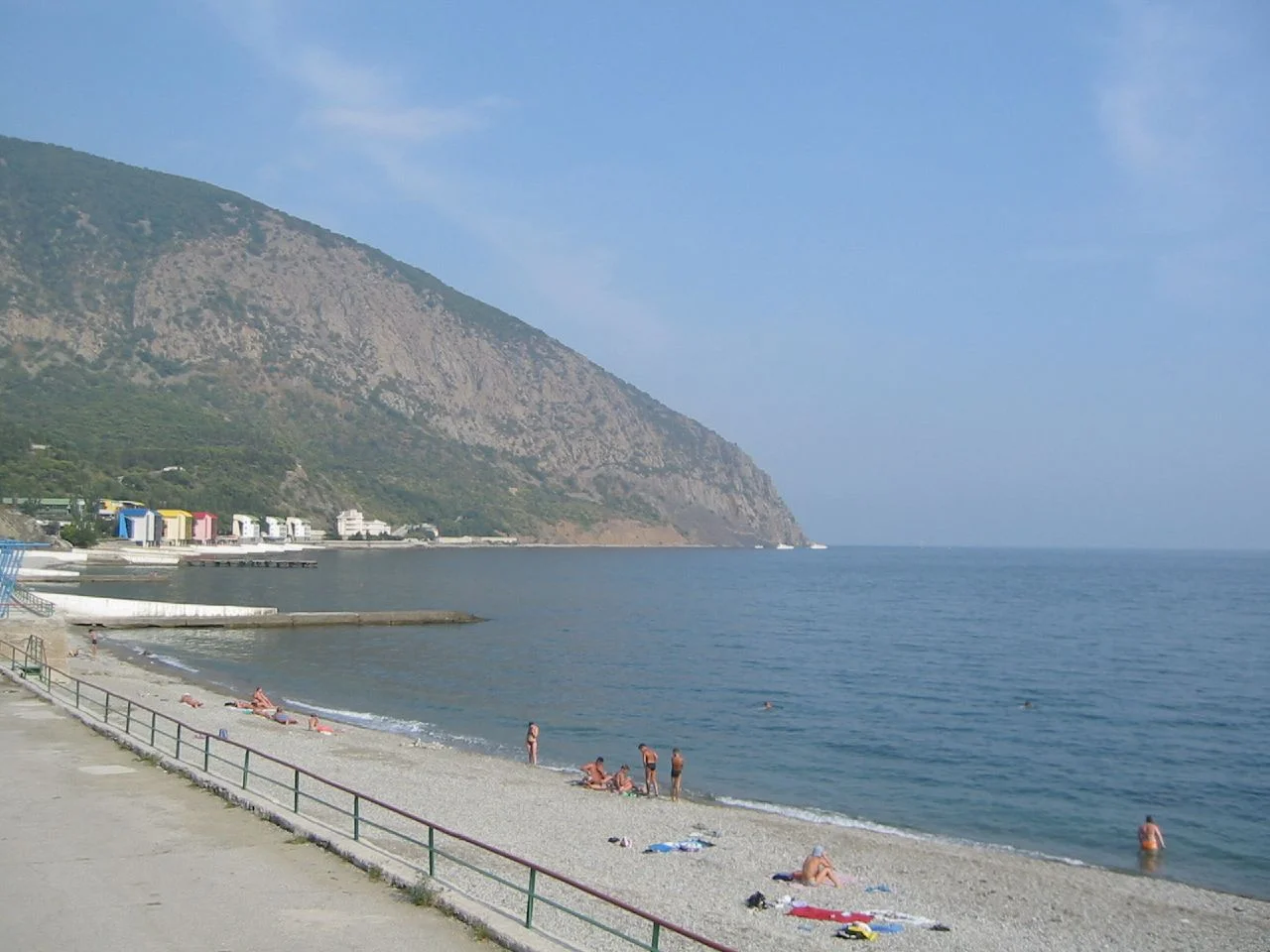

Ayu-Dag
From a distance it is impossible not to see the bear. The broad rounded mass of Ayu-Dag heaves up from the Crimean coast and slopes down into the Black Sea like some enormous animal lowering its head to drink, and that resemblance is written into its very name. In Crimean Tatar, Ukrainian, and Russian alike, the mountain is Bear Mountain, a rare case of a landform whose shape so plainly suggests a creature that entirely different peoples reached for the same word.
The Names It Has Worn
This headland has been renamed by every people who ever sailed past it, and the layers of naming read like a history of the coast itself. It rises some sixteen kilometers northeast of Yalta, standing between the towns of Gurzuf and Partenit, a landmark impossible to miss and apparently impossible to leave un-named. The ancient Greeks, whose ships worked these waters, called it Kriou Metopon, the "Ram's Head," seeing a different animal in the same rock. The Crimean Tatars named it for the bear, joining ayuv, bear, to dag, mountain. The Slavic versions that came later, Medved'-gora, are simply translations of that older Tatar word, one people borrowing another's vision of the stone. There is even a whisper of the sacred in the syllable Aya, a hint of holiness. Each name is a small window onto the sailors, herders, and settlers who once looked up at this silhouette and reached for a word to hold it, and together they turn a single mountain into a kind of dictionary of everyone who has passed this way.
A Mountain That Never Erupted
The bear's strangest secret is that it is a volcano that never quite happened. Ayu-Dag is a laccolith, a dome of molten rock that pushed up beneath the surface in the deep past and then cooled underground before it could ever break through the crust as a true, fire-throwing volcano. It is, in effect, a mountain of frozen intention, magma that swelled toward the light and then stopped. That buried origin is precisely what gives the mountain its unmistakable form: the smooth, rounded hump has no crater or jagged crown, only the swelling curve that reads so plainly as an animal's back and shoulders lowered toward the water. Today its slopes and the surrounding land are protected as a nature reserve of about 5.5 square kilometers, a pocket of wild Crimean coast where forest tumbles unbroken down toward the sea on every side, and where the shape of the bear stays as still as it has for millions of years.
Byzantine Harbor, Modern Playground
Long before it became scenery, this was a working corner of a great empire. On these slopes archaeologists have uncovered the remains of an early-medieval settlement and a scattering of churches, the stone footings of a community that once made its home on the bear's flanks. In the ninth and tenth centuries the site was a well-known seaport, its ships casting off for the cities of the Byzantine Empire, so that the same headland travelers now admire for its shape was once a busy point on a trade map, watched for from the deck of an approaching vessel. The mountain sorts its two faces to two very different neighbors. The eastern slopes run down toward the ancient settlement of Partenit; the western slopes descend to the famous children's camp of Artek, which nestles directly in the mountain's shadow. To stand beneath Ayu-Dag today, then, is to occupy a strangely layered place, ground where Byzantine merchants once loaded cargo bound across the sea, and where, many centuries later, generations of children spent the golden summers of their lives, all in the lee of the same unmoving stone bear.
From the Air
Ayu-Dag rises to a summit near 44.561°N, 34.327°E on the coast between Gurzuf and Partenit. Its huge rounded headland jutting into the Black Sea is one of the most recognizable natural landmarks on the entire Crimean shore; the Artek camp lies on its western flank and Partenit to the east. Give the terrain a comfortable margin and fly the coast at 2,500 to 3,500 feet, watching for turbulence and fast-changing mountain weather. The nearest major airport is Simferopol International (UKFF), about 55 km to the northwest.
Nearby Stories
- Soviet Hospital Ship Armenia 5.2 km away
- Eski Kermen 5.5 km away
- Battle of the Alma 6.4 km away
- Novyi Svit Winery 8.5 km away
- 1988 Black Sea Bumping Incident 14 km away
- Akmesdzhyt Friday Mosque 16 km away
- Novyi Svet 31 km away
- Abkhazia 518 km away