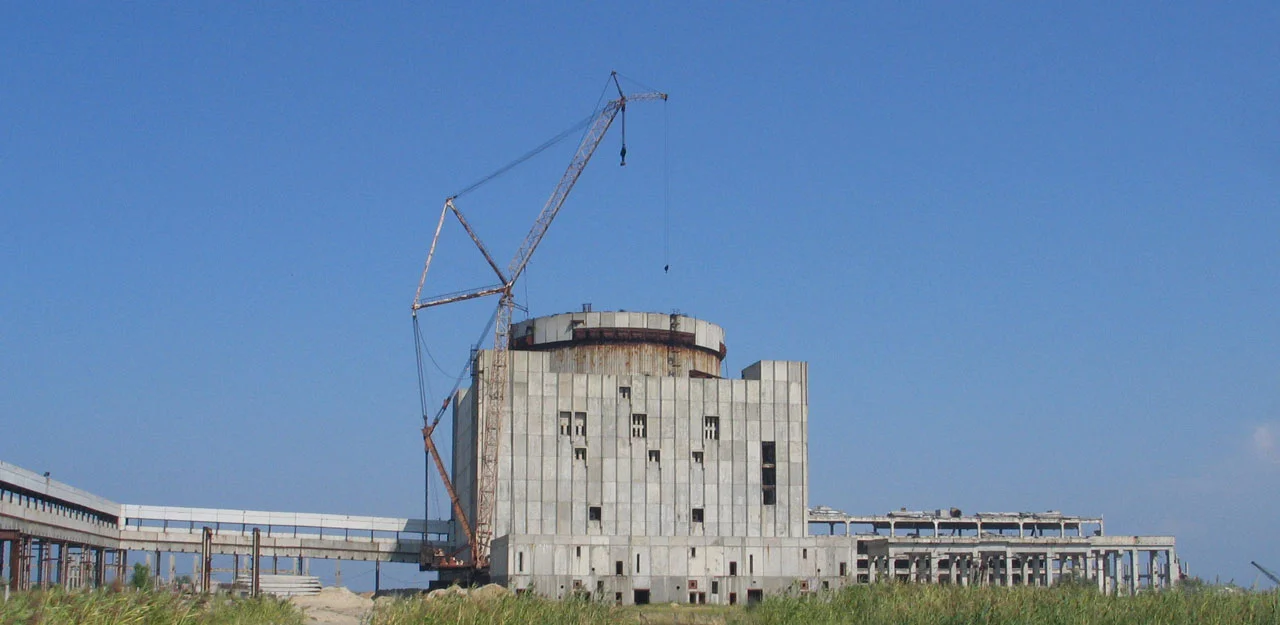

Crimean Nuclear Power Station
For a few summers in the 1990s, the loudest thing at Cape Kazantyp was not a turbine but a bassline. The Crimean Nuclear Power Station was supposed to hum with the controlled fury of a fission reactor. Instead, its cavernous concrete halls sat silent and unfinished, a monument to Soviet ambition abruptly halted, until a generation of ravers discovered that the empty reactor building made an unforgettable dance floor. They called their festival KaZantip, and they gave the venue a nickname that captured the delicious absurdity of the place: the Reaktor. A power plant that never produced a watt became instead a generator of pure, chaotic joy.
The Plant That Feared Its Own Ground
The project began in earnest in 1976, part of the Soviet Union's sweeping push into nuclear power. Two years later, in 1978, the new town of Shcholkine rose nearby to house the engineers and workers who would run the station, a purpose-built settlement on the shore of Aqtas Lake near the cape of Kazantyp. Then came 1986 and the catastrophe at Chernobyl, which forced the entire Soviet nuclear program into anxious self-examination. Inspectors turned their attention to the Crimean site and found a serious problem: the ground beneath it was geologically volatile, an unwelcome quality anywhere, and an alarming one under a reactor. In 1989 construction was summarily abandoned. The plant would never be finished, its reactor never fueled. It was a colossal investment left to stand idle, a monument to the confidence with which it had been begun and the fear with which it was halted, the mood of a nation that had learned, at Chernobyl, exactly what a reactor on bad ground could do.
The Reaktor Comes Alive
What do you do with a half-built nuclear plant on a beautiful stretch of Crimean coast? Between 1993 and 1999, the answer was to throw a party. The KaZantip festival took over the abandoned station, and the hulking unused structure became its defining stage. The nickname wrote itself. Where planners had once imagined dials and control rooms and the sober discipline of atomic energy, there was now music, movement, and a crowd drawn to the strange thrill of dancing inside a machine built for a purpose it never fulfilled. It was one of the more surreal reinventions of Soviet-era infrastructure anywhere, industrial decay repurposed as pure spectacle.
Sold to No One in Particular
After the music moved on, the station drifted through the bureaucratic afterlife of an unwanted asset. From 1998 to 2004 it sat under the jurisdiction of Ukraine's Ministry of Fuel. In 2004 responsibility passed to the government of Crimea. Then, in 2005, the Crimean representation of the State Property Fund sold the station to an undisclosed firm, a fittingly murky end for a place that had already lived two improbable lives. The reactor vessel itself was cut up for scrap that same year, but the great reactor building, once one of the largest structures of its kind in the region, stood largely intact for another decade and a half as a magnet for urban explorers, until authorities began systematically demolishing it in 2021, finally clearing the site by the mid-2020s.
A Town Built for a Plant That Never Ran
The strangest legacy of the Crimean station may be the town beside it. Shcholkine was raised from nothing in 1978 for a single purpose: to house the thousands of engineers, builders, and their families who would run the reactor. It was a company town without a company, a settlement whose entire reason for existing evaporated the moment construction stopped in 1989. Yet the people did not simply vanish. Shcholkine endured, reinventing itself on the shore of the warm Sea of Azov, its Soviet apartment blocks looking out toward a plant that would never glow with power. There is something quietly moving in that persistence, a community outliving the grand plan that summoned it, making an ordinary life in the shadow of an extraordinary failure. The station drew the curious for decades before its demolition was completed in the mid-2020s, but the town remains the more human monument.
From the Air
The unfinished plant stands near Cape Kazantyp on the shore of Aqtas Lake at 45.39°N, 35.80°E, in northeastern Crimea near the Sea of Azov. From 4,000 feet the site of the former reactor building and the nearby planned town of Shcholkine stand out against the flat coastal plain, with the round cape of Kazantyp jutting into the sea just north. Nearest major airfield is Simferopol (UKFF), roughly 130 km southwest.
Nearby Stories
- Kimmerikon 15 km away
- Kul-Oba 17 km away
- Ozbek Han Mosque 17 km away
- Feodosiya 28 km away
- Arabat Spit 31 km away
- Byriuchyi Island 47 km away
- Henichesk 86 km away
- Meotyda National Nature Park 174 km away