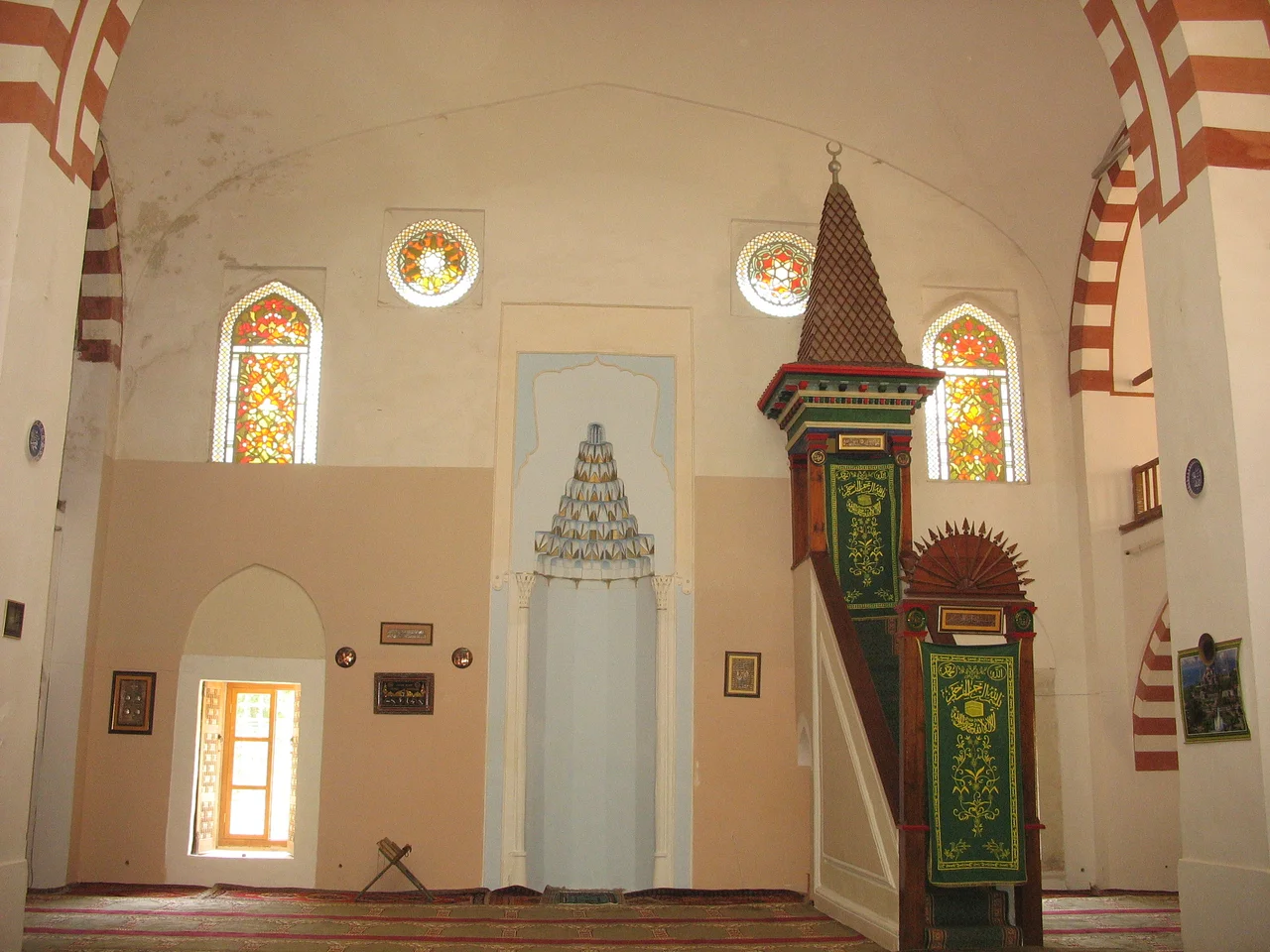

Juma-Jami Mosque
The man who designed this mosque had, at the same moment, one of the busiest desks in the sixteenth century. Mimar Sinan was the chief architect of the Ottoman Empire, and when a Crimean khan commissioned him to build a great mosque on the shore of the Black Sea, Sinan was already deep in the construction of the mighty Süleymaniye Mosque in Istanbul. The result of his attention, half a world of logistics away, still stands in Yevpatoria: the Juma-Jami Mosque, the largest in Crimea, its domes and slender minarets rising above the old town like a piece of Istanbul transplanted to the northern edge of the empire.
A Khan's Commission
The mosque was founded in 1552 by Khan Devlet I Giray, ruler of the Crimean Khanate, who reached out to the imperial capital for the finest talent the age could offer. That talent was Mimar Sinan, born around 1489, the master builder whose works would come to define Ottoman architecture. Sinan had already given Istanbul the Sinan Pasha Mosque and the Şehzade Mosque, and his reputation was unmatched. For a khan on the Black Sea to secure Sinan's design was a statement of ambition and connection, a way of binding Crimea's greatest house of worship to the architectural heart of the Ottoman world. It announced that this coast, far from the capital, belonged fully to the empire's civilization, worthy of the same master hand that was reshaping the skyline of Istanbul itself.
Built Against the Odds
Great buildings rarely rise smoothly, and the Juma-Jami took a long time to complete, with construction spanning roughly from 1552 to 1564. Part of the delay lay far from Crimea. Sinan was simultaneously laboring over the vast Süleymaniye Mosque in Istanbul, itself troubled by financial strain as the empire's money drained into a war against Ivan the Terrible. Resources and attention were stretched across an enormous distance and a demanding agenda. That the mosque was finished at all, and finished to Sinan's standard, speaks to the determination behind it, and to the reach of an empire that could coordinate a major building project across the whole width of the Black Sea. Over the following centuries it was not left to age untended but cared for and enriched. Between 1740 and 1743 the mosque was rebuilt and its main structure restored, and later still, from 1758 to 1769, its western facade was adorned with painted decoration. Each of these campaigns was a fresh act of devotion by a community that clearly treasured the building, layering the work of new generations onto Sinan's original design and keeping the great mosque alive through changing centuries and rulers.
A Landmark on the Shore
Today the Juma-Jami, sometimes called the Friday Mosque, remains one of Yevpatoria's defining sights, a domed silhouette that has watched over the town for more than four and a half centuries. It is the largest mosque in Crimea and a rare surviving monument of the Crimean Khanate's golden age, a tangible link to the era when this coast belonged to a Muslim state tied by faith and politics to Istanbul. The mosque was more than a building; for generations it served as the spiritual center of the khanate's western towns, a place where the community gathered each Friday to pray. Standing before its central dome and twin minarets, a visitor sees not just a place of prayer but the reach of Sinan's genius, extended from the imperial capital to a harbor town on the far shore of the Black Sea, a work by the empire's finest architect set down in a place he almost certainly never saw with his own eyes, yet which has carried his name across the centuries all the same.
From the Air
The Juma-Jami Mosque stands in the old town of Yevpatoria near 45.20°N, 33.38°E, close to the western Crimean coast. Its central dome and minarets make it a recognizable landmark, best appreciated at lower altitudes of 1,500–3,000 feet in clear conditions, with the broad arc of Kalamita Bay just to the south. The nearest airport is Saky (UKFI) to the southeast.
Nearby Stories
- Tarkhankut Peninsula 17 km away
- Simferopol 28 km away
- Karkinit Bay 31 km away
- Soviet Cruiser Chervona Ukraina 35 km away
- Soviet Destroyer Otvazhny 35 km away
- Crimea 35 km away
- Syvash 77 km away
- Januarius MacGahan 385 km away