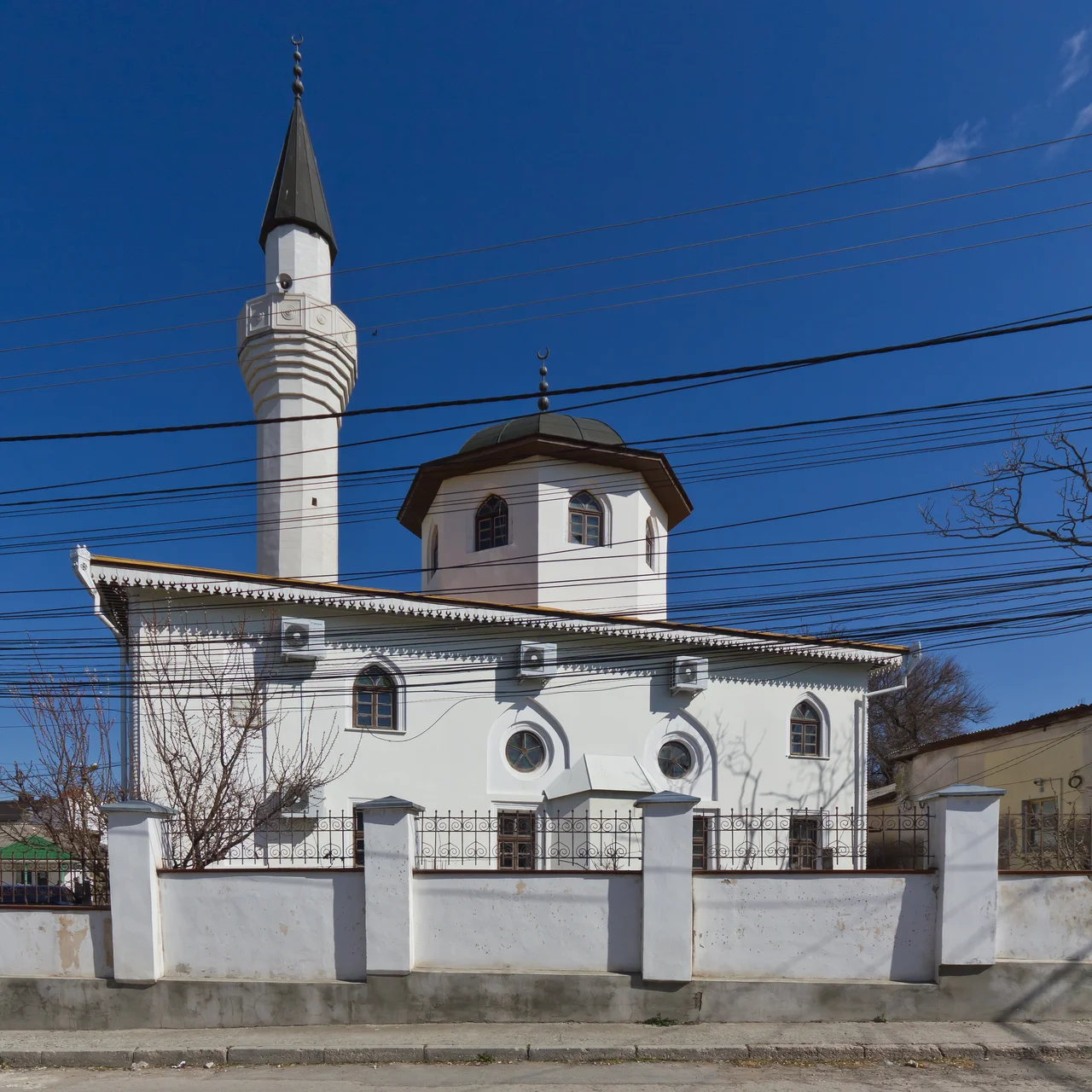

Kebir Mosque
The oldest thing in Simferopol is a mosque, and it is older than the city itself. Long before Catherine the Great's officials laid out the imperial capital and gave it a Greek name, a Crimean Tatar khan raised a house of worship here, and its whitewashed walls gave the medieval town its identity. The place was called Aqmescit, the White Mosque, named for this very building. The Kebir Mosque, or Kebir-Jami, still stands, low and modest amid the modern streets, an anchor to more than five centuries of history that the traffic passes without a glance.
A Khan's Dedication
The mosque was dedicated in 1508, or the year 914 by the Islamic calendar, and an Arabic inscription above its entrance records the moment with formal grace. It was raised, the writing declares, for the glory of Khan Meñli I Giray, asking that Allah forgive the sins of the khan and his children, and dating the work to the month of Muharram in the year nine hundred and fourteen. Meñli Giray was among the most powerful rulers of the Crimean Khanate, and the mosque he endowed became the heart of the settlement that grew around it. It is widely believed that the building's pale, whitewashed walls are the reason the town was ever called Aqmescit, the White Mosque, a name it carried for centuries. Few buildings can claim to have named the city that surrounds them.
The Silent Years
The mosque's long life was not untroubled. After the Second World War it fell into neglect, and for several years its rooms were put to a purpose far from prayer, used as a workshop for making book covers. The deeper wound lay in what had happened to the people who had prayed there. In 1944 Stalin's Soviet government deported the Crimean Tatars, the mosque's community, en masse from their homeland, an exile that scattered them for decades and left their mosques empty. The Kebir Mosque stood through those silent years as a shell of its former self, its congregation gone, its walls repurposed, a monument to a community forced away from the ground its ancestors had held since the Middle Ages.
A Return and a Revival
The story turns with the return of the Crimean Tatars from deportation in the late twentieth century. In 1989 the old mosque was handed back to the Muslim community, and in late October 1991 the work of reconstruction began, restoring a building that had waited half a century for its people to come home. The Kebir Mosque became once again a principal center of worship, serving for years as the residence of the Mufti and the seat of the Spiritual Direction of the Muslims of Crimea. Its grounds grew to include a madrasah, an Islamic school, and a Crimean Tatar library. From a khan's dedication in 1508 to a community's homecoming, the white-walled mosque has outlasted empires and exile alike, and it endures as the living root of the city.
Five Centuries of Weather
What makes the Kebir Mosque remarkable is less any single feature than its sheer persistence. It has been reconstructed many times over the centuries, patched and repaired and altered by generation after generation, so that the building standing today is a palimpsest of all the hands that kept it up. It watched the Crimean Khanate rise and fall, saw the Russian Empire lay a new capital around it, endured a Soviet century that emptied and repurposed it, and survived to serve the faithful once more. Newer and grander mosques have since risen in Simferopol, but none can claim what this modest structure holds: the distinction of being the oldest building in the city, and the origin of its very name. To stand before its whitewashed walls is to touch the single oldest thread still running through the fabric of Simferopol, unbroken across more than five hundred years.
From the Air
The Kebir Mosque sits in central Simferopol at 44.95 degrees north, 34.11 degrees east, on the central Crimean plain. It is a low, historic structure best appreciated from ground level, but from the air the surrounding old city center marks its location, just south of the Salhyr River that threads through Simferopol. The nearest airport is Simferopol International (ICAO UKFF), a few kilometers northwest of downtown.
Nearby Stories
- Eski Kermen 4.3 km away
- Crimean Mountains 5.1 km away
- Battle of the Alma 11 km away
- Perchem 12 km away
- Juma-Jami Mosque 29 km away
- Aeroflot Flight 6515 40 km away
- Battle of Eupatoria 71 km away
- 1976 Anapa Mid-Air Collision 198 km away