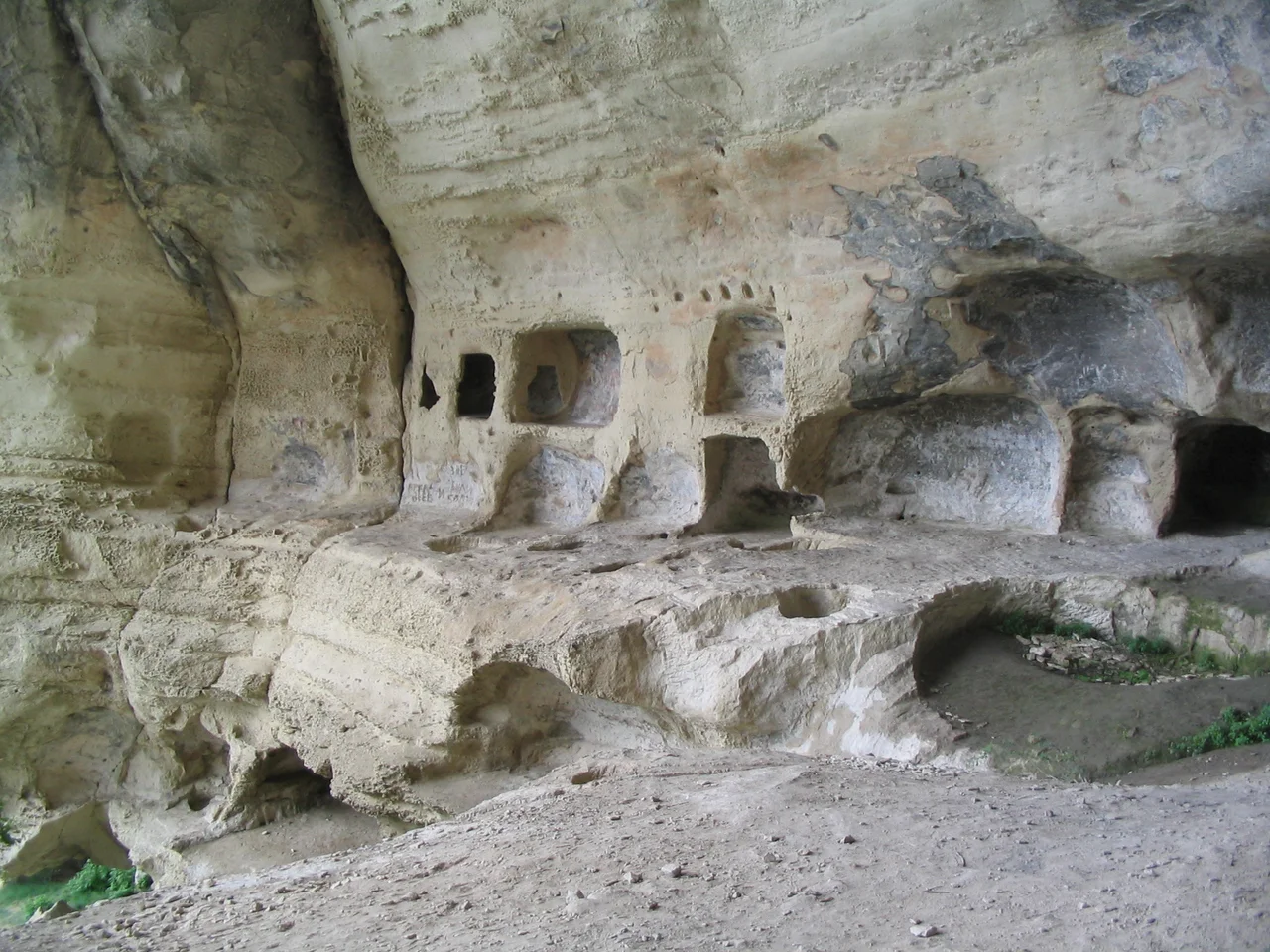

Eski Kermen
The name says it plainly: Eski Kermen, the old fortress. And old it is - a long, narrow plateau rising sheer above the wooded hills of southwestern Crimea, its flat crown pocked with some four hundred chambers hewn directly into the living stone. The buildings that once stood on the surface are almost entirely gone, weathered away over the centuries. What survives is subterranean: a honeycomb of rooms, stairways, and hollows cut into the cliff, a whole town turned inside out and pressed into the rock itself. To walk it now is to move through the bones of a place that was born to guard a frontier and outlasted nearly everyone who ever held it.
A Fortress on the Cliff
Eski Kermen was raised in the sixth century by the Byzantine Empire, built to defend against the westward pressure of the Goturks who ranged across the steppe. The site was chosen for its natural strength: a plateau roughly a kilometer long and only about two hundred meters wide, its edges falling away in cliffs that made assault nearly impossible. On top the builders laid out a fortified town and, in time, a basilica, whose remains have been found among the ruins. The people who lived here were probably Alans or Goths - communities of the Crimean uplands who took shelter behind Byzantine walls. For a while, this was a genuine stronghold, a link in the chain of defenses protecting the great coastal city of Chersonesos below.
Conquered, But Not Abandoned
Its life as a fortress was cut short. In the seventh or eighth century the Khazars, a powerful steppe people, conquered Eski Kermen, and with that its military importance faded. But the town did not die. Stripped of its strategic role, it carried on as a thriving cave settlement, its rock-cut rooms lived in and worked for centuries more. Through the era of the Pechenegs it remained inhabited, still busy into at least the eleventh century - a community that had simply outgrown the reason it was founded and kept going out of sheer momentum. The caves that had sheltered a garrison now sheltered ordinary lives: homes, storerooms, chapels, all carved patiently into the same unyielding stone.
The Slow Emptying
Eventually even that endurance ran out. By the fourteenth century, under the rule of the Tatars, Eski Kermen appears to have been deserted - emptied not by a single catastrophe recorded in the chronicles but by the long, quiet processes that hollow out any settlement when its purpose is gone. The people left, the surface buildings crumbled, and the plateau was given back to wind and weather. What time could not erase was the rock itself. The chambers cut into the cliff endured precisely because they were carved, not built - too deep and too solid for the elements to easily undo. And so the town's absence became its most striking feature: a place defined by the four hundred rooms its vanished people left behind.
Walking the Empty Rooms
Today Eski Kermen is one of Crimea's celebrated cave towns, a protected monument reached by a climb up to the plateau. The reward at the top is a landscape of stillness and stone - openings in the cliff face framing views over the surrounding hills, stairways worn smooth by feet that stopped climbing them seven centuries ago, the ghost of a street plan traced in weathered foundations. Standing in one of the carved rooms, cool and quiet in the rock, it is easy to feel the layered history pressing in: Byzantine engineers, Alan and Gothic families, Khazar conquerors, all passed through here and moved on. The old fortress kept none of them, but it remembers them all, written in stone that refuses to forget.
From the Air
Eski Kermen sits at approximately 44.61 degrees north, 33.74 degrees east, on an isolated plateau in the hills of southwestern Crimea, inland from Sevastopol and southwest of Bakhchysarai. From lower altitudes in clear weather the distinctive long, cliff-edged plateau stands out from the surrounding wooded valleys. The nearest airports are Sevastopol's Belbek (ICAO UKFB) to the west and Simferopol International (UKFF) to the northeast.
Nearby Stories
- 1988 Black Sea Bumping Incident 5.4 km away
- Battle of the Alma 7.5 km away
- Yalta 8 km away
- Russian Battleship Ekaterina II 10 km away
- Akmesdzhyt Friday Mosque 12 km away
- Soviet Hospital Ship Armenia 15 km away
- KaZantip 52 km away
- Januarius MacGahan 338 km away