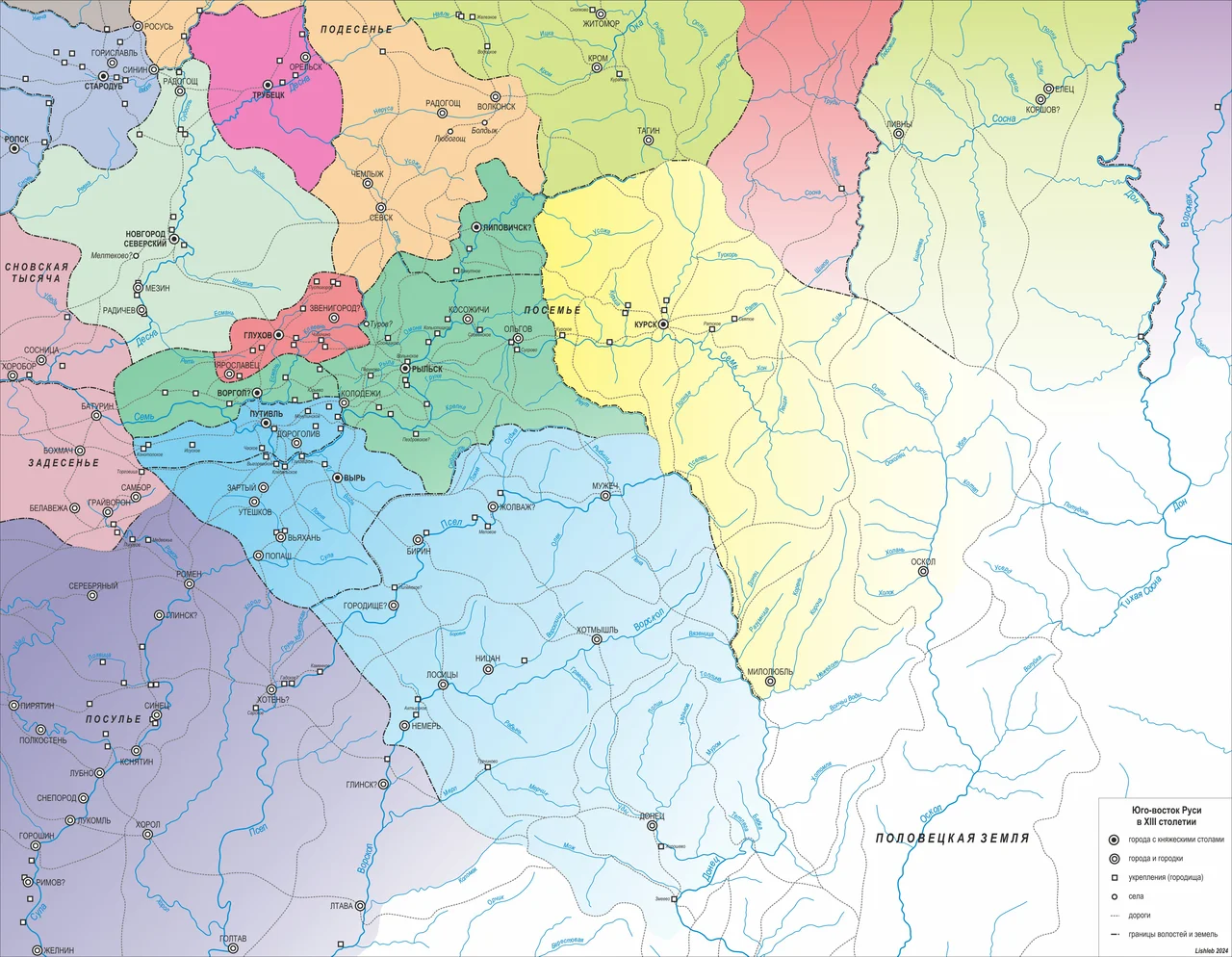

Principality of Novgorod-Seversk
When the great confederation of Kievan Rus' began to fracture in the late eleventh century, its outer lands broke away into a mosaic of rival principalities. On the wooded frontier of the Desna, one prince, Sviatoslav Olgovich, carved out a realm of his own and founded a dynasty. His line, the Olgovichi, a branch of the sprawling Rurikid house that ruled all the Rus', would hold this borderland for generations and reach, at their most audacious, for far grander thrones. This was the Principality of Novgorod-Seversk, centered on the town now called Novhorod-Siverskyi, and its story is one of ambition lived out on the edge of the steppe. It would last some four centuries, from its emergence in the twelfth century to its final absorption by Moscow in 1503, a long life for a frontier state perpetually caught between larger powers.
Born from a Fracturing Realm
Novgorod-Seversk began as a piece of something larger. It was originally a subdivision of the Principality of Chernigov, and as it grew it absorbed territories that had once belonged to Chernigov and to the neighboring Principality of Pereyaslavl. The men who ruled it, the Olgovichi, were Rurikids, descendants of the semi-legendary founder of the Rus' ruling house, and like all the branches of that family they were players in the endless, shifting contest for the lands of the Rus'. Their principality lay on a dangerous frontier, facing the open grasslands to the south from which the nomadic Cumans, whom the Rus' called the Polovtsy, launched their raids. To hold Novgorod-Seversk was to stand watch on the edge of the settled world.
The Campaign That Became a Poem
In 1185 the principality's most famous ruler, Prince Igor, led a large Rus' campaign south against the Cumans. It ended in defeat, and that defeat became immortal. An unknown poet turned Igor's failed expedition into The Tale of Igor's Campaign, the towering masterpiece of early East Slavic literature, and so a border prince's military misfortune was transmuted into one of the enduring works of the Slavic world. The Olgovichi were not finished reaching, either. After the death of Roman the Great, the first prince of Galicia and Volhynia, in 1205, the three sons of Igor seized power in the distant city of Halych and reigned there from 1206 to 1212, a bold Olgovichi bid for a wealthy western throne far from their home on the Desna.
Passed from Hand to Hand
Like every Rus' principality, Novgorod-Seversk could not withstand the Mongol invasions of the thirteenth century. In their aftermath the territory was absorbed by the principality of Bryansk, and later, as the power of the Golden Horde waned, it passed to the expanding Grand Duchy of Lithuania. Its final chapter as a principality came in the fifteenth century, when it was granted to Prince Ivan of Mozhaisk after he fled from Grand Prince Vasily II of Moscow, a reminder that even in decline these frontier lands remained bargaining chips among the great powers gathering around them. The realm was gone by the early sixteenth century, but the town at its heart, and the poem it inspired, outlived it.
From the Air
The principality was centered on Novhorod-Siverskyi, at roughly 51.98°N, 33.27°E on the Desna River in northern Chernihiv Oblast. From about 3,000 feet the domed monastery above the river and the Desna's broad meanders mark the old seat of Olgovichi power. Kyiv's Boryspil (UKBB) is the nearest major airport, to the southwest.
Nearby Stories
- Hlukhiv 11 km away
- Siege of Hlukhiv 31 km away
- Baturyn Fortress Citadel 44 km away
- Principality of Chernigov 52 km away
- Battle of Listven 84 km away
- Battle of Lesnaya 191 km away
- Mogilev Ghetto 251 km away
- Grace Darling 447 km away