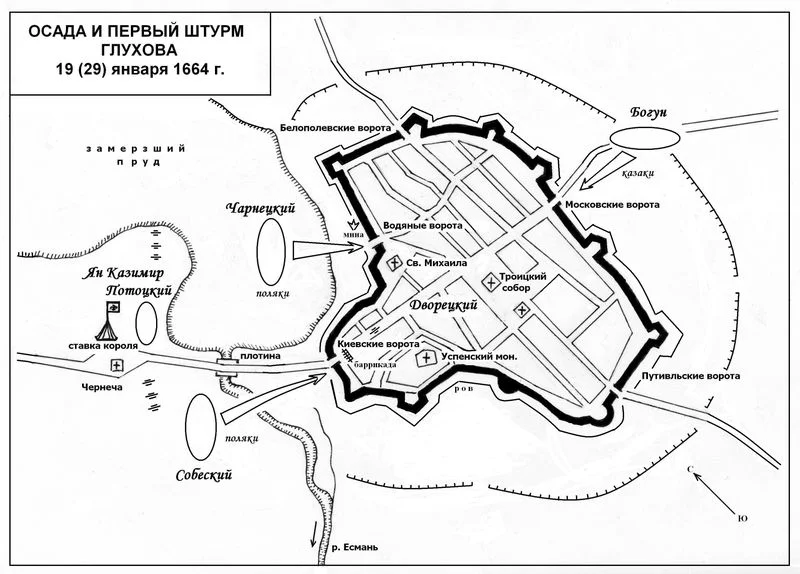

Siege of Hlukhiv
A French duke who was there could not quite believe what he was seeing. Antoine III de Gramont, an officer in the Polish king's army, watched a small garrison behind broken walls beat back storm after storm, firing their cannon with a skill and a bravery he called miraculous. It was the winter of 1664, the walls were at Hlukhiv, and outside them stood the army of King John II Casimir of Poland, fifty thousand men or more, come to bring the Left Bank of Cossack Ukraine to heel. What the duke witnessed over those weeks was not a mismatch resolving as expected. It was a great army breaking itself against a stubborn town, and then dissolving in the retreat.
The King's Great Offensive
The campaign had begun in confidence. In November 1663, John II Casimir and his ally Pavlo Teteria, hetman of the Right Bank, marched east against the Left Bank of the Cossack Hetmanate with an enormous host, well over a hundred thousand counting camp followers. The defenders had nothing to match it. The Muscovite prince Grigory Romodanovsky and the Left Bank hetman Ivan Briukhovetsky pulled back toward Putyvl rather than be crushed in the open. Town after town gave way, and the royal army advanced almost unopposed until it reached Hlukhiv. There the momentum stopped. The town was held by Zaporozhian Cossacks under Colonel Vasyl Dvoretsky and Muscovite streltsy under Avraam Lopukhin, and they had no intention of surrendering.
Two Stormings, Two Repulses
The Polish and Lithuanian artillery went to work, and explosives tore openings in the walls. Grand Duke John III Sobieski, a future king himself, personally led the assault. The attackers with their Crimean Tatar allies poured through the breaches, and there in the streets they blundered into a prepared ambush, met by point-blank artillery and musket fire from the Cossacks. Some four thousand of them fell, two hundred of them officers, and the survivors were driven back out. Eight days later, on 30 January, the king ordered the storming repeated. Again the attackers forced their way into the fortress; again a Muscovite and Cossack counterattack threw them out. De Gramont, watching a second time, marveled at how the defenders retook every gap in the walls and kept firing back through the heaviest bombardment aimed at them.
The Retreat That Became a Rout
While the king battered Hlukhiv, the ground shifted beneath him. Romodanovsky and Briukhovetsky arrived with a relief force of some forty-five thousand, and across the Left Bank towns that had earlier surrendered without a fight now rose in revolt against the occupation, a rising that spread even into the Right Bank. Unwilling to risk a pitched battle he was already losing, John II Casimir lifted the siege. The withdrawal toward Novhorod-Siverskyi turned into a catastrophe, the retreating Crown Army harried the whole way by Muscovite and Cossack pursuers. It was, in the end, one of the worst defeats of the entire war. The retreat also carried a darker act: during it the Poles executed the Ukrainian colonel Ivan Bohun, suspected of passing information to the town's defenders, a renowned Cossack commander killed on the road.
The Weight of a Small Victory
The defense of Hlukhiv did more than save one town. It shattered the Polish-Lithuanian design to bring the Left Bank of the Cossack Hetmanate back under the Commonwealth's control, and the great offensive of 1663 to 1664 came to nothing. In the years that followed, the Commonwealth was consumed by its own internal strife, and the fighting on the Muscovite frontier wound down toward exhaustion. When the Truce of Andrusovo was finally signed in 1667, it closed the long Russo-Polish War as a Muscovite victory, with the Left Bank passing to the Tsardom. Behind that treaty stood, among much else, the memory of a frozen winter when a garrison behind broken walls refused to yield, and turned a king's army back.
From the Air
The siege was fought at the site of present-day Hlukhiv, at about 51.68 degrees N, 33.92 degrees E, on the Esman River in northern Sumy Oblast. From altitude the modern town's historic core marks the ground where the seventeenth-century fortress once stood. The nearest airfields serve Sumy (ICAO: UKHS) to the southeast.
Nearby Stories
- Mezine 23 km away
- Konotop 32 km away
- Maryino Estate 39 km away
- Battle of Konotop 62 km away
- Sumy 71 km away
- Battle of Lesnaya 237 km away
- Mogilev Ghetto 302 km away
- Grace Darling 430 km away