.jpg)
Hlukhiv
In November 1708, in the Trinity Cathedral of a town called Hlukhiv, a metropolitan was compelled to pronounce a curse. The anathema fell on Ivan Mazepa, the Cossack hetman who had thrown in his lot with Sweden's Charles XII, and it fell in Hlukhiv because the old capital of Baturyn had just been destroyed on orders from Peter the Great. Overnight, this modest town on the Esman River became the seat of the Cossack Hetmanate. For the next half-century the fate of Cossack Ukraine was decided in Hlukhiv, and the town remade itself in Baroque splendor to suit its new role, a small place suddenly made to carry the weight of a nation's capital.
Eight Centuries of Changing Hands
Hlukhiv is old enough to have belonged to nearly everyone. Chroniclers first noted it in 1152 as a town of the Severian lands, and after the Mongol invasion it became the seat of a branch of the Chernihiv princes. From the fourteenth century it passed to the Grand Duchy of Lithuania, then to Moscow, then in 1618 to the Polish-Lithuanian Commonwealth, which granted it Magdeburg rights, the coveted charter of self-government, in 1644. When the Cossack Hetmanate rose in the mid-seventeenth century, Hlukhiv became part of it. In 1664 it earned a place in military history by withstanding a great siege, its garrison holding firm against a far larger Polish army that broke and suffered ruinous losses in the retreat that followed. Layer upon layer, the town absorbed the empires that swept across the borderland.
The Capital That Sang
As the capital of the Hetmanate from 1708 to 1764, and afterward the administrative center of the Little Russia Governorate, Hlukhiv was rebuilt in the elegant Baroque style favored by the last hetmans. Fires would later consume much of that finery, but the town's cultural inheritance proved harder to burn. In 1738 the first school of singing in the Russian Empire was founded here, and Hlukhiv became a nursery of music. Two of the most celebrated composers of the age, Dmytro Bortniansky and Maksym Berezovsky, are believed to have trained in the town where their statues now stand in Bortniansky Square. For a place its size, Hlukhiv gave the empire an astonishing share of its musical voice.
The Oldest Arch in Ukraine
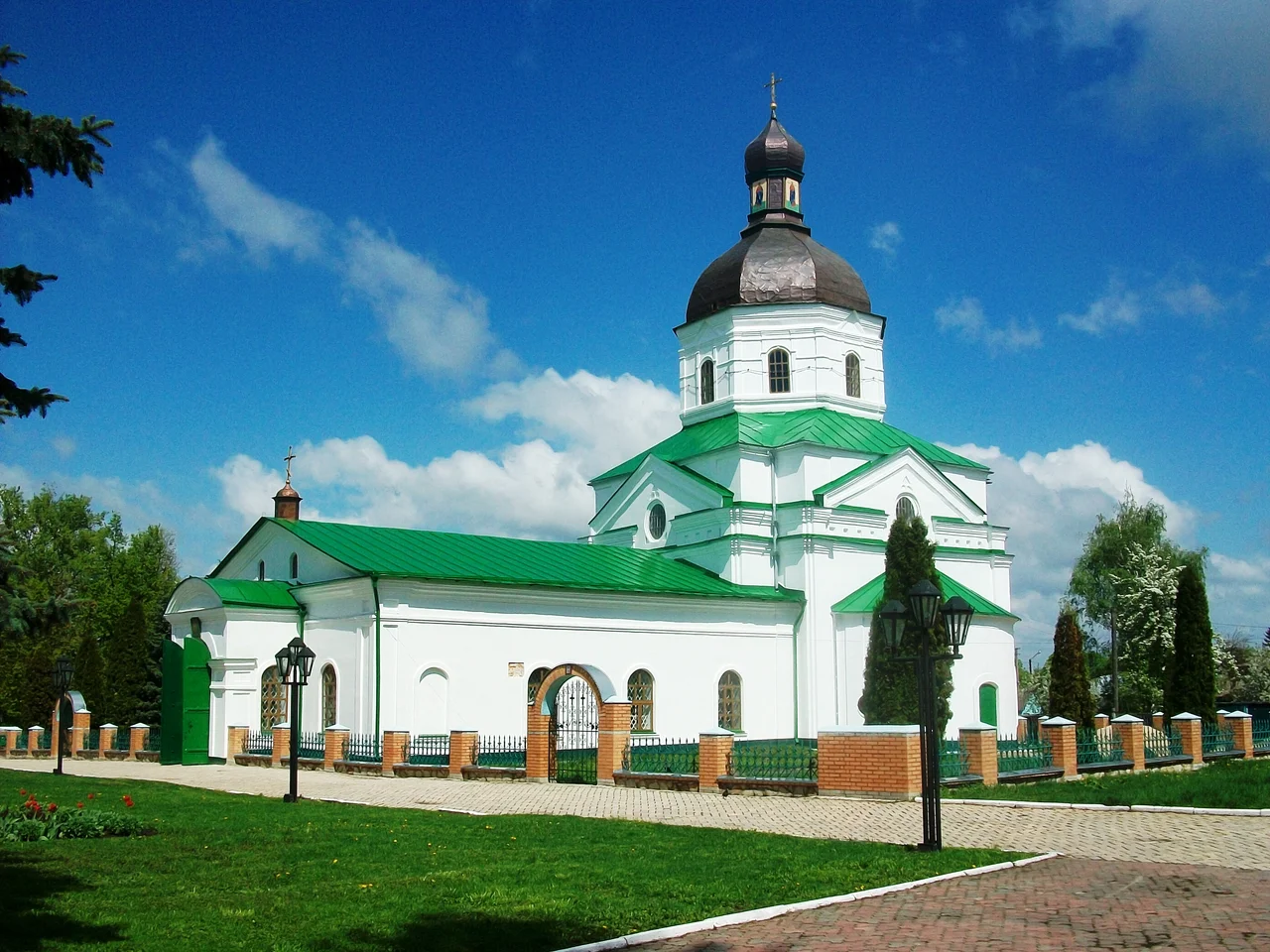
Walk the town today and its history stands in stone. The oldest building is the Church of St. Nicholas, raised in 1693 in the Ukrainian Baroque style with three pear-shaped domes, modeled on the traditional wooden churches of the region. Grander later monuments include the Transfiguration church of 1765 and a massive Neo-Byzantine cathedral of the 1880s and 1890s echoing St. Volodymyr's in Kyiv. But the town's most quietly remarkable structure is its triumphal arch, dated to either 1744 or 1766 and thought to be the work of the architect Andrey Kvasov. Plain as it is, it holds a distinction: it is the oldest triumphal arch in Ukraine. Damaged in the Second World War and afterward restored, it still frames the approach to a town that was once the gateway to a Cossack capital.
Sugar, Charity, and a French Grandson
Hlukhiv's later prosperity owed much to the Tereshchenko family, Ukrainian-born magnates who made fortunes in sugar and gave lavishly back. In 1879 the Tereshchenko brothers endowed a free hospital in the town and supported it out of their own pockets, and in 1899 their money founded a college that survives today. The family's thread runs improbably into the present: in 2015 the townspeople elected as their mayor Michel Tereshchenko, a naturalized Ukrainian from France and grandson of Mikhail Tereshchenko, returning a descendant of the town's benefactors to civic office more than a century later. Around such stories Hlukhiv also nurtured scientists and scholars, giving the world the astronomer Iosif Shklovsky among many others, a small town with a long habit of producing large lives.
From the Air
Hlukhiv lies at about 51.68 degrees N, 33.91 degrees E, on the small Esman River in northern Sumy Oblast, near the edge of the region. From the air, look for the compact historic core with its Baroque church domes and the conspicuous 1920s water tower rising above the low skyline. The nearest airfields serve Sumy (ICAO: UKHS) to the southeast.
Nearby Stories
- Konotop 17 km away
- Principality of Novgorod-Seversk 17 km away
- Mezine 34 km away
- Maryino Estate 34 km away
- Novhorod-Siverskyi 48 km away
- Sumy 53 km away
- Battle of Konotop 55 km away
- Grace Darling 446 km away