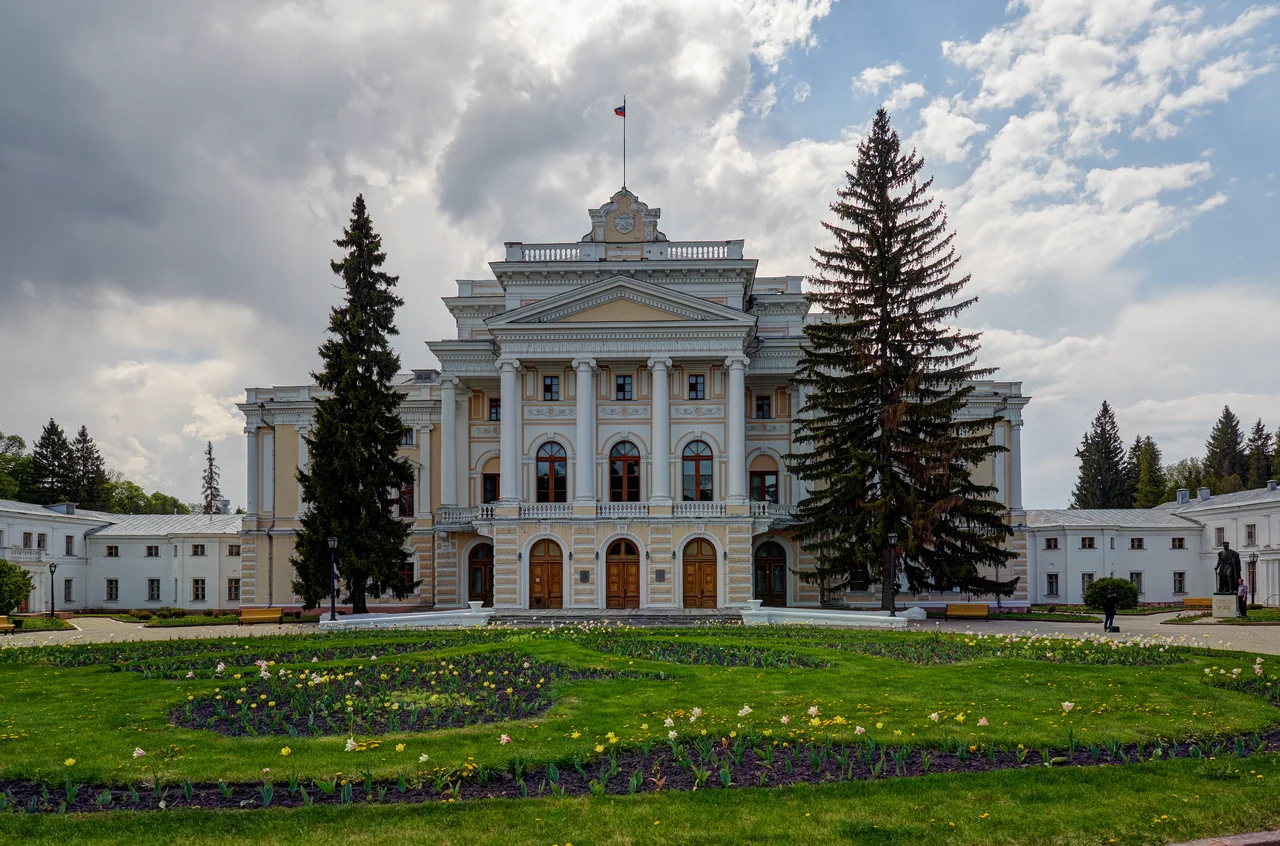

Maryino Estate
Prince Ivan Baryatinsky married twice, and both of his wives were named Maria. When he built his great country palace in the rolling farmland of what is now Kursk Oblast, he found a way to honor them both at once and named the whole estate Maryino. It began under a plainer name, Izbitsky Dom, after the little Izbitsa River nearby, but Maryino is the name that stuck, a monument in brick and parkland to two women of the same name and one family's sense of its own grandeur. Two centuries later the palace still stands above its ponds, and the two Marias are remembered every time the estate is spoken of.
A Palace to Match a Name
Maryino rose between 1811 and 1820, built to be the principal seat of the Baryatinsky family and, quite deliberately, a symbol of its dignity. The design came from the architect Karl Hoffman, and the estate took shape as a four-story manor house flanked by two-story wings that enclose a pair of farmyards. It was conceived in the Empire style then in fashion across Russia, all restraint and grandeur. In 1860 a church in the Byzantine manner was added to the complex, and in 1869 and 1870 the palace was reworked again, this time with the help of the painter Fyodor Bruni, its interiors shifting from the crisp Empire look toward a richer Academic style. Marble fireplaces, ceiling moldings, and pre-revolutionary parquet floors from those years survive inside to this day.
Islands, Bridges, and a Miniature Church
The true magic of Maryino lies outside the walls, in its landscape park. A large pond was dug on the Izbitsa River, and within the grounds a round pond and an oval one hold two islands linked to the shore by three bridges. Empire-style statues stand among the trees. Each island carries its own small folly, a favorite conceit of the great Russian estates: one holds a sixteen-column rotunda, an open temple of the kind meant to be glimpsed across water, and the other a miniature Lutheran church, tiny and precise. It is a designed landscape in the grand manner, a place built to be walked through slowly, where every turn of the path was arranged to compose a view.
From Aristocrats to a New Age
The estate passed down the Baryatinsky line, inherited after 1859 by Prince Ivan's sons Alexander and Vladimir, and it was in Vladimir's hands by the time of the First World War. The revolution ended private ownership in 1917, and in the years that followed the palace found new uses: an agricultural technical school from 1919, then a home for various Soviet state bodies. The park's statues and the estate's treasures were dispersed to museums across the country. In 1952 Maryino became a sanatorium for the Communist Party's Central Committee, a role it has kept ever since under new management, and today it holds a house church and a museum, its halls hung with copies of famous paintings and portraits of the palace's former owners. Before the main entrance stands a monument to Field Marshal Alexander Baryatinsky, keeping the family's memory at the threshold of the house they built.
From the Air
Maryino Estate lies in Rylsk District of Kursk Oblast at about 51.59 degrees N, 34.94 degrees E, in gently rolling farmland. From the air, the clearest markers are the ornamental ponds with their two islands and connecting bridges set within the wooded park around the four-story manor house. The nearest regional airfields serve Kursk (ICAO: UUOK) to the east.
Nearby Stories
- Glinsk Hermitage 26 km away
- Sumy 49 km away
- Cathedral of Our Lady of the Omen 50 km away
- Central Black Earth Nature Reserve 72 km away
- Principality of Novgorod-Seversk 83 km away
- Konotop 87 km away
- Novhorod-Siverskyi 119 km away
- Grace Darling 406 km away