._%D0%94%D0%BE%D1%80%D0%B5%D0%B2%D0%BE%D0%BB%D1%8E%D1%86%D0%B8%D0%BE%D0%BD%D0%BD%D0%B0%D1%8F_%D0%BE%D1%82%D0%BA%D1%80%D1%8B%D1%82%D0%BA%D0%B0.jpg)
Cathedral of Our Lady of the Omen
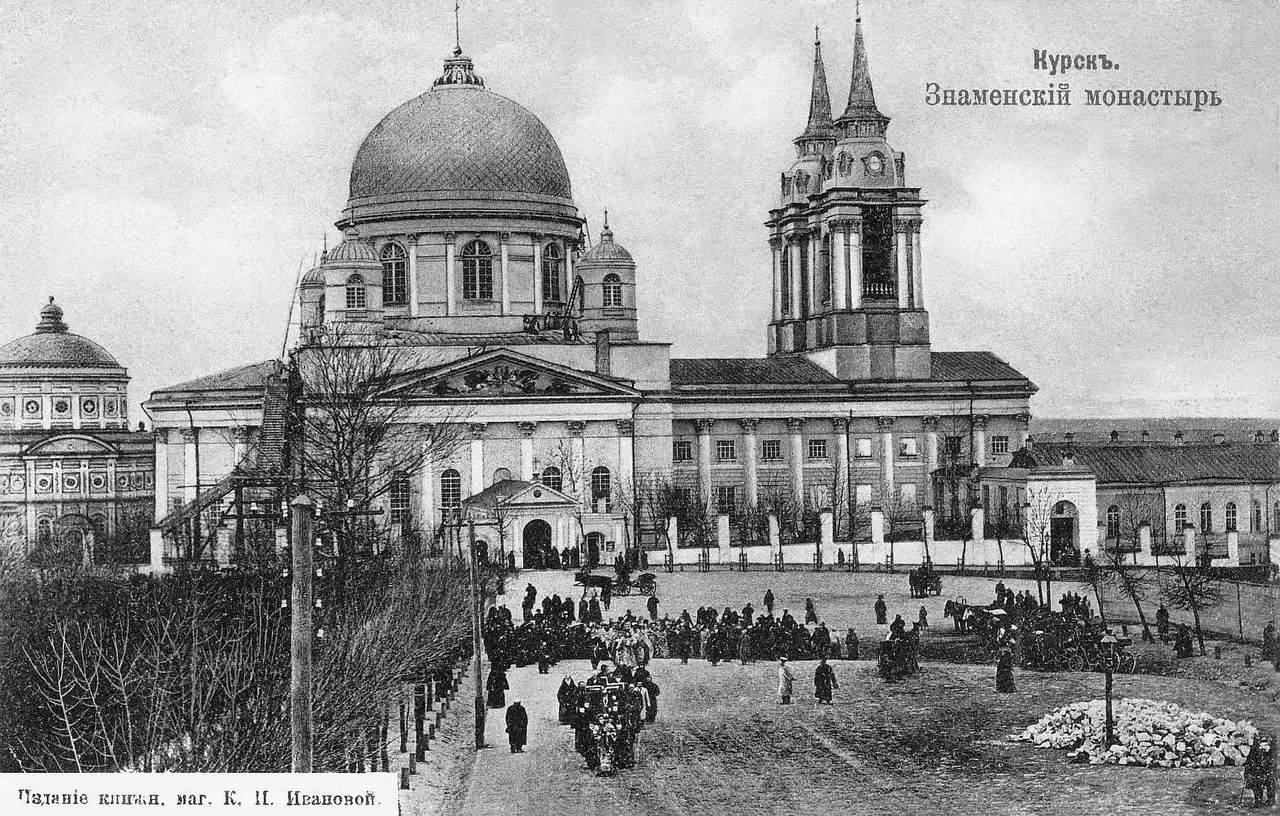
For fifty-five years, the people of Kursk bought their movie tickets inside a cathedral. From 1937 the Znamensky Cathedral, the Cathedral of Our Lady of the Omen, was the October cinema, its icons gone, its domes and bell towers torn down, up to nine thousand spectators a day filing beneath a dome first raised to the glory of God. The building had been born of gratitude, begun in 1816 to give thanks for Russia's deliverance from Napoleon's invasion of 1812. It would be desecrated, burned, made a warehouse and even a prison, and then, against the odds, restored to what it was meant to be. Few buildings have worn so many disguises and still come back as themselves.
A Monument to Deliverance
The cathedral rose on ground already sacred to the city. The site had held the old Kursk fortress, and legend traced the whole tradition to 1612, when the townspeople believed the intervention of the Virgin Mary had saved their fortress from a besieging Polish-Lithuanian army; in gratitude they vowed to build a monastery in her honor. Two centuries later, after Napoleon's Grande Armee was driven from Russia, Kursk built anew. Construction ran from 1816 to 1826, funded by the donations of citizens and the income of the monastery, and rose in the pure classical style, a cross-in-square church crowned by a great light-filled drum. The dome spanned twenty meters and climbed forty-eight meters high, its brickwork a full meter thick at the base, a triumphal monument as much as a place of prayer.
The Icon and the Bomb
For generations the cathedral guarded the miracle-working icon known as the Theotokos of Kursk, or the Omen, carried each year in a great procession to a hermitage outside the city. That devotion drew a strange assault. In the small hours of 8 March 1898, an explosion tore through the cathedral, shattering every pane of glass and mangling a candlestick made for a hundred and fifty candles, all aimed at destroying the icon and, with it, the people's faith. The icon survived unharmed. The bombers, it turned out, were four young men, none older than twenty-two, and they had set the timer for the dead of night precisely to avoid killing anyone. They showed remorse, and the court sent them into Siberian exile rather than to a harsher fate. The episode so gripped the age that the writer Leonid Andreev built his play Savva around it.
Cinema, Fire, and Return
The revolution ended the cathedral's first life. In 1932 it was closed, and by the mid-1930s its lateral domes, bell towers, and portico had been pulled down and the interior gutted to make the October cinema, which opened in 1937 with a film about Peter the Great. War brought worse. During the fighting the building burned, its ceilings collapsed, and its remaining paintings were destroyed. Afterward it served as a warehouse, a prison, and a factory before being handed back to the cinema, reopening in 1956 with a new parabolic dome replacing the old hemisphere. Only in 1992 did the Russian Orthodox Church regain the building, and in 1993 an exact 1902 copy of the lost icon was brought to it, kept safe through the Soviet years by believers. Restoration under the architect V. P. Semenikhin recreated the stucco, the columns, and the paintings from old photographs.
The Cathedral Today
The restored interior gleams again. Sixteen engaged columns line the nave, stained-glass icons of the Theotokos and of the great church fathers fill the high windows, and the drum of the dome carries the figures of eight Old Testament prophets. Beneath it hangs a golden chandelier, a panikadil weighing two and a half tons and rising six and a half meters through twelve tiers of candles, cast in the church's own workshops. A new bell tower carries eleven bells, the largest weighing more than a ton. Not everyone loves the modern silhouette; local critics note that the parabolic main dome sits oddly beside the restored hemispherical towers, as if, one said, the cathedral had pulled its head into its shoulders. Yet every Friday the faithful still gather before the icon, in a building that has been many things and is once more a cathedral, the anchor of Kursk's Red Square.
From the Air
The cathedral stands in the historic center of Kursk, on Red Square, at about 51.73 degrees N, 36.19 degrees E. From the air its large central dome and flanking towers rise above the surrounding streets as one of the tallest features of the old city core. The nearest regional airport serves Kursk (ICAO: UUOK).
Nearby Stories
- Maryino Estate 44 km away
- Central Black Earth Nature Reserve 62 km away
- Sumy 83 km away
- Verkhnii Saltiv Museum-Reserve 153 km away
- Chuhuiv 215 km away
- Battle of Lesnaya 352 km away
- Grace Darling 357 km away
- Katyn Commission 415 km away