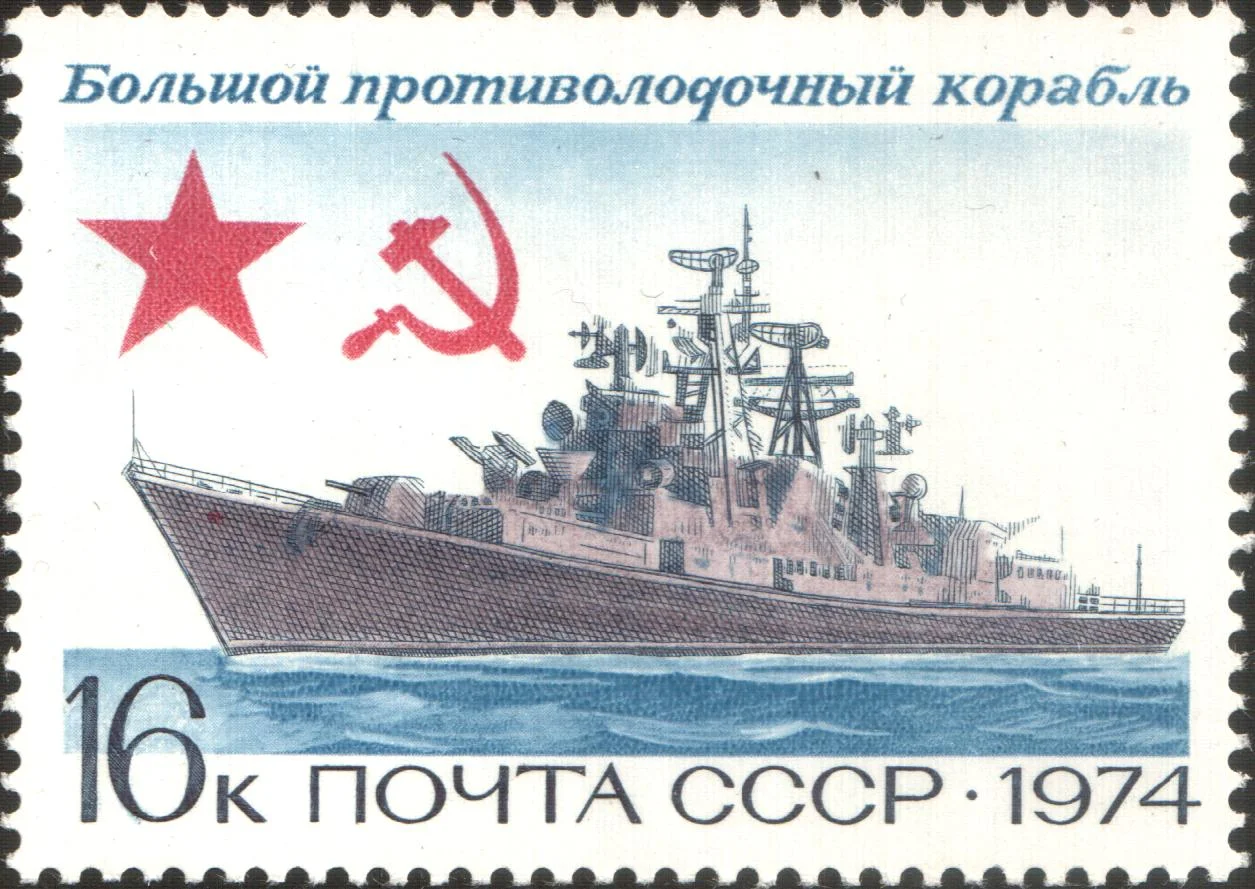

Soviet Destroyer Otvazhny
On the morning of 30 August 1974, the destroyer Otvazhny reached her assigned patch of the Black Sea and signaled that she was ready to begin fleet exercises. Minutes later, one of the anti-aircraft missiles in her aft magazine ignited on its own. What followed was not the sharp violence of battle but a long, grinding fight against fire and flooding that lasted nearly six hours, watched by rescue ships that could tow her, cool her, and take off her wounded, but could not put out the fire inside her. By late afternoon she was gone, and twenty-four of her crew with her.
A Cold War Traveler
Otvazhny had ranged far beyond the Black Sea in her nine years of service. Laid down in 1963 at the 61 Kommunara shipyard in what is now the Ukrainian city of Mykolaiv, launched in 1964, and commissioned into the Soviet Navy at the end of 1965, she was a Kashin-class destroyer built for a navy asserting itself across the world's oceans. During the Six-Day War in 1967 she carried out combat duties off Port Said, and she returned to the Egyptian coast during the Yom Kippur War in 1973, escorting Soviet landing ships. That same autumn she paid a friendlier call at the Italian ports of Taranto and Messina, then spent months deployed in the Mediterranean before coming home to the exercises that would be her last.
The Fire That Would Not Die
The missile that ignited touched off the warheads of others stored with it, and the blast tore the hull enough to let water in. Otvazhny took a twelve-degree list to starboard, and every effort to flood her magazines and drown the fire failed. Ships raced out from Sevastopol: the destroyer Soznatelny reached her first and took her under tow, joined by Bedovy, Komsomolets Ukrainy, and the rescue ship Beshtau, which fought the flames and lifted off the injured. The towing itself went wrong, a line parting or an order confused, so that she was taken in tow, cast loose, and taken up again. All the while the water pumped aboard to fight the fire pooled in her empty compartments, and her list slowly, relentlessly worsened.
The Last Hour
At 14:47 a second ammunition explosion ripped through her stern, and her list lurched to twenty-seven degrees. She lost all power. The order to abandon ship came at 15:10, and the crew went into the water and onto the rescue vessels as she began to settle by the stern. At 15:57, more than six hours after the first spark, Otvazhny sank. Of the 287 people aboard, including a rear admiral and staff officers who had come along for the exercises, 24 were killed. There was no enemy in this story, no shot fired in anger, only a peacetime drill turned catastrophe and a long afternoon of men trying, and failing, to hold on to their ship.
From the Air
The destroyer was lost during exercises northwest of Sevastopol, at roughly 44.73 degrees north, 32.98 degrees east, in open Black Sea waters off Crimea's western coast. From 5,000 to 8,000 feet the low, straight coastline running north from Sevastopol toward Yevpatoria is the main reference against open sea. The nearest airfields are Sevastopol's Belbek (UKFB) and Simferopol (UKFF).
Nearby Stories
- Konstantin Battery 15 km away
- Saky Air Base 17 km away
- Object 100 20 km away
- Soviet Destroyer Dzerzhinsky 25 km away
- SS Santa Fé (1921) 32 km away
- Zaliznyi Port 125 km away
- Racecourse of Achilles 162 km away
- Januarius MacGahan 320 km away