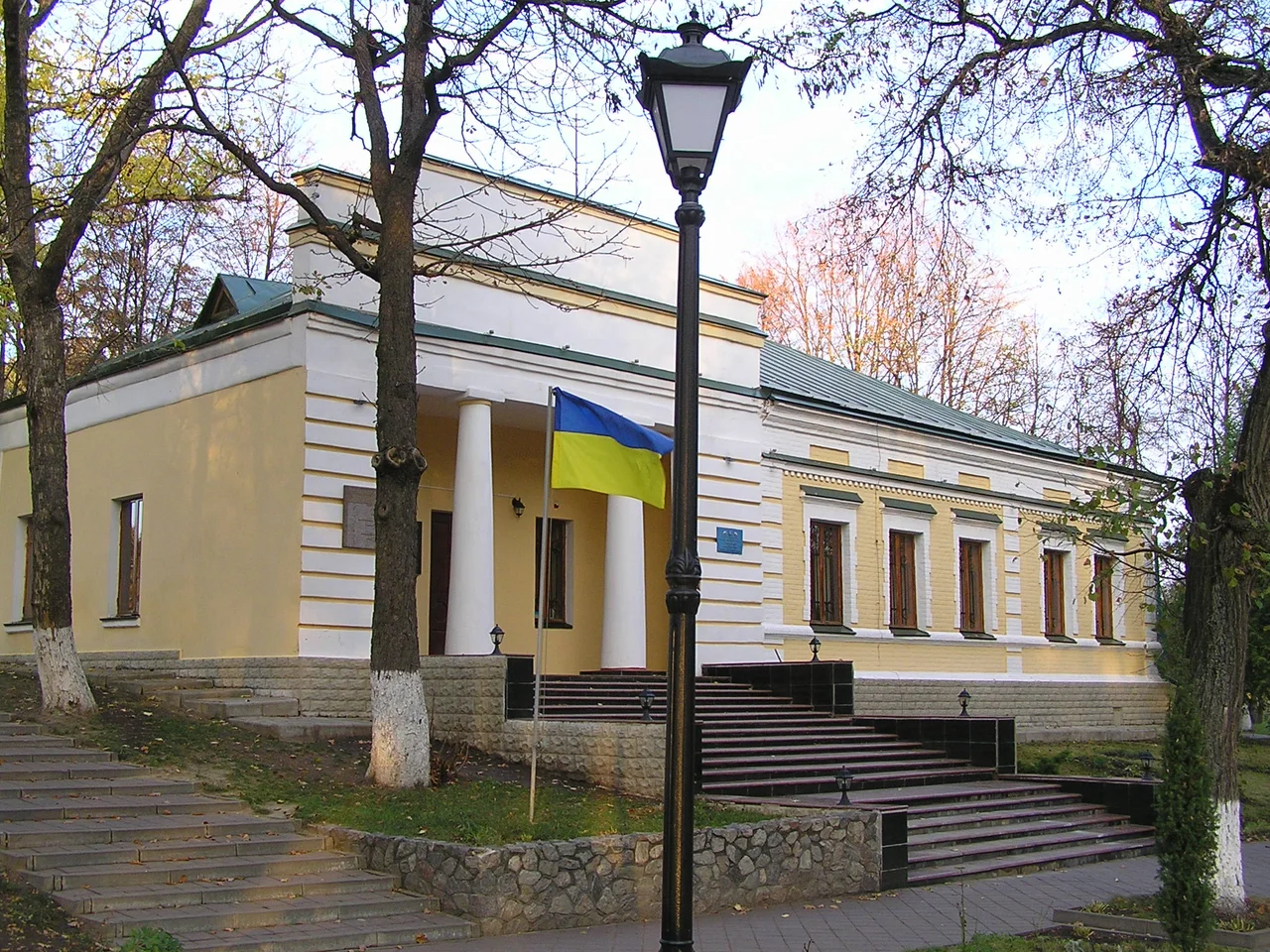

Hryhorii Skovoroda Literary Memorial Museum
The philosopher chose his own epitaph before he died here: "The world tried to catch me, but did not." Hryhorii Skovoroda, the barefoot wandering sage often called the Ukrainian Socrates, spent the last four years of his life in this quiet estate at Skovorodynivka in Kharkiv Oblast, a guest of the Kovalivsky family whose son was his friend. According to the story handed down here, in the autumn of 1794 he spent three days digging his own grave, ate a final dinner, announced that his time had come, lay down in the next room, and died. Two centuries later, the eighteenth-century manor where he passed his final days became a national museum devoted to his life, set in a park where his first burial place is still marked.
A Museum a Century in the Making
The idea of honoring Skovoroda at Pan-Ivanivka, as the village was then called, was first proposed in 1922 by the historian Dmytro Bahalii, who wrote to the head of education urging a museum on the estate. It took fifty years to arrive. Before then the building served as a school, and in 1960 it briefly housed a modest volunteer-run museum. Only in 1972, on the 250th anniversary of the philosopher's birth, did the state museum finally open in the old Kovalivsky manor. Assembling it was a labor of scholarship: staff from the Kharkiv Historical Museum gathered exhibits from libraries and collections across Moscow, Leningrad, Kyiv, and Kharkiv. In 2008, a presidential decree granted the museum national status, cementing its place among Ukraine's most cherished cultural sites.
The Violin and the Grave
The collection gathered here tried to conjure the whole restless life of a man who traveled Europe and never owned a home. Four halls held its treasures: engravings of the European cities Skovoroda had visited, models of the Kyiv-Mohyla Academy and the Kharkiv Collegium where he studied and taught, the manuscript of his poem "Dream," and folk ceramics and embroidery softening the walls. Among the most affecting objects were the intimate ones: a violin the philosopher is said to have played, an eighteenth-century English watch that may have been his, and a chest belonging to the Kovalivsky family that Skovoroda himself used. Outside, a garden park laid out as a near-perfect square, its seven linden alleys crossing at the center, preserved the well, the site of his first burial, and monuments raised to his memory.
A Missile in the Night
The museum had been closed for restoration, its walls being readied for Skovoroda's 300th anniversary, when the invasion reached it. At eleven o'clock on the night of May 6, 2022, a missile struck the roof and set the building ablaze. The fire raced through every room, injuring the guard on duty and gutting some 280 square meters of the interior. Yet the outer walls held. Staff, anticipating danger, had already moved the most valuable exhibits to safety, and in the days after, a statue of the philosopher was pulled intact from beneath the ashes. His gravestone and a memorial bust, standing apart from the building, survived untouched. There was something bitterly fitting in it: the world had come once more for Skovoroda, and once more it had not managed to catch him.
The Garden of Divine Songs, Rebuilt
In the wake of the strike came an outpouring of resolve to restore what was lost. Restorers judged that the building could be rebuilt and the barely-damaged sculpture repaired. The national postal service issued a charity stamp block titled "Garden of Divine Songs," after Skovoroda's own collection of verse, pledging its proceeds to the reconstruction. UNESCO committed funds for emergency conservation, the regional government added its own, and in Kharkiv Oblast a public campaign called "301 True Friend of Skovoroda" set out to gather the money to save his home. While the physical museum heals, the institution has done something its wandering namesake might have appreciated: it launched online tours, letting the philosopher's ideas keep traveling even as his house stands quiet and scaffolded, waiting to welcome visitors again.
From the Air
The memorial complex sits at roughly 50.16 degrees north, 35.77 degrees east, near the village of Skovorodynivka in Kharkiv Oblast. From the air, look for the compact garden park with its geometric linden alleys and two artificial ponds set among the ridges of a rural landscape. The nearest major airport is Kharkiv (UKHH) to the southwest.
Nearby Stories
- Aeroflot Flight 1491 10 km away
- Trostianets 14 km away
- Okhtyrka 23 km away
- Chuhuiv 36 km away
- Borki Train Disaster 41 km away
- Dykanka 46 km away
- Central Black Earth Nature Reserve 63 km away
- Sumy 80 km away