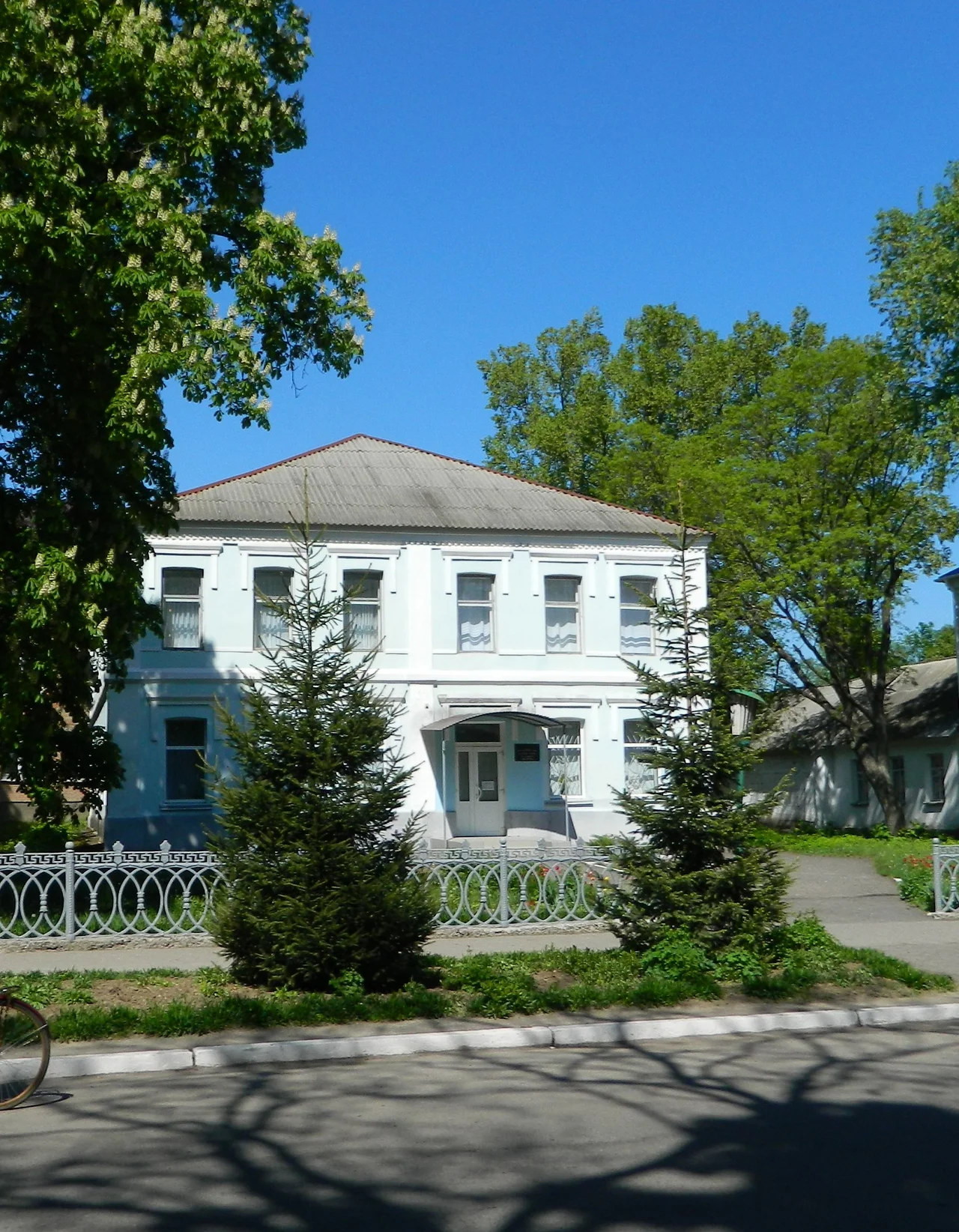

Dykanka
A young writer named Nikolai Gogol borrowed this village's name for the title of his first book, and in doing so he made a quiet corner of central Ukraine famous across the literary world. Evenings on a Farm Near Dikanka, published in the early 1830s, spun folk tales, devils, and Cossack ghosts out of the countryside around this settlement on the road from Poltava. One story in the collection, set on St John's Eve, would ripple outward far beyond the page: it helped inspire Modest Mussorgsky's tone poem Night on Bald Mountain, the swirling nightmare of witches that many now know from its place in film and concert hall alike. Dykanka is a small place with an outsized shadow.
Older Than Its First Mention
Dykanka enters the written record only in 1658, described then as a small village, but people had lived on this ground far longer. Archaeologists have found traces of Scythian settlement within the area, along with the remains of an older settlement that had at some point been razed, and two more dating to the seventh and sixth centuries BC. Long before it had a name in any chronicle, this was inhabited land, worked and abandoned and worked again across the deep prehistory of the steppe's northern edge. In 1430, according to pre-revolutionary historians, the surrounding area came into the holdings of a Tatar noble, Leksada Mansurksanovych, remembered later as Prince Alexander Glinski, of the same princely line that would rise to prominence at the courts of Muscovy and Lithuania.
The Kochubey Estate
For centuries Dykanka was closely tied to the Kochubeys, one of the great aristocratic families of the Ukrainian lands, and their patronage left the village studded with elegant architecture. The estate drew names that worked for emperors: the palace facade was attributed to Giacomo Quarenghi, the Italian architect who shaped much of imperial St Petersburg, and a triumphal arch was raised in 1820 to the design of Luigi Rusca. Two churches anchor the village still, the late-Baroque Church of the Holy Trinity from 1780 and the Church of St Nicholas, designed in 1797 by the gifted Russian architect Nikolay Lvov. Near the old estate spreads a famous lilac grove, laid out in the early nineteenth century, that still perfumes the air each spring, a living remnant of the Kochubeys' vanished world.
Gogol's Devils
It is the literary connection that has carried Dykanka's name furthest. Gogol grew up nearby, and when he set out to write the tales that made his reputation, he wrapped them in the atmosphere of this very region, its fairs and farmsteads, its superstitions and its long winter nights. The stories are funny and frightening at once, full of mischievous devils and doomed lovers, and they gave educated readers across the empire their first vivid taste of Ukrainian village life. That one of them fed into Mussorgsky's music only deepened the reach. A place most travelers had never heard of became, through a young author's imagination, a synonym for a whole world of folklore.
A Village Again
In the modern era Dykanka held the status of an urban-type settlement from 1957 and served for decades as the administrative center of its own district. That role ended with Ukraine's administrative reform: the Dykanka district was abolished in July 2020 and folded into the larger Poltava district, and in January 2024 a new law even stripped away the urban-type designation, so that Dykanka is once more, officially, a rural settlement. There is a fitting symmetry in that. The place Gogol knew as a village, and immortalized as one, has in a sense come full circle back to what it was, its fame secured no matter what the administrative maps decide to call it.
From the Air
Dykanka lies at about 49.82°N, 34.53°E in Poltava Oblast, roughly 30 kilometers north of Poltava. From 3,000 to 6,000 feet the village's church domes and the dark mass of the Kochubey lilac grove and estate parkland stand out against surrounding farmland. Poltava International Airport (UKHP) is the nearest sizable field, to the south.
Nearby Stories
- Velyki Sorochyntsi 24 km away
- Krasnokutskyi Arboretum 28 km away
- Okhtyrka 30 km away
- Hadiach 31 km away
- Hryhorii Skovoroda Literary Memorial Museum 44 km away
- Kremenchuk 76 km away
- Battle of the Vorskla River 83 km away
- Samar 105 km away