
Nebelivka
Six thousand years ago, while the first cities of Mesopotamia were rising along the Euphrates, another vast community was taking shape on the plains of what is now central Ukraine, and almost no one has heard of it. Near the village of Nebelivka in Kirovohrad Oblast, buried under ordinary farmland, lie the traces of a settlement that once sprawled across as much as 300 hectares and may have housed 15,000 to 17,000 people. It belonged to the Cucuteni-Trypillian culture, and it is so old, and so large, that archaeologists have had to invent a word for places like it: a mega-settlement, among the earliest experiments in city living anywhere on Earth.
A City Before Cities
The scale is what stuns. Within a great boundary ditch, geophysical surveys have mapped more than 1,200 structures, laid out in the concentric, planned pattern that marks these Trypillian giants. Research carried out between 2012 and 2014 raised a genuinely radical possibility: that Nebelivka points to a state-level society, developing at roughly the same moment as Uruk in the Near East, the place often called the world's first city. Among the buildings, archaeologists identified mega-structures large enough to have served as public halls for meetings or ceremonies. This was not a village that grew by accident but something organized, deliberate, and shared by thousands, thousands of people who built and maintained a common settlement millennia before the pyramids, without leaving a single written word behind to tell us who they were.
The Temple in the Earth
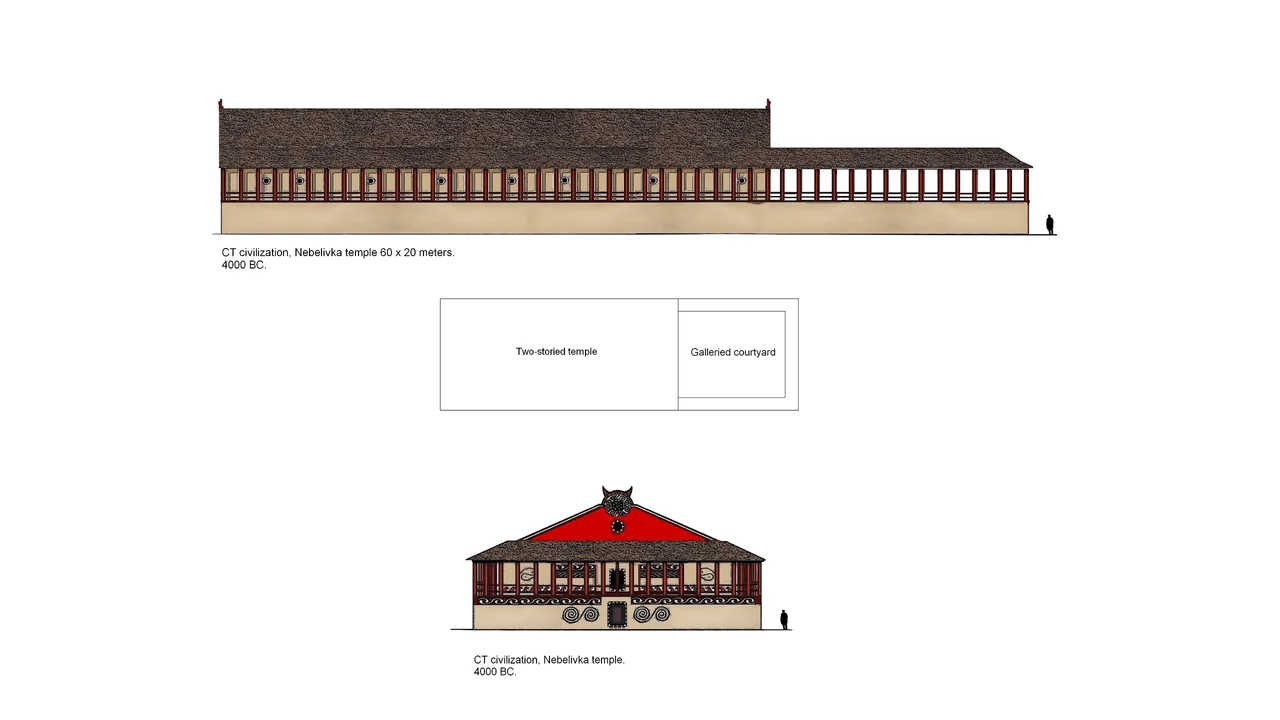
The most remarkable find at Nebelivka is a temple. Excavators uncovered a two-storey structure of mud and wood, built around a galleried courtyard, whose size and contents set it apart from any ordinary dwelling. Inside were female figurines of the kind archaeologists call Venus figures, pottery worked into stylized faces, the charred bones of animals, and small pieces of gold that may once have adorned hair or clothing, some of the oldest worked gold from this part of the world. Eight clay platforms, likely altars, stood within it. The floors and walls of all five upper rooms had been painted red, deliberately, to create what the researchers described as a ceremonial atmosphere. Stand in imagination inside those red-washed rooms and you are standing in one of humanity's first purpose-built sacred spaces.
The Silence of the Plains
What makes Nebelivka haunting is how little of it shows. There are no ruins to walk through, no standing walls, no monuments; the mega-settlement survives mainly as patterns in the soil, readable by instruments rather than the eye. The people who lived here left extraordinary things, planned streets, a painted temple, gold ornaments, and then, like the other Trypillian giants across this region, their great settlements were eventually abandoned, the reasons still debated by scholars. That absence is its own kind of eloquence. Beneath the grain fields of Kirovohrad Oblast lies proof that the idea of the city is far older and far more widespread than the familiar story of Mesopotamia allows, and that some of the earliest chapters of urban humanity were written, quietly, right here.
From the Air
Nebelivka lies at 48.64°N, 30.56°E, near its namesake village in Kirovohrad Oblast, central Ukraine. From about 3,000 to 5,000 feet, the site is invisible on the surface, marked only by the surrounding farmland; the nearby village and field boundaries are the practical landmarks. Ukrainian airspace is closed to civil aviation; the nearest operating airport is Chișinău (ICAO LUKK) in Moldova.
Nearby Stories
- Strategic Missile Forces Museum 25 km away
- Bug Gard National Nature Park 33 km away
- Battle of Korsun 66 km away
- Khutir Nadiia 76 km away
- Battle of Korsun-Cherkassy 88 km away
- Multimedia Fountain Roshen 110 km away
- Vinnytsia 125 km away
- Tiraspol 167 km away