.jpg)
Samar
A city can be renamed. Whether it forgets is another question. For most of living memory this place on the right bank of the Samara River was called Novomoskovsk, but in 2024 Ukraine's parliament handed it back the name its Cossack founders had used: Samar. The word is older than the empire that changed it, older even than the failed 1777 experiment when planners tried to build a city here and named it Yekaterinoslav, "the glory of Catherine," only to watch spring water turn the ground to bog. Twenty-seven kilometers from the regional capital of Dnipro, Samar carries its layered names the way its river carries silt, downstream from everything that came before.
A Town With Four Names
The first Samar rose at the end of the seventeenth century, a Cossack settlement that gave its name to a whole administrative district of the Zaporozhian lands. In 1688 the Cossacks abandoned that original site, now called Old Samar, when the Russian tsardom raised the Bohorodytska Fortress there. The displaced inhabitants simply moved upstream and rebuilt, founding a new Samar that eighteenth-century documents also record as Samarchyk, Novoselytsia, and Palanka. Then in 1777 came the imperial rebranding: Yekaterinoslav, meant to flatter Empress Catherine II. That grand name did not survive the swamp the site turned out to be. The settlement was renamed Novomoskovsk in 1794, while the prestigious Yekaterinoslav title migrated to what is now Dnipro. Four names in a century, each a small record of who held power over the river bend.
The Wooden Cathedral
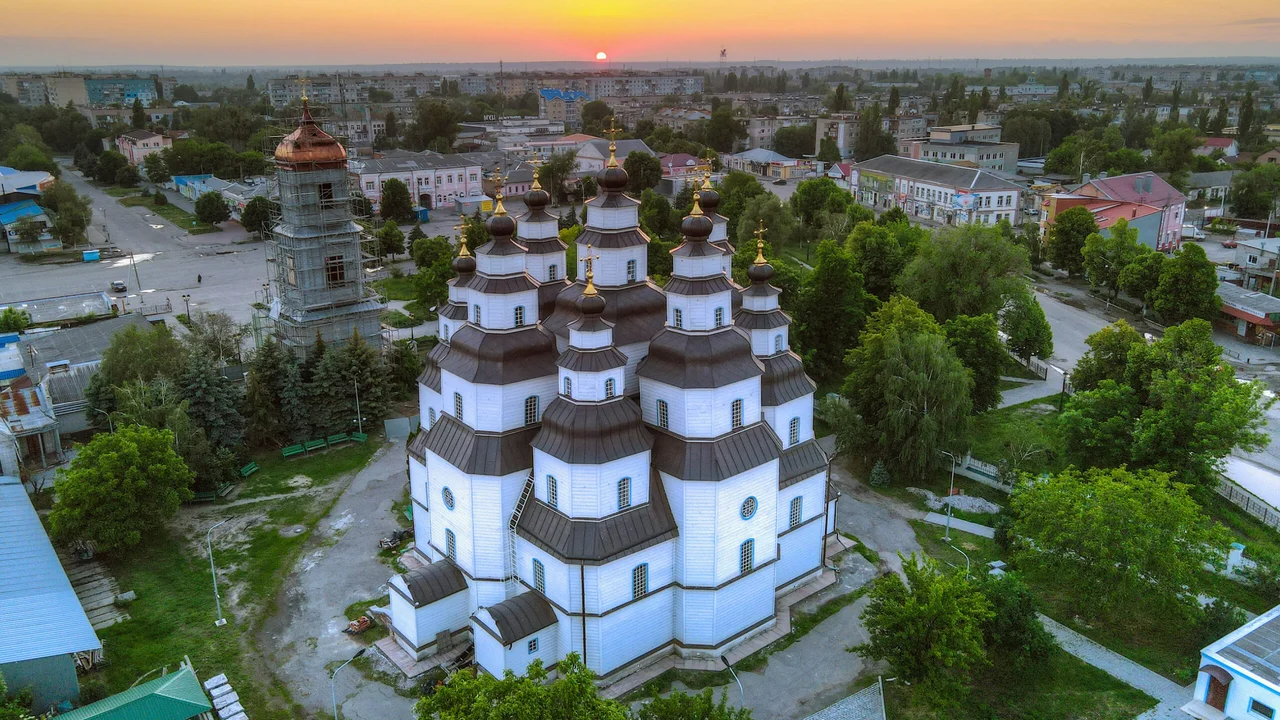
Rising above the town's rooftops is one of the most remarkable pieces of folk architecture in Ukraine: the Trinity Cathedral, built entirely of wood between 1772 and 1781 by the Zaporozhian Cossacks. It is the only surviving wooden nine-domed church in the country, its central dome soaring to around sixty-five meters with four lower domes at the cardinal points and four lower still between them. Nearby stands a monastery, and the city's older streets still hold a former synagogue and the St. Nicholas Cathedral, a stone record of the many communities who once shared these blocks. The cathedral's Soviet-era indignity, when it served as a storehouse, was immortalized in Oles Honchar's novel The Cathedral, a book that made this wooden monument a national symbol of what should not be let to rot.
The People of the River Bend
By the 2001 census the city counted 71,860 residents; on the eve of the 2022 invasion the figure stood near 69,855. The community is overwhelmingly Ukrainian, more than eight in ten, with a substantial ethnic Russian minority and smaller numbers of Belarusians, Germans, Armenians, Jews, Romani, and people of Turkic origin, the human sediment of a borderland crossed by many currents. Among those the town claims as its own are the painter Mykola Hlushchenko, who lived a double life as a Soviet spy, the animator and film director Stepan Koval, and football manager Viktor Skrypnyk. The former synagogue standing among the residential streets is a quiet reminder of a Jewish community that, like so many across Ukraine, was devastated in the twentieth century.
Reclaiming the Old Name
Names became a battleground again after 2022. With Russian forces invading the country, a city called Novomoskovsk, "new Moscow," carried a resonance many residents no longer wanted. In January 2024 the city council voted to rename it Nova Samar. That September, Ukraine's Verkhovna Rada made it official and simpler still: Samar, the name the Cossacks had given the river settlement three centuries earlier. The decision closed a long loop. The town that had been Old Samar, then Samarchyk, then briefly Catherine's glory, then new Moscow, became once more what it started as. In a country reasserting its own story, few gestures are as concrete as calling a place by its first true name.
From the Air
Samar lies at about 48.63°N, 35.22°E, strung along the right bank of the Samara River just before it joins the Dnieper. From roughly 4,000 to 7,000 feet the wooded river course and the tall central dome of the Trinity Cathedral help fix the town against the surrounding plain. Dnipro International Airport (UKDD) is the nearest major field, about 27 kilometers to the south-west.
Nearby Stories
- 1979 Dniprodzerzhynsk Mid-Air Collision 11 km away
- Dnieper Rapids 20 km away
- Battle of the Vorskla River 50 km away
- Battle of Dibrivka 61 km away
- Borki Train Disaster 93 km away
- Poltava Governorate Zemstvo Building 97 km away
- Kryvbas 110 km away
- Second Battle of Kharkov 116 km away