
Derzhprom
Stand at the exact center of Kharkiv's Freedom Square and the building resolves into perfect symmetry. Step a few paces in any direction and it dissolves again into a jagged cluster of towers, bridges, and setbacks, an optical trick its architects built in on purpose. This is Derzhprom, the State Industry Building, and when it opened on November 7, 1928, it was the first modern skyscraper in the Soviet Union and, briefly, the most spacious single structure in the world. Raised in just three years from an audacious lattice of reinforced concrete, it was less a building than a manifesto in stone: proof that a new age of industry and machinery had arrived on the flat steppe of eastern Ukraine.
Three Years, and a Rescue From Moscow
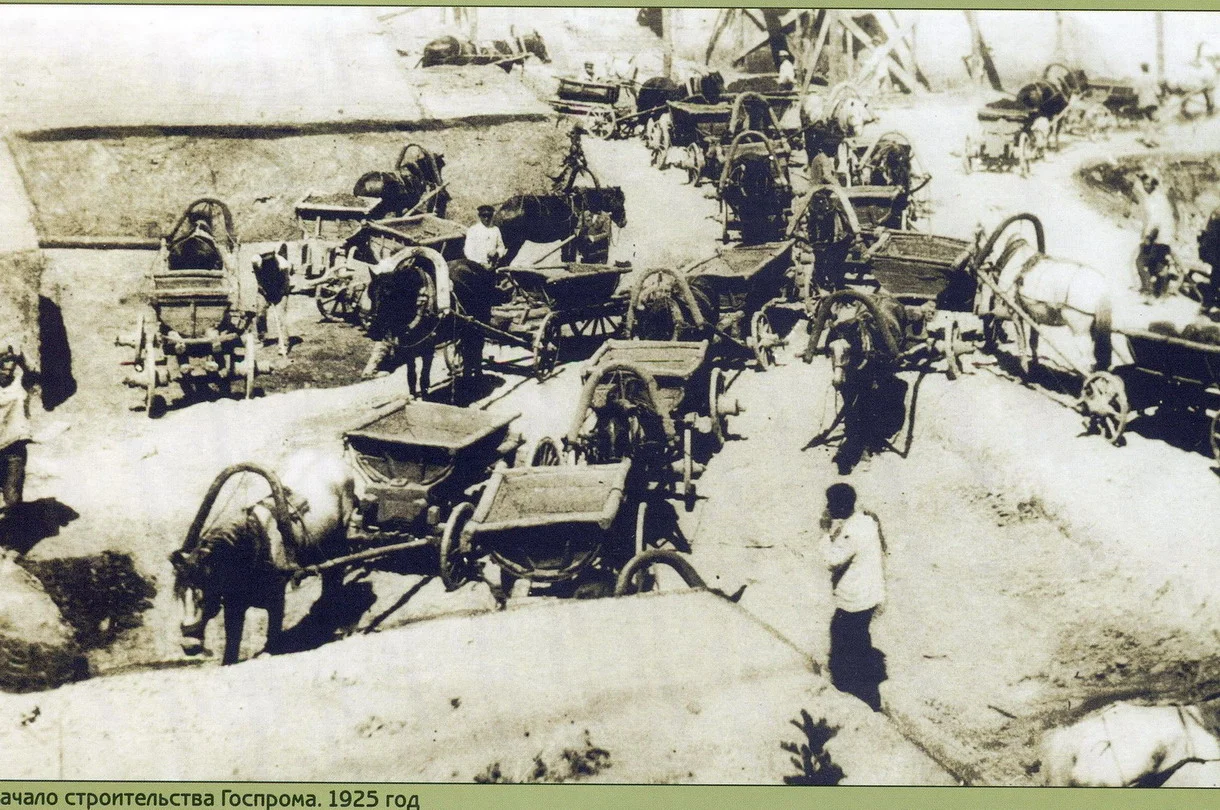
Derzhprom was one of a handful of showcase projects commissioned when Kharkiv, not Kyiv, was the capital of Soviet Ukraine. Three Leningrad architects, Sergei Serafimov, Samuel Kravets, and Mark Felger, designed it, and a workforce raised it in only three years, an astonishing pace for a structure of its scale. It nearly did not happen. In the spring of 1926, financial troubles forced construction to halt. The project's chief, Pavlo Rottert, traveled to Moscow to plead for support and secured backing from Felix Dzerzhinsky; by that August the money was flowing again on an emergency basis. The interlinked towers, connected by a system of overhead walkways, were unlike anything the region had seen, laced together in concrete and glass into a single, restless, mechanical whole.
One of the Century's Great Buildings
Derzhprom was not merely large; it was, by serious critical judgment, one of the finest works of its era. The British architectural historian Reyner Banham, in his influential Theory and Design in the First Machine Age, ranked it among the major architectural achievements of the 1920s, comparable in scale only to the Bauhaus building at Dessau and the Van Nelle Factory in Rotterdam, two touchstones of European modernism. It became shorthand for the future itself, filmed as a symbol of modernity by the pioneering directors Dziga Vertov and Sergei Eisenstein. When the capital moved to Kyiv in 1934, and Constructivism fell out of official favor in the shift to grandiose Stalinist architecture, Derzhprom's fame dimmed, but the building's stature never truly did.
The Building the War Could Not Destroy
Derzhprom's most remarkable feat may be simple endurance. During the Second World War, occupying forces reportedly tried to bring the structure down and failed. Its innovative concrete frame, the same engineering that had made it a marvel, proved so robust that it fully survived the attempts to destroy it, outlasting a conflict that flattened much of the city around it. In the decades after, it settled into ordinary usefulness: one of its towers served as a television center, and a TV relay mast was raised on its roof. Recognition of its global importance grew, too. UNESCO placed the building on its World Heritage tentative list in 2017 and granted it provisional enhanced protection in 2022, an acknowledgment that this concrete colossus belonged to the heritage of the whole world.
A New Wound
On October 28, 2024, that long survival met a new test. A Russian guided bomb, believed to be a FAB-500, struck Derzhprom, inflicting significant damage on a structure that had stood for nearly a century and weathered a world war. The strike on a UNESCO-protected landmark drew international attention and, in its wake, a commitment from UNESCO to help restore it. For Kharkiv, the building has always been more than architecture. It is the emblem of the city as industrial, modern, and unbowed, the shape that appears on postcards and in the civic imagination. Damaged but standing, its symmetrical heart still holding the center of Freedom Square, Derzhprom remains what it was designed to be: a monument to a city that builds, and rebuilds.
From the Air
Derzhprom dominates Freedom Square at roughly 50.01 degrees north, 36.23 degrees east, in central Kharkiv, one of the largest city squares in Europe. From the air, look for the vast open plaza and the building's distinctive cluster of interlinked towers on its northern edge. The nearest major airport is Kharkiv (UKHH) to the south.
Nearby Stories
- Giant Ukrainian Radio Telescope 12 km away
- Hryhorii Skovoroda Literary Memorial Museum 18 km away
- Borki Train Disaster 20 km away
- Hetman National Nature Park 61 km away
- Central Black Earth Nature Reserve 81 km away
- Second Battle of Kharkov 88 km away
- Poltava Governorate Zemstvo Building 95 km away
- Grace Darling 538 km away