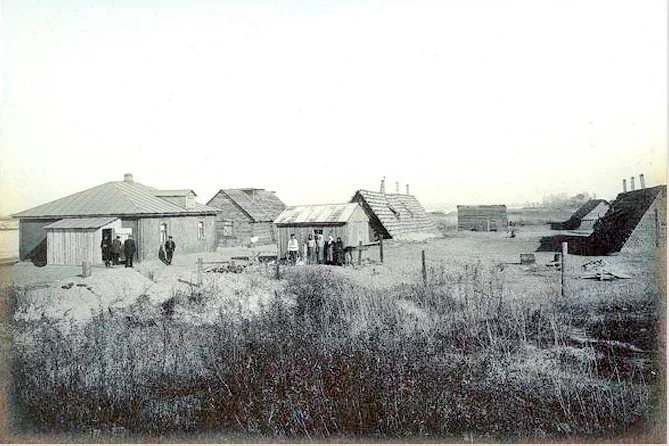

Deriivka
The evidence was a horse's skull, buried on purpose more than six thousand years ago, and for a generation it seemed to answer one of prehistory's biggest questions: when did humans first ride? At Deriivka, an ancient settlement on the right bank of the Dnieper in central Ukraine, archaeologists found a place where three-quarters of the animal bones came from horses, and where one stallion had been laid in the ground with what looked like the marks of a bit worn into its teeth. Here, many believed, was the cradle of horseback riding. The site is gone now, submerged beneath the waters of the Kamianske Reservoir. And the claim that made it famous turned out to be wrong.
A Village of Horses
Deriivka belonged to the Sredny Stog culture of the Copper Age, roughly 4500 to 3500 BC, a people of the open steppe near the great river. The excavated settlement was modest, three dwellings and six hearths, but each was packed with animal bones, hundreds of them, and around three-quarters came from horses. To the inhabitants, horses were clearly central, though whether as mounts, as herds, or simply as a food staple was not obvious from the bones alone. The site drew special interest because of who these people may have been. Within the influential Kurgan hypothesis of the archaeologist Marija Gimbutas, the Sredny Stog complex sits close to the roots of the Indo-European languages, the vast family that would one day stretch from Ireland to India. Deriivka was not just a village. It was a candidate for a homeland.
The Stallion That Fooled Everyone
The centerpiece was a single skull. A stallion, seven or eight years old, had been deliberately buried apart from the main site, and in 1991 the archaeologist David Anthony reported microscopic wear on its teeth of the kind a bit leaves behind. If the horse belonged to the Copper Age settlement, it pushed the invention of riding back thousands of years, to this very spot. It was a thrilling conclusion, and it held for years. Then, in 1997, radiocarbon dating undid it. The buried stallion was intrusive, dug into the older layers from a far later era, its true death somewhere in the Iron Age, centuries before Christ rather than millennia. The famous evidence had never belonged to Deriivka's builders at all, and the question of when humans first swung onto a horse's back was suddenly, thrillingly, open again.
Beneath the Reservoir
Long before the debate over the stallion, the land itself had been claimed. When the Dnieper was dammed to create the Kamianske Reservoir, the waters rose and closed over Deriivka, sealing the settlement and its cemeteries beneath a new artificial lake. Two burial grounds lie there, one from the earlier Dnieper-Donets culture and one from the Sredny Stog people, the graves of a community that lived along this river for thousands of years. Deriivka survives now as coordinates on a map, a name in the specialist literature, and a cautionary tale about how a single spectacular find can shape a field until better science tests it. The horses of Deriivka were real. The riders remain a mystery, and the search for them has moved on to other stretches of the same endless steppe.
From the Air
Deriivka lies at about 48.914 N, 33.765 E, now beneath the Kamianske Reservoir on the Dnieper in Kirovohrad Oblast. From 1,500 to 3,000 feet AGL the broad reservoir and its wooded right bank are the defining features; the site itself is underwater and invisible. Nearest sizeable airport is Dnipro International (UKDD) to the southeast, with Kremenchuk's airfield to the north.
Nearby Stories
- Battle of Zhovti Vody 16 km away
- 1979 Dniprodzerzhynsk Mid-Air Collision 19 km away
- Battle of Kurukov Lake (1625) 19 km away
- Poltava Governorate Zemstvo Building 41 km away
- Poltava Museum of Long-Range and Strategic Aviation 61 km away
- Samar 67 km away
- Kropyvnytskyi 86 km away
- Cherkasy 100 km away