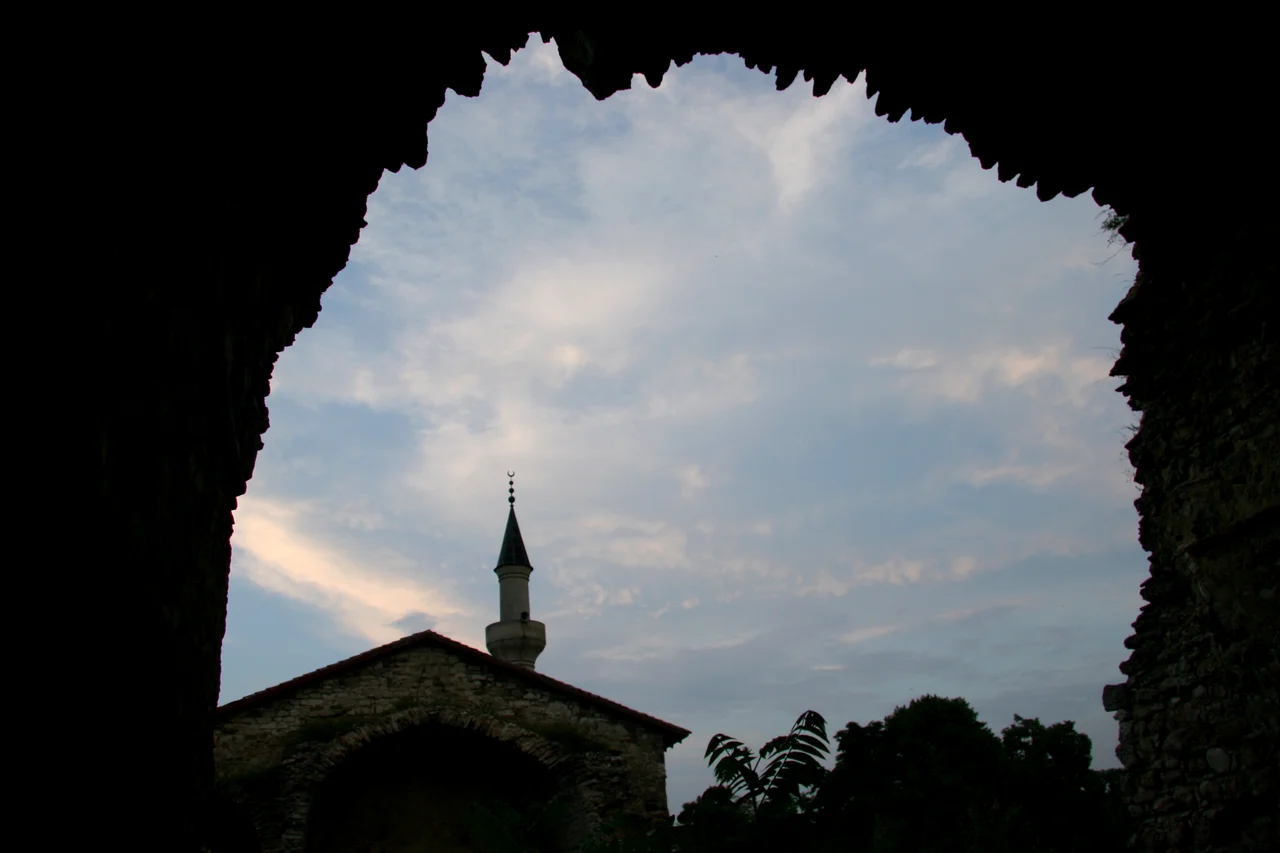

Ozbek Han Mosque
The carved wooden door is the thing that stops you. Set into a monumental stone portal, it has been swinging on its hinges, in one form or another, since 1314, when this mosque rose in a city that was then the thriving capital of Crimea. The Ozbek Han Mosque is the oldest mosque on the entire peninsula, older than the Crimean Khanate itself, a survivor from the age of the Golden Horde. That it still functions today as a place of worship, in a town most of the world has never heard of, makes it something more than a monument. It is a thread of continuity stretching unbroken across seven centuries.
When Solkhat Was a Capital
To understand the mosque, you have to picture the town as it once was. Today it is the quiet settlement of Staryi Krym, but in the fourteenth century it was Solkhat, a prospering city under the Golden Horde and the seat of the early Crimean khans. Trade routes and Mongol power flowed through it, and it was wealthy enough to raise a great mosque in the name of Özbeg Khan, the ruler under whose reign it was built in 1314. Solkhat's prominence lasted until the capital shifted to Bakhchisaray in the early sixteenth century, after which the old city slowly faded from importance. The mosque outlasted that decline, a stone survivor of an era when this corner of Crimea sat at the center of things.
Stone, Wood, and Learning
The mosque is built on a square floor plan, and its architecture speaks of connections that reached far beyond Crimea. Its features echo the buildings of Anatolia during the Seljuk period, a reminder of how ideas and craftsmen traveled across the medieval Islamic world. Its most striking element is that monumental entrance with its carved wooden door, a work of craftsmanship that has drawn admirers for centuries. Beside the mosque, against its southern wall, once stood a madrasah, a school of Islamic learning built in 1332 by Inci Hatun, the daughter of Kilburun Bey. Little of it remains today beyond ruins, but its presence marks Solkhat as a place not only of prayer but of scholarship, where a woman of standing endowed a center of education nearly seven hundred years ago.
A Living Faith
What gives the Ozbek Han Mosque its quiet power is that it is not a museum piece. After centuries that saw the fortunes of Crimea's Muslim community rise and fall, the mosque today serves once more as a working place of worship. Staryi Krym is home to a small but devoted Crimean Tatar population, the descendants and heirs of the people whose faith built this place, and for them the mosque is a living link to a heritage that reaches back to the Golden Horde. To step through that ancient door is to enter a space that has held prayer, in one century or another, for the better part of a thousand years, an unhurried testament to endurance in a landscape that has seen empires come and go.
From the Air
The mosque stands at 45.03°N, 35.09°E in Staryi Krym, in the eastern Crimean Peninsula about 25 km west of Feodosia. From roughly 2,000 to 2,500 feet the small town sits amid gardens and low hills; the mosque and the nearby madrasah ruins are best appreciated at low altitude in clear air. The nearest airports are Feodosia (UKFF) to the east and Simferopol (URFF) to the west.
Nearby Stories
- Valley of Ghosts 9.2 km away
- Aeroflot Flight 6515 17 km away
- Crimean Nuclear Power Station 23 km away
- Akmesdzhyt Friday Mosque 30 km away
- Battle of the Kerch Peninsula 41 km away
- Alushta 49 km away
- Syvash 82 km away
- Soviet Destroyer Smyshlyony 99 km away