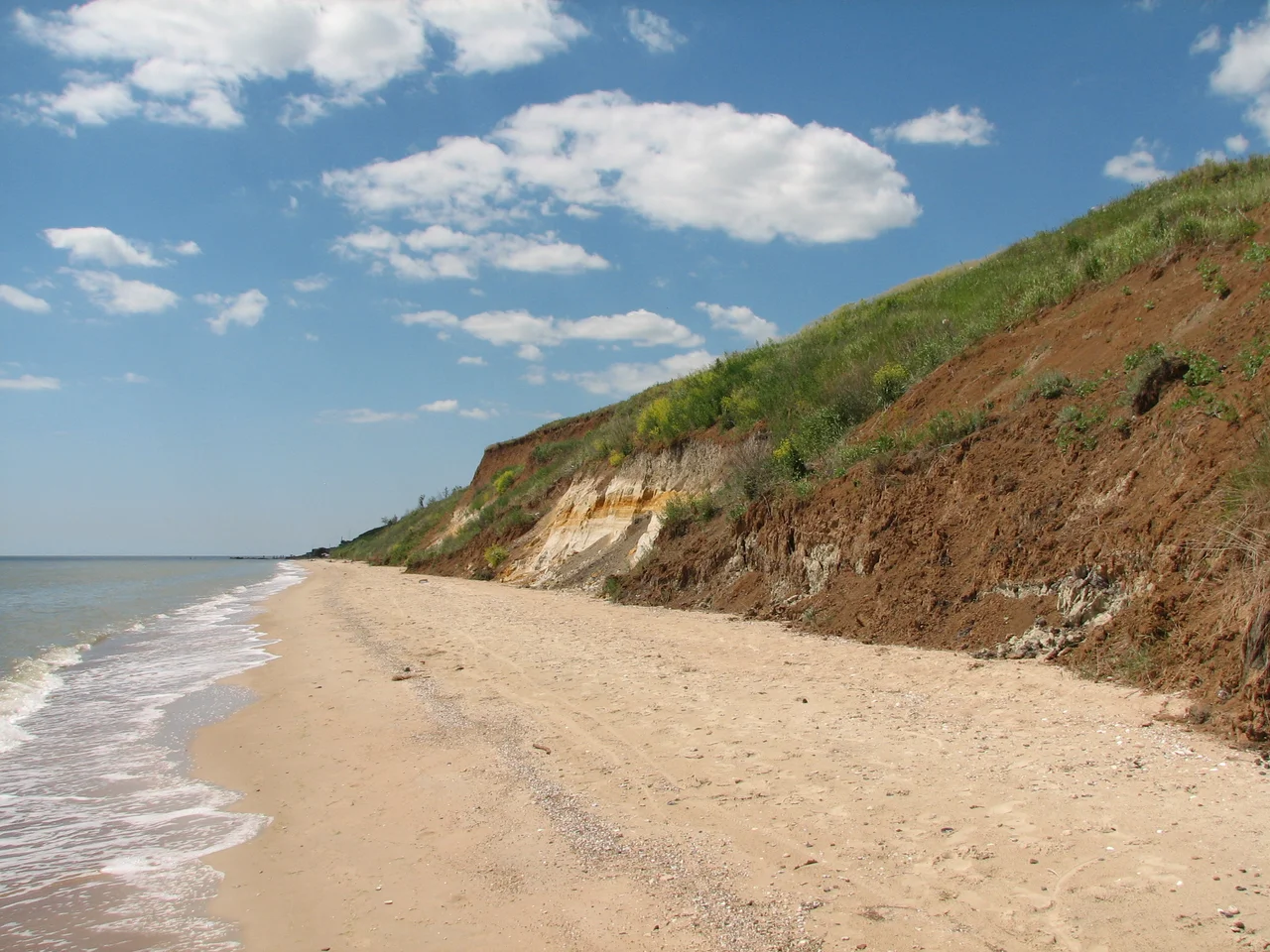

Meotyda National Nature Park
In spring the sandbars off the northern coast of the Sea of Azov turn white - not with foam, but with birds. Terns and gulls, plovers and avocets crowd the low shell islands and grassy spits, wheeling up in clouds when a shadow passes overhead. This is Meotyda National Nature Park, a ribbon of coastline and estuary where the flat Ukrainian steppe finally meets the sea. It takes its name from the Maeotians, a people who lived on these shores in antiquity, and whose memory the water itself once carried: the Greeks called the Sea of Azov the Maeotian Sea, or Lake Maeotis.
Where the Steppe Meets the Sea
Meotyda was assembled in 2009, stitched together from a scattering of smaller reserves, state lands, and cultural monuments along the shore in the southwest corner of Donetsk Oblast, near the port city of Mariupol. What makes it remarkable is variety packed into a narrow strip. Within a short walk the land shifts from open steppe to coastal plain, from floodplain swamp to estuary, from sandy-shell islands and dunes to shallow saline lakes. Spits reach out into the sea like fingers; behind them, sheltered lagoons of variable salinity form nurseries for fish and feeding grounds for wading birds. Few places on the Azov coast concentrate so many habitats in one place, which is precisely why so much life gathers here.
A Continental Climate on a Warm Sea
The park sits within the Pontic-Caspian steppe, the vast belt of grassland that runs from the northern shores of the Black Sea all the way east toward Kazakhstan. Its weather is continental and swings hard between seasons: hot summers, with at least one month averaging above 22 degrees Celsius, and comparatively mild winters. Rain is scarce, averaging only about 350 millimeters a year - drier than much of Ukraine - so the land depends on the sea and its estuaries for moisture. The Sea of Azov is the shallowest sea in the world, which lets it warm quickly; the water off Meotyda climbs to an average of 27.5 degrees Celsius in July. That warmth feeds the plankton and fish that in turn feed the birds, tying the whole system together.
A Flyway Stopover
Before recent disruptions, Meotyda supported important populations of migratory waterfowl and more than a hundred species of nesting birds. Its position matters: the Azov coast lies along a major migratory corridor, a refueling station for birds traveling between breeding grounds in the north and wintering areas around the Mediterranean and beyond. The undisturbed spits and islands give ground-nesting species something increasingly rare on a crowded continent - a safe place to lay eggs, away from predators and people. Colonies of terns and gulls can number in the thousands, their collective alarm a wall of sound. For a bird making the long haul across the steppe, a stretch of protected shore is not scenery. It is survival.
A Park Under Strain
Meotyda has not been spared the turmoil of its region. As of 2018 the eastern sections of the park had fallen outside its administrators' control amid the fighting in the Donbas, and the effect on its vulnerable wildlife remained unclear. On the western sections that the park still managed, its director noted an unexpected twist: heavier patrols along the coast had actually reduced human and dog traffic near the nesting colonies, giving some birds more peace than they had known before. Beneath the park's fortunes, though, the underlying reserves keep their legal status, a paper promise that these estuaries and shell islands are meant to endure - a place set aside for the terns and the plovers, whatever passes overhead.
From the Air
Meotyda spreads along the Azov coast near 47.18°N, 36.95°E, best seen from 3,000 to 6,000 feet where the pale spits, blue lagoons, and shell islands trace the shoreline. The port of Mariupol lies just to the east; the flat, silver Sea of Azov fills the southern horizon. The nearest airport is Mariupol International (UKCM).
Nearby Stories
- Battle of Dibrivka 57 km away
- Beriev 93 km away
- Klivazh 97 km away
- Yunkom Coal Mine 123 km away
- Khortytsia 130 km away
- Byriuchyi Island 143 km away
- Russian Battleship Rostislav 172 km away
- Soviet Cruiser Mikhail Kutuzov 246 km away