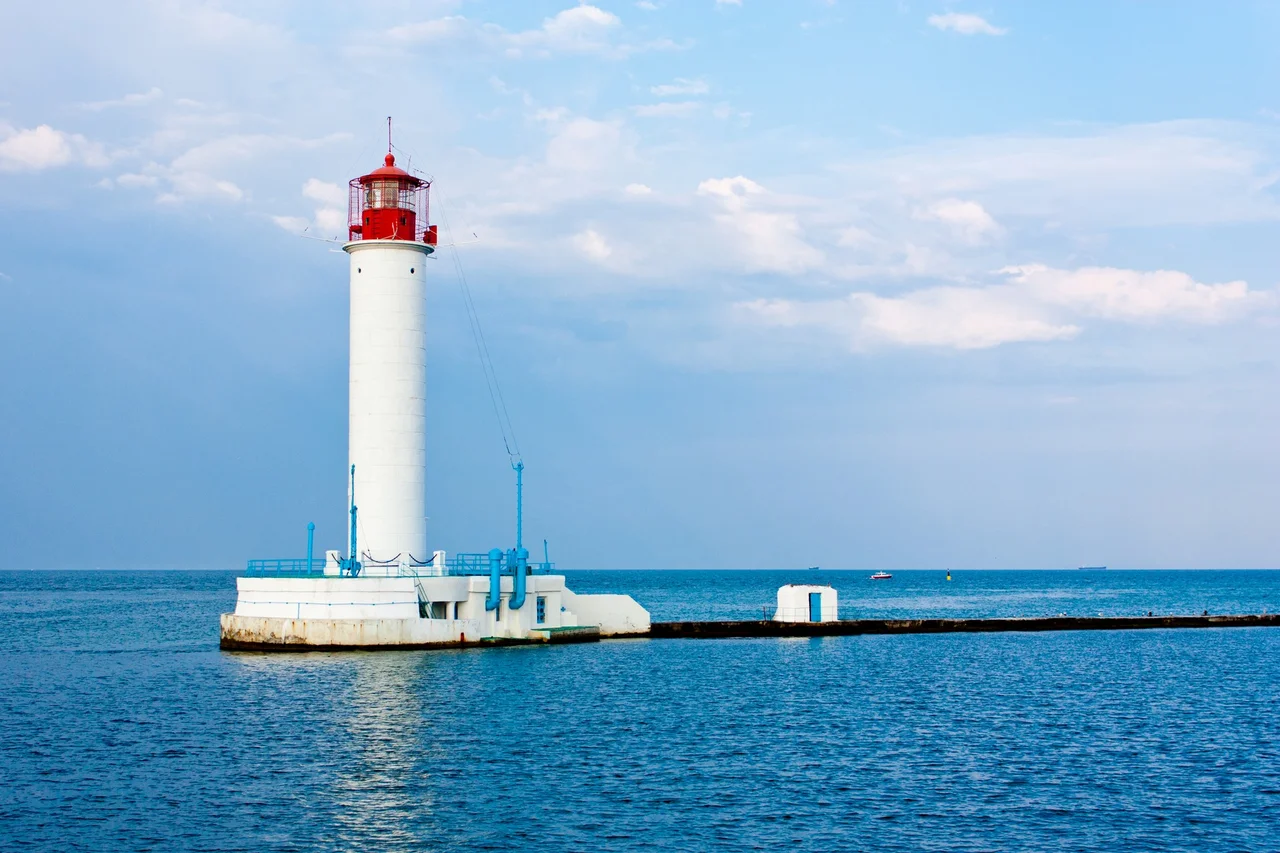

Vorontsov Lighthouse
Far out at the end of a long stone causeway, where the harbor meets the open Black Sea, a red-and-white tower blinks a message into the dark. Three long flashes, over and over: in Morse code, the letter O. It stands for Odesa, and every ship approaching the port reads the city's own initial written across the waves. The Vorontsov Lighthouse has been the maritime face of Odesa for generations, a slender sentinel guarding the entrance to one of the Black Sea's great ports, and its steady signal is as much a part of the city's identity as its stairs or its opera house.
A Signal Written in Light
The lighthouse rises 27.2 meters, painted in the bold red and white bands that make it easy to pick out against sea and sky. Its heart is a signal light of extraordinary power, rated at a million watts and visible up to twelve nautical miles out, some twenty-two kilometers across the water. The choice of flash is no accident. Rather than a generic pattern, the beam sends the Morse letter O, three long dashes, claiming the port for Odesa in a language sailors have understood for well over a century. When storms roll in or fog swallows the coast, a foghorn joins the light, so that even ships that cannot see the beacon can still hear it calling them home.
The Third to Stand Here
The tower that stands today is not the first to hold this post. It is the third lighthouse to occupy the same spot, part of a lineage that reaches back to 1862, when the original was raised in wood. That first beacon belonged to the era of the Russian Empire and the bustling grain trade that made Odesa rich, and as the port grew and technology advanced, the wooden light gave way to sturdier successors. Built with iron tubing sealed by lead gaskets, the modern lighthouse carries forward a duty that has never lapsed across more than a century and a half: to mark the safe way in, night after night, for the ships that are the lifeblood of the city.
Guardian of the Harbor Mouth
The lighthouse does not stand alone but as the tip of a great work of maritime engineering. A long stone causeway and jetty reach out from the shoreline to carry it, and together with huge concrete breakwaters raised on rock along the eastern side, they shield the harbor from the heavy seas that sweep up from the south. To reach the tower is to walk out along that jetty, the city receding behind you and the open water stretching ahead, until you stand at the very threshold between Odesa and the Black Sea. It is one of the most striking vantage points in the whole city, the place where land finally surrenders to sea.
Named for the Builder of a City
The lighthouse carries the name of Prince Mikhail Semyonovich Vorontsov, the governor-general who did so much to shape nineteenth-century Odesa, the same figure remembered by a cathedral, a palace, and a much-debated statue in the city center. It is fitting that his name should also belong to the beacon at the harbor's edge, for Odesa was always a creature of the sea, and Vorontsov understood that its future ran out through this very channel. Today the red-and-white tower remains a beloved emblem of the port, appearing on postcards and in the memories of everyone who has sailed in past its light. In three patient flashes, it goes on spelling the name of the city it has watched over for so long.
From the Air
The Vorontsov Lighthouse stands at the seaward end of the harbor jetty at 46.497°N, 30.760°E, off the Odesa waterfront. From about 2,000 feet the red-and-white tower and its long stone causeway are clearly visible where the breakwaters enclose the port, just southeast of the historic center. The nearest airport is Odesa International (UKOO), roughly 5.5 nm to the southwest.
Nearby Stories
- Lower Dniester National Nature Park 9.3 km away
- Battle of Berezan (1788) 15 km away
- Moldavian Autonomous Soviet Socialist Republic 46 km away
- Black Sea Shipyard 57 km away
- Racecourse of Achilles 57 km away
- Tiraspol 87 km away
- Zaliznyi Port 119 km away
- Danube Delta 128 km away