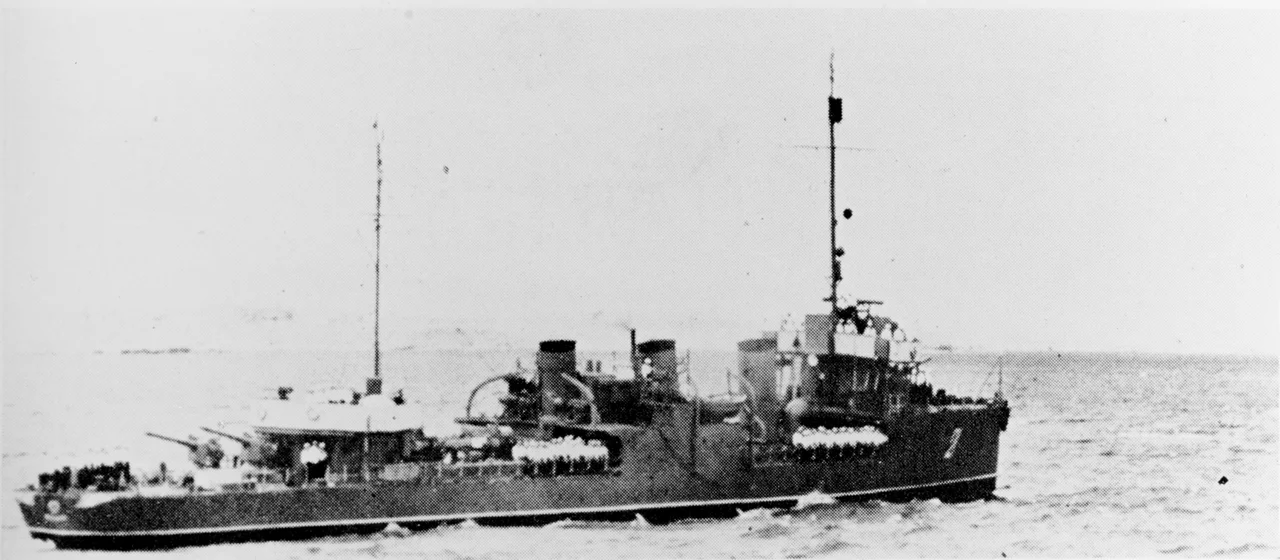

Soviet Destroyer Dzerzhinsky
For most of a year, the destroyer Dzerzhinsky lived on borrowed luck. Through the desperate summer of 1941 she ran ammunition into besieged Odessa, dueled shore batteries, and shrugged off Heinkel bombers and near-misses that damaged her guns and torpedo tubes. She survived them all. What finally killed her, on 14 May 1942, was not a German plane or shell but a Soviet mine, struck in fog as she groped toward Sevastopol through her own side's defensive minefield. She sank so quickly that of nearly three hundred people aboard, only twenty-seven were pulled from the sea.
Two Names, Two Empires
The ship began life under the Imperial flag. She was one of eight Fidonisy-class destroyers built for the Imperial Russian Navy during the First World War, launched in 1916 under the name Kaliakria. Even her armament reflected the moment: unhappy with the anti-aircraft guns originally planned, the navy swapped in a pair of Hotchkiss guns while she was still under construction in 1917, the year the empire that ordered her fell. In 1926 she was renamed Dzerzhinsky, after the founder of the Soviet secret police, and carried that name into a second war a generation later. Fast for her size, with four single 102-millimeter guns and banks of torpedo tubes, she was a relic of one era pressed into the service of the next.
The Odessa Runs
When Germany invaded in June 1941, Dzerzhinsky was stationed at Batumi and immediately went to work, laying 240 mines off the naval base in four night sorties. Then came Odessa. With larger ships held back after heavy losses, the aging destroyers carried the burden of supporting the city's defenders. Dzerzhinsky ran ammunition in and wounded out, bombarding Axis positions at Dofinovka and Fontanka, expending hundreds of shells at a stretch. The work was punishing and improvised: a turret elevator failed and had to be reloaded by hand, artillery fragments damaged a gun and her torpedo tubes, and more than once she slipped out of the burning port under her own smokescreen, nearly out of fuel and with no drinking water left aboard.
Lost in the Fog
By May 1942 the focus had shifted to besieged Sevastopol. Loaded with reinforcements at Novorossiysk, Dzerzhinsky approached the harbor channel on the foggy night of 13-14 May and waited for the visibility she needed to thread a Soviet minefield. Late that morning, with commanders fearing the ships had drifted too close to the mines, she was ordered to find the minesweeper marking the cleared lane. She turned toward it without deploying her paravanes. Before she reached it, at 12:20, she struck a mine and went down fast. Of 170 crew and 125 passengers, only 27 survived, her captain among them. Struck from the navy that summer, she lay unfound until 2006, when a Ukrainian-American expedition located her wreck on the Black Sea floor.
From the Air
The destroyer was lost near the approaches to Sevastopol, at roughly 44.30 degrees north, 33.07 degrees east. From 4,000 to 7,000 feet the harbor entrances of Sevastopol and the indented southwestern Crimean coastline are the main visual references over otherwise open water. The nearest airfields are Sevastopol's Belbek (UKFB) and Simferopol (UKFF).
Nearby Stories
- Foros 3.2 km away
- Eski Yurt 14 km away
- Soviet Destroyer Otvazhny 21 km away
- Tarkhankut Lighthouse 79 km away
- Russian yacht Livadia (1873) 108 km away
- Januarius MacGahan 305 km away
- Tottenham (1802 Indiaman) 338 km away
- Abkhazia 596 km away