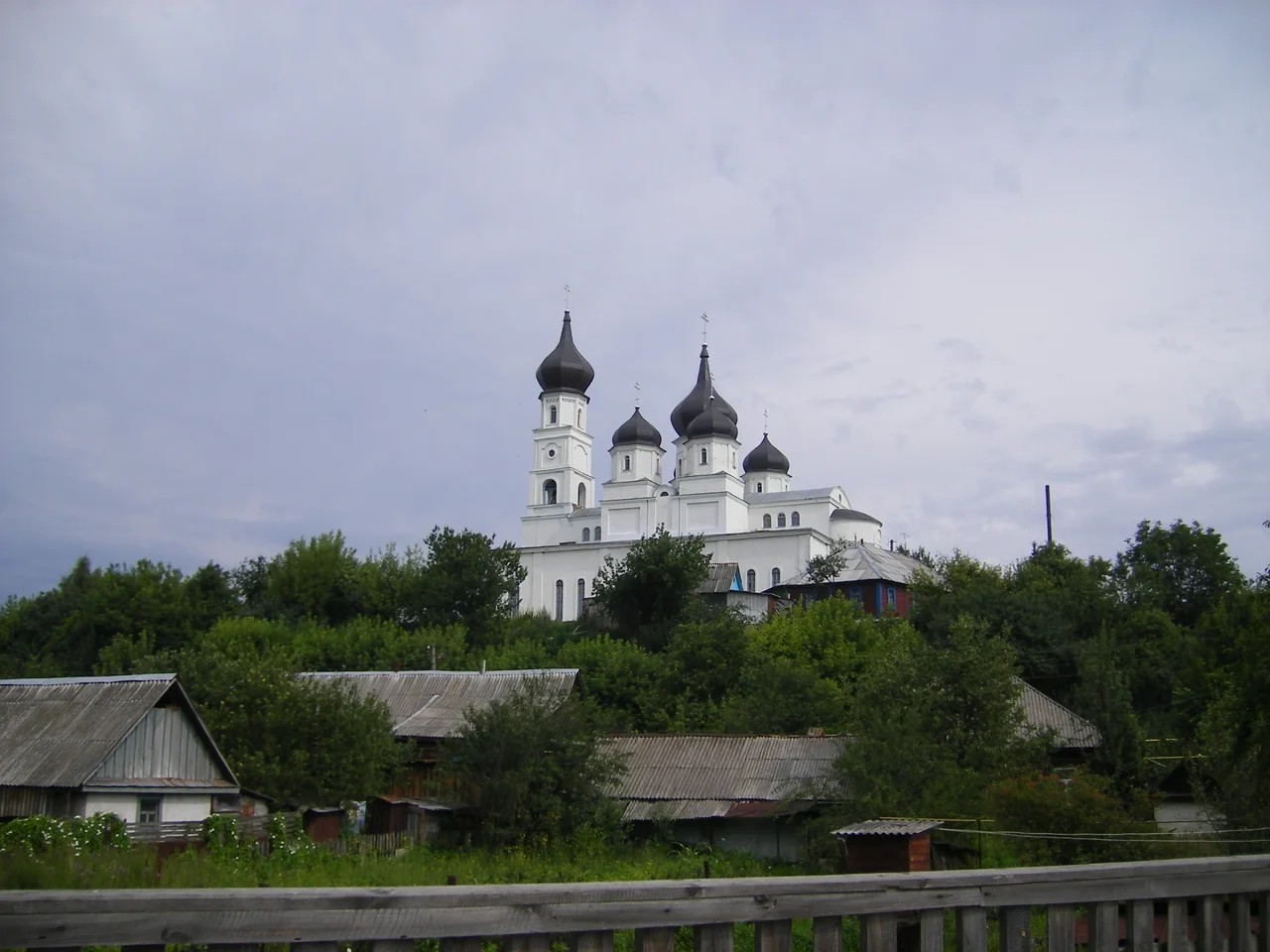

Ovruch
One building in Ovruch has watched almost the entire history of this town, and it very nearly did not survive to tell it. St. Basil's Church, its walls banded with polished colored stone set into elaborate brick, was commissioned by a prince of Kyiv in the 1190s - and for centuries afterward it stood as a ruin, its great dome collapsed, its walls crumbling, until only three apses and a fragment of wall remained. That it stands whole today is the work of a restorer who guessed at what had been lost. In a town that has been sacked, starved, and bombed across a thousand years, this church is the one enduring mark of Ovruch's deep antiquity - and the thread that ties its story together.
The Second Drevlian Capital
Ovruch enters the record early. It was first mentioned as Vruchiy in the year 977, an important town of Kievan Rus tucked into the woods and marshes of the Polissya region in what is now northern Ukraine, about fifty kilometers south of the Belarusian border. Its rise came at a neighbor's expense. After the nearby stronghold of Iskorosten - modern Korosten - was sacked and destroyed, Ovruch inherited its role, becoming the capital of the Drevlians, the fierce East Slavic tribe of the region. The town would change hands many times over the centuries that followed: conquered by the Mongols in the 13th century, absorbed into the Grand Duchy of Lithuania, then granted the status of a royal city under the Polish crown. Each ruler left a layer, but the Rus foundations ran deepest.
A Prince's Church of Colored Stone
In the late 1190s, Rurik II of Kyiv ordered his court architect to build a church here in his own domain, dedicated to his patron saint. St. Basil's is a small marvel of medieval Rus design: four pillars, three apses, a single dome, and a western facade flanked by two round towers that echo the great Saint Sophia Cathedral in Kyiv. Its most striking feature is decorative - facades of elaborate brick interlaced with bands of polished colored stone, a technique that made the walls glow with pattern. But beauty was no shield against war. During a siege of Ovruch by the Lithuanian ruler Gediminas in 1321, the dome and vaults came crashing down. What remained slowly weathered away over the next five centuries, until by 1842 the ruins had crumbled to little more than the three apses and a piece of the northern wall.
Raised From the Ruins
The church's second life began in 1907, when the architect Aleksey Shchusev was commissioned to restore it to its presumed original form, building the surviving fragments of Rurik's church directly into a new edifice. The two-year effort earned Shchusev the title of Academician of Architecture and cemented his reputation. His work has not gone unquestioned - later scholars argued that his reconstruction of the drum followed a more archaic model than the turn of the 13th century actually called for, misjudging the church's complex vaulting and true height. Restoration is always an act of interpretation, a best guess at a vanished original. Whatever its imperfections, Shchusev's church still stands, surrounded by convent buildings modeled on the medieval architecture of Pskov - and it remains, as the record plainly states, the only visible mark of the town's antiquity.
The Weight of the Centuries
Ovruch's long history has carried a heavy share of suffering, and the town remembers it. The man-made famine known as the Holodomor claimed more than 1,500 recorded lives here between 1932 and 1933. During the Second World War, the region saw fierce resistance; one Jewish-Belarusian partisan famously blew up a restaurant filled with German officers. Even in recent years, the town has been struck again, its homes, hospital, schools, and an art center damaged in air attacks in 2022 that took civilian lives. Through all of it, Ovruch endures on its old ground in the Polissya woods - a hundred kilometers from the ghost town of Pripyat and the Chernobyl plant to its northeast, yet rooted in a past far older than any of the catastrophes that have swept over it.
From the Air
Ovruch lies at about 51.324 N, 28.808 E in Zhytomyr Oblast, deep in the forested Polissya region roughly 50 km south of the Belarusian border. From the air, the town appears as a compact settlement amid extensive woodland and marsh; look for St. Basil's Church and its convent near the center, and the rail lines that make Ovruch a junction. A viewing altitude of 3,000-4,000 feet AGL suits the low, wooded terrain. The nearest major airports are in Kyiv - Zhuliany (UKKK) and Boryspil (UKBB) - to the southeast.
Nearby Stories
- Korosten 3 km away
- Malyn 24 km away
- Chernobyl Exclusion Zone 58 km away
- Polesie State Radioecological Reserve 58 km away
- Liubech 141 km away
- Olyka Castle 165 km away
- Holy Trinity Orthodox Cathedral, Lutsk 203 km away
- Nesvizh Castle 215 km away