
Klivazh
At nine o'clock in the morning on 16 September 1979, deep inside a coal mine in the Donbas, the Soviet Union set off a nuclear explosion on purpose. This was not a weapon test and not an accident. It was an industrial procedure - a small nuclear charge lowered between two coal seams and detonated to solve a problem that had been killing miners for years. The Soviets called such operations peaceful nuclear explosions, part of a program with the bureaucratic name Nuclear Explosions for the National Economy. This one was code-named Klivazh, and for decades almost no one outside a small circle knew it had happened at all.
The Problem in the Seams
The Yunkom coal mine, near the town of Bunhe in the Yenakiieve area, sat in a zone of intense underground tectonic stress, and that stress made the mine treacherous. The coal seams were prone to sudden, violent outbursts - the rock and coal would abruptly squeeze out gas under enormous pressure, a phenomenon that could kill without warning. Before 1979, these rapid coal-and-gas outbursts were a recurring danger. Soviet engineers proposed a radical fix: a nuclear detonation deep between the seams to shatter the rock structure, relieve the built-up pressure, and lower the tension that made mining so deadly. It was an extreme solution born of a genuine hazard - an attempt to make an unsafe workplace safer by the most powerful means available.
The Blast Below
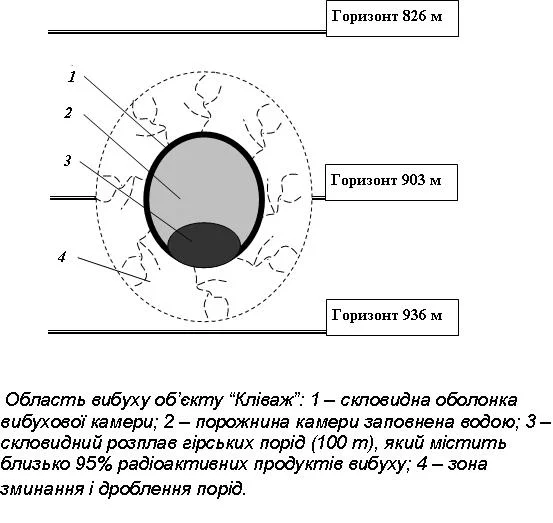
The device was modest by nuclear standards, releasing energy equivalent to roughly 200 to 300 tons of TNT - a fraction of a bomb's yield, but detonated in solid rock far underground. The explosion carved out a cavity some five to six meters across, surrounded by a crush zone of shattered rock reaching twenty to twenty-five meters. By the measure that mattered most to the engineers, it worked: after the blast, the dangerous coal-and-gas outbursts became less frequent. And by another crucial measure, it appeared contained. Radiation levels in the mine workings and in the surrounding underground water were monitored regularly from 1979 through 2000, and they stayed at natural background levels. The rock had swallowed the explosion and, for a time, held it there.
The Water Rises
A sealed underground blast site depends on staying dry, and that is where the story turns anxious. Ukrainian ecologists had long warned that if the Yunkom mine were ever allowed to flood, water could reach the contaminated cavity and carry radioactive material into the groundwater. For years, pumps kept the mine drained and the danger at bay. But the region around Yenakiieve fell under the control of separatist forces after conflict began in the area in 2014, and infrastructure deteriorated. In April 2018, the pumps were removed, and the mine began filling slowly with natural water. The concern that followed was serious: that contamination might spread into the Mius River and onward to the Sea of Azov, threatening supplies of drinking and irrigation water across the region.
A Buried Question
Klivazh sits at the intersection of ambition and consequence. It was a product of an era that believed almost any problem, even the ancient danger of gas in a coal seam, could be solved by sufficient technological force - and for two decades of careful monitoring, that belief seemed vindicated. But nuclear decisions have very long timelines, and the people who authorized the blast in 1979 could not have foreseen who would control the ground above it decades later, or whether anyone would still be tending the pumps. What was meant to protect miners became a slow environmental question mark, its answer depending on water levels deep underground and on the stability of a region in turmoil. The explosion is long over. The waiting is not.
From the Air
The Klivazh site lies at 48.21°N, 38.28°E in Donetsk Oblast, eastern Ukraine, beneath the former Yunkom coal mine near Bunhe and Yenakiieve - a landscape of mine headframes and spoil tips typical of the Donbas coalfield. From 3,000-5,000 feet the industrial mining infrastructure and slag heaps distinguish the terrain. Note that Ukrainian airspace is closed to civil aviation.
Nearby Stories
- Merheleva Ridge 26 km away
- Chalk Flora Nature Reserve 44 km away
- Battle of the Kalka River 83 km away
- Taganrog Aviation Museum 84 km away
- Second Battle of Kharkov 87 km away
- Battle of Dibrivka 91 km away
- Beriev 102 km away
- Alexandrov Kremlin 877 km away