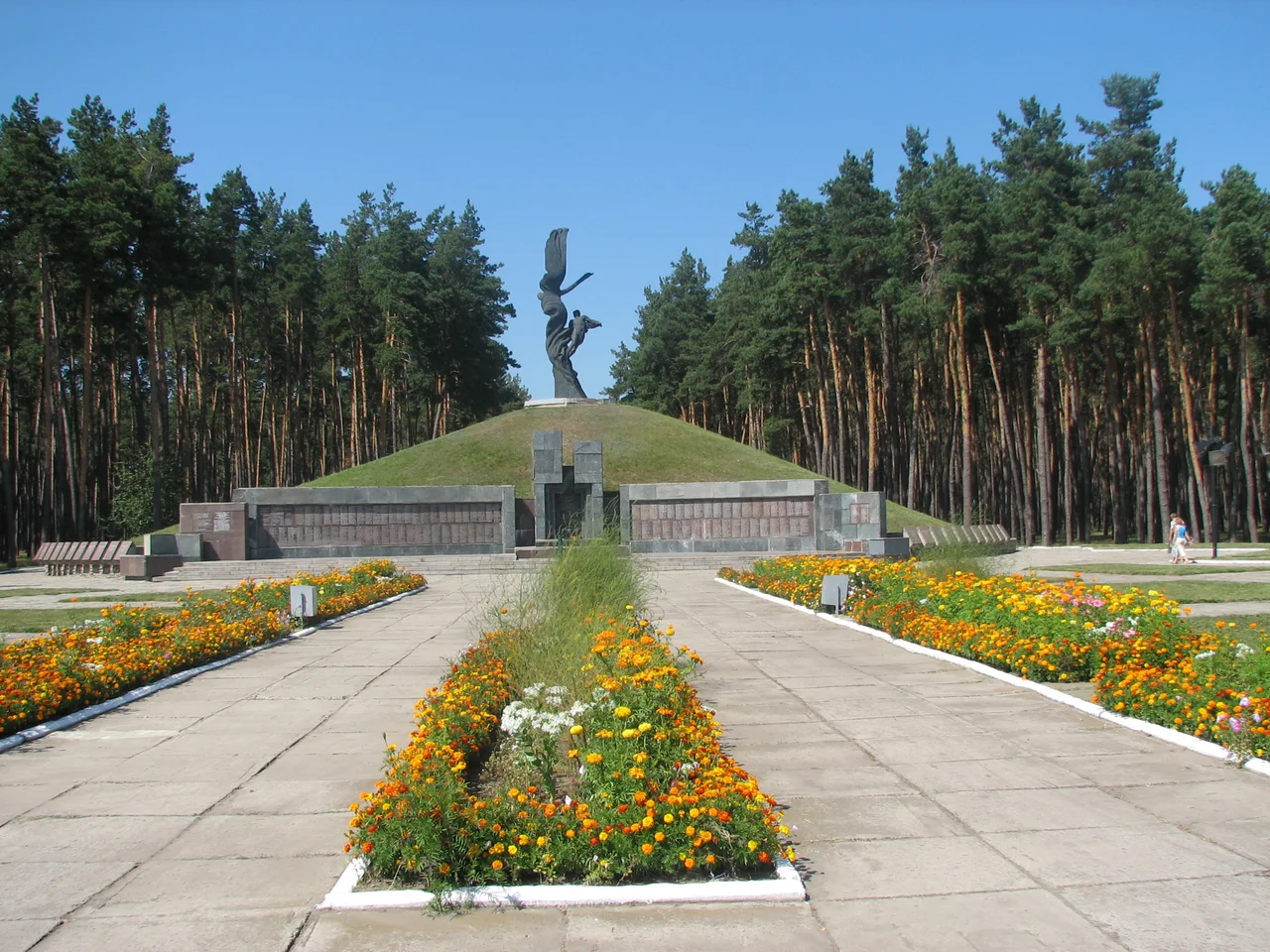

Lebedyn
The town is named for a swan. Lebedyn, in the Ukrainian northeast, is said to take its name from nearby Lebedyn Lake, and the image suits a place with a deep well of song: this modest city on the Sloboda Ukraine frontier produced Borys Hmyria, one of the finest bass voices Ukraine has ever known, whose Boris Godunov and Taras Bulba filled opera houses and whose talent so impressed Dmitri Shostakovich that the composer wrote a solo part with him in mind. Each year Lebedyn honors that native son with a Ukrainian song festival held in the name of its glorious fellow countryman. But the swan's town has also known cruelty, and its history holds a darker echo alongside the music.
A Fortress on the Frontier
Lebedyn began in 1653 as a small wooden fortress, an ostrog thrown up on the southern edge of the Tsardom of Russia in the borderland known as Sloboda Ukraine, where fleeing peasants and Cossacks settled the open country. From those timber walls it grew into a district town. In April 1780 it became the administrative center of the Lebedyn uyezd within the Kharkov Governorate of the Russian Empire, presiding over a broad rural district, and it kept that role for generations. Old churches still mark the town's growth, St Nicholas, the Resurrection, and the Intercession among them, their domes rising over a settlement that spent centuries as a quiet provincial capital between the forest and the steppe.
The Reprisal of 1708
In 1708, Lebedyn became the setting for one of the grimmer episodes of the era. That year the Cossack hetman Ivan Mazepa broke with Peter the Great and allied himself with Sweden in the Great Northern War. The tsar's vengeance fell hard on those suspected of supporting him. At Lebedyn, on Peter's orders, Cossacks who had backed Mazepa were put to death, an act of mass execution meant to terrify the region into obedience. It is a chapter told plainly rather than dwelt upon here, but it deserves to be remembered: these were people caught in the collision of empires and loyalties, and the town's name is bound to their fate. The swan's lake had seen sorrow long before the modern age arrived.
A Town That Sings
For all its hard history, Lebedyn's living identity is bound up with culture, and above all with music. The city keeps a local history museum and a notable art museum, libraries, a children's art school, and a house of youth creativity, but it is the singing that defines it. Amateur folk ensembles carry the old songs forward; the Lebedynska Pisnia vocal group is spoken of as a wellspring of love for folk music, and dance groups like the Sunflower ensemble win admirers far beyond the town. Choirs, dancers, and children's ensembles keep the region's traditions alive, so that in Lebedyn the beauty of Ukrainian folk song is not a museum piece but an everyday inheritance, sung and danced in the present tense.
Under Fire, and After
The twenty-first century brought war to Lebedyn's doorstep. When the Russian invasion swept toward Kyiv through the Sumy region in early 2022, fighting reached the area: on February 27 clashes broke out as Ukrainian defenders held positions on the town's outskirts, and on the morning of March 5 an airstrike hit local infrastructure, damaging civilian homes, cars, and fuel stations. By early April, Russian forces had withdrawn from the Sumy region and Lebedyn's communications were restored. The town that had risen as a frontier fortress and endured a tsar's reprisal found itself, three and a half centuries on, once more on a contested edge, its people enduring as they long have, and its songs, one imagines, carrying them through.
From the Air
Lebedyn lies at about 50.58°N, 34.48°E in Sumy Oblast, in Ukraine's northeast, near Lebedyn Lake with an air base and a railway station nearby. From 3,000 to 6,000 feet the town's church domes, the lake to the north, and the surrounding forest-steppe mosaic are the key landmarks. Sumy Airport (UKHS) lies to the north-east, with Poltava International Airport (UKHP) to the south-west.
Nearby Stories
- Sumy 17 km away
- Treaty of Hadiach 20 km away
- Bilsk Hillfort 20 km away
- Krasnokutskyi Arboretum 21 km away
- Velyki Sorochyntsi 30 km away
- Hryhorii Skovoroda Literary Memorial Museum 61 km away
- Konotop 79 km away
- Central Black Earth Nature Reserve 90 km away