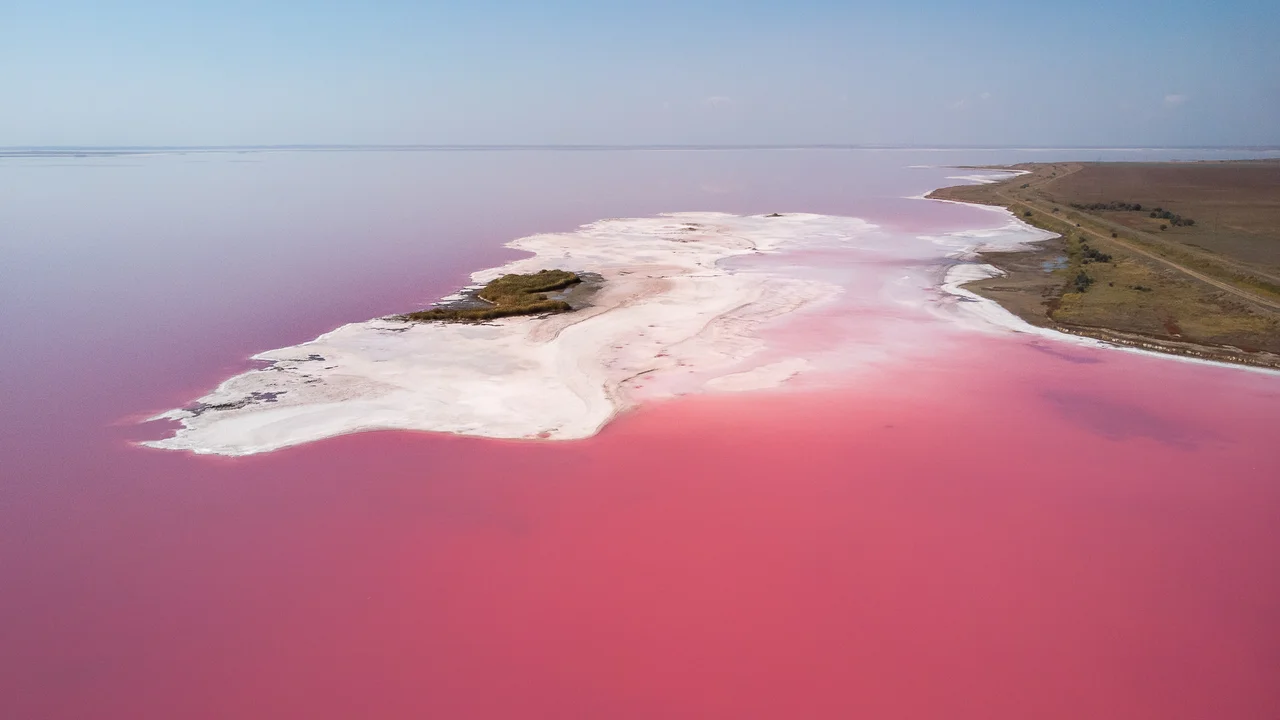

Lake Lemuria
The locals called it Yama, the Pit, and they swam in it for fun. Nobody expected the water to turn the color of watermelon flesh, or the shore to crust white with salt crystals that grow like tiny stalagmites, or the muddy bottom to end up prescribed by German health insurers. Yet that is the strange arc of Lake Lemuria, a small pink lake in the Kherson region of Ukraine, tucked into the western edge of the Syvash. It began as an excavation and became a destination named for a continent that never existed.
Why the Water Turns Pink
The color comes from something almost too small to imagine: a single-celled alga called Dunaliella salina, which floods itself with beta-carotene to shield against the relentless ultraviolet light. That pigment, the same orange-red compound that colors carrots, tints the whole reservoir. The hotter the summer, the more water evaporates and the more concentrated the brine becomes, deepening the pink toward crimson. This is no ordinary water. Salinity here reaches 270 to 300 grams of salt per liter, several times saltier than the ocean, dense enough that a swimmer bobs on the surface like a cork. As the shoreline retreats in the heat, it leaves behind heavy drifts of salt crystals, and in places those crystals pile upward into strange little formations. White shore, pink water: the effect gives this corner of Kherson an appearance unlike anywhere else in the country.
From the Pit to a Lost Continent
The lake was not shaped by geology so much as by digging. An excavation was cut into the ground, and over time underground water seeped in and filled it, leaving a salt-laden pool the surrounding villagers simply called Yama. Word spread that the briny water and mud could heal, and a small current of green tourism began to trickle toward this once-anonymous hollow. The romantic name arrived later, and from an unlikely direction. Admirers of Helena Blavatsky, the 19th-century founder of Theosophy whose esoteric writings described a vanished continent called Lemuria, attached that legend's name to the lake. So a Ukrainian salt pit acquired the branding of a mythical drowned landmass, and the change was more than cosmetic: as the story caught on, property values in the surrounding communities reportedly climbed sixfold in half a year.
Mud Worth Prescribing
Beneath the pink water lies the real draw for many visitors: the mud. In 2005 it was formally certified and approved for use as a therapeutic and cosmetic product, joining a long regional tradition of treating the salt lakes of the Black Sea and Azov coasts as open-air spas. Its reputation now reaches well beyond Ukraine. The lake's mud has been included in the program of insurance medicine in Germany, meaning a substance dredged from a former excavation on the Syvash is considered legitimate treatment thousands of kilometers away. Bathers coat themselves in the dark silt, let it dry under the sun, then wade back into the buoyant brine to rinse. It is a humble ritual for a place that carries the name of a lost world, and a reminder that the most memorable landscapes are not always the grandest, only the most unexpected.
From the Air
Lake Lemuria sits at 46.24°N, 33.74°E on the western Syvash in Kherson region. From 3,000-5,000 feet it is a standout navigation mark: a small, vivid pink pool ringed by salt-whitened ground, set against the vast pale mudflats and lagoons of the Syvash. The nearest airport is Kherson (UKOH) to the northwest, with Simferopol (UKFF) further south across the isthmus.
Nearby Stories
- Dzharylhach National Nature Park 9.7 km away
- Swan Islands Nature Reserve 20 km away
- Skadovsk 25 km away
- Syvash 32 km away
- Arabat Spit 80 km away
- Pontic Olbia 89 km away
- Mykolaiv Regional Museum of Local History 127 km away
- Khortytsia 157 km away