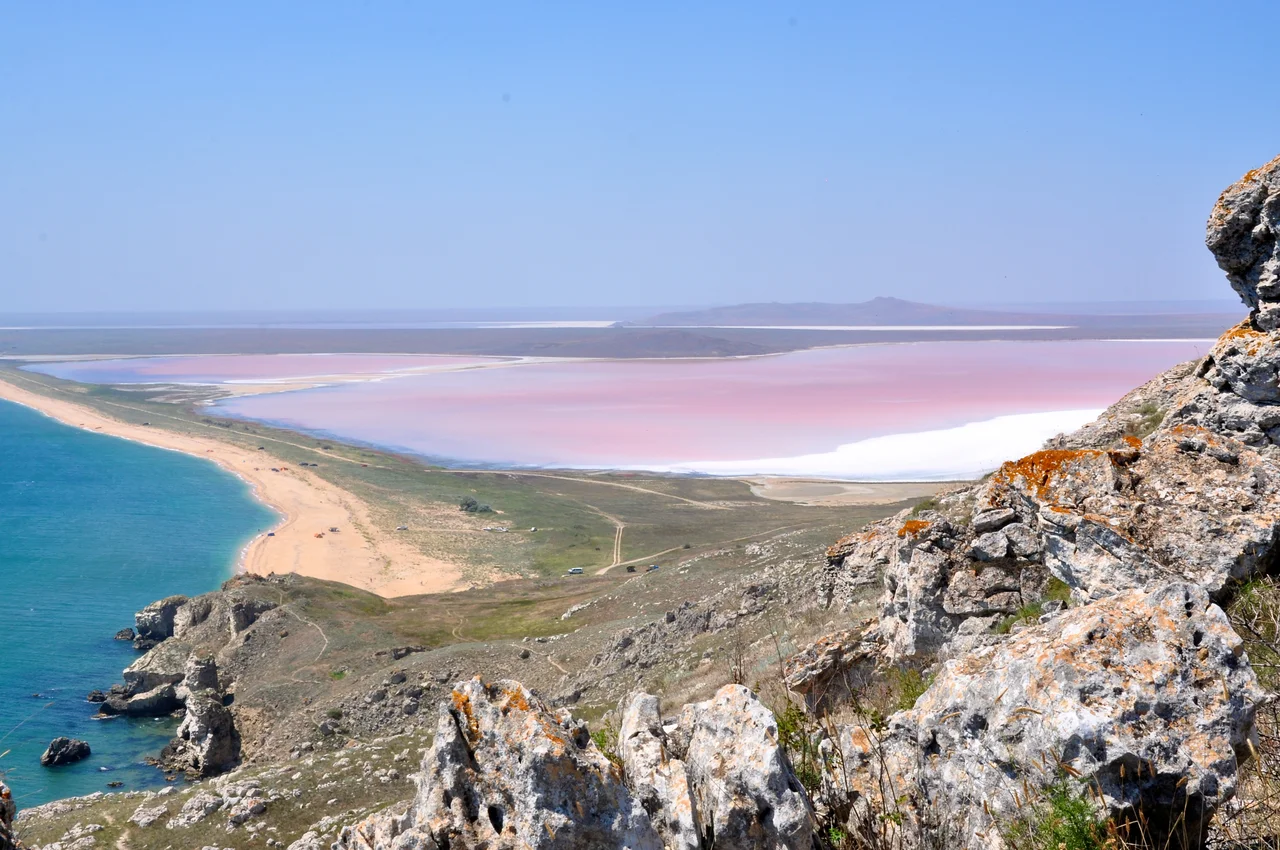

Koyashskoye Salt Lake
From the air, the shoreline of southern Crimea looks like a painter tested two colors side by side and could not choose. On one side lies the deep blue of the Black Sea. On the other, separated by nothing more than a thin strip of land, glows a lake of improbable pink, deepening to scarlet as the sun shifts. This is Koyashskoye, and its color is alive: countless microscopic algae tint the shallow, salty water, so that the whole lake blushes and reddens depending on the light and the season. It is barely a meter deep and only four kilometers long, yet it is one of the most quietly astonishing sights on the peninsula.
A Lake the Color of Salt and Sun
The pink comes from life adapted to an extreme home. Few organisms can survive in water this salty, but the microalgae that thrive here paint it in warm tones that intensify as summer wears on and the water grows saltier still. The color is never quite fixed. On an overcast morning the lake may lie a soft rose; by a hot afternoon it can deepen toward blood-red, then shift again as the sun sinks. It is a body of water that behaves almost like a mood ring for the sky, responding to light and heat and season in a way that no ordinary lake ever does. The lake stretches about four kilometers long and two wide, so shallow that in places it seems more like a colored mirror laid across the land than a body of water. Its neighbor, Uzunlarske Lake, lies directly to the west, part of a chain of coastal salt lakes strung along this stretch of shore. The strip of land separating Koyashskoye from the open sea is all that keeps the two worlds, one blue and briny, one pink and hypersaline, from becoming one.
When the Water Disappears
The lake's most surprising gift arrives as it dries. As the shallow water evaporates under the Crimean sun, dissolved salt crystallizes on the stones and along the shore, encrusting them in glittering white. Locals describe these as crystal stones, and stranger still, the crystallizing salt is said to carry a faint scent of viola, the delicate perfume of violets rising from a bed of salt. It is the kind of sensory detail that sounds invented until you stand at the edge and breathe it in. The lake performs this slow transformation every summer, blooming with color and then rimming itself in crystal as the season deepens.
The Healing Lake Few Ever Find
For all its beauty, Koyashskoye is not a place of crowds. It is appreciated mostly by locals, who consider its waters and salt-rich mud to have healing properties, part of a long regional tradition of treating salt lakes as places of restoration. It remains largely unknown to tourists, tucked away on the southern coast of the Kerch Peninsula where few travelers venture. That obscurity is part of its magic. In an age when the world's most photogenic places are rarely quiet, here is a lake that turns the color of a sunset and smells of violets, and still, most days, keeps its wonders to itself.
A Landscape Built on Salt
Koyashskoye does not stand alone. It belongs to a whole family of salt lakes strung along the coast and interior of the Kerch Peninsula, shallow basins where the sun does the slow, patient work of turning seawater into mineral. Its immediate neighbor, Uzunlarske, is larger; others lie scattered across the steppe like a broken necklace of brine. Nearby rises the flat-topped mass of Opuk mountain, and the surrounding land forms part of a protected reserve, so that the pink lake shares its horizon with cliffs, offshore islets, and some of the peninsula's rarest wildlife. This is a corner of Crimea shaped fundamentally by salt, by the meeting of a warm dry climate and a coastline of enclosed lagoons. Koyashskoye is its most vivid expression, the moment where that quiet chemistry blooms suddenly, improbably, into color.
From the Air
Koyashskoye Salt Lake lies at 45.05°N, 36.19°E, on the southern coast of the Kerch Peninsula, hard against the Black Sea. From 3,000 feet the vivid pink lake beside the blue sea is unmistakable, with the larger Uzunlarske Lake just west and the flat-topped mass of Opuk Mountain rising nearby. Nearest major airfield is Simferopol (UKFF), roughly 175 km to the west.
Nearby Stories
- Porthmion 4.6 km away
- Feodosiya 11 km away
- Taman 19 km away
- Crimean Nuclear Power Station 19 km away
- Soviet Destroyer Smyshlyony 19 km away
- Aeroflot Flight 6515 28 km away
- Valley of Ghosts 87 km away
- 1976 Anapa Mid-Air Collision 105 km away