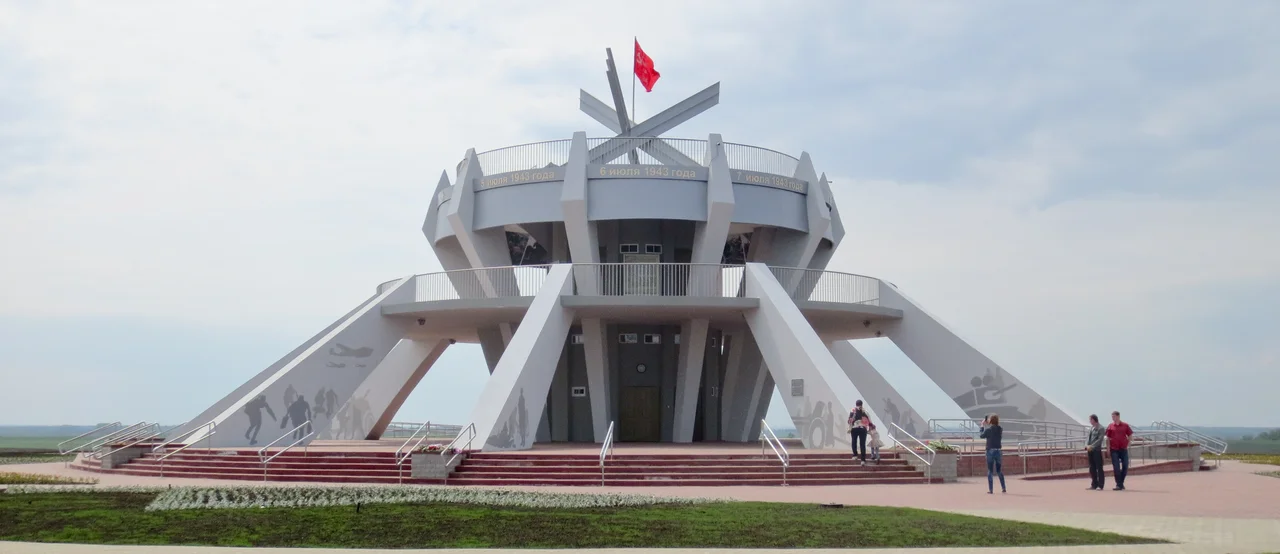
.JPG)
Battle of Kursk
By the summer of 1943, the map told the story. A vast bulge, the Kursk salient, jutted 250 kilometers into the German lines, and both sides knew it was where the year would be decided. The Germans meant to pinch it off; the Soviets, warned months in advance by their intelligence, chose to let the blow fall and break it. What followed near this quiet city in southwestern Russia became the single largest battle in the history of warfare and the largest tank battle ever fought. Its opening day, 5 July, saw more aircraft shot from the sky than any day of aerial combat before or since. When it ended, the last great German offensive in the East had failed, and the initiative would never return.
The Trap Prepared
The German plan was called Operation Citadel: two pincers, one from the north and one from the south, closing behind the Soviet armies inside the salient. Hitler hoped a victory here would restore German prestige and reassure wavering allies. But the Soviets knew it was coming, forewarned by the Lucy spy ring, and they did something patient and deliberate. Rather than strike first, they dug in. Over three months, more than three hundred thousand civilians labored alongside soldiers to build defense in depth, belt after belt of minefields, anti-tank ditches, entrenchments, and gun positions reaching back nearly 300 kilometers. Red Army engineers laid over half a million mines. Where the German armor came, it would have to grind through a fortified landscape designed for one purpose: to wear the spearhead down.
Five of July
The Germans committed the finest of their army, some 777,000 men and more than 2,400 tanks and assault guns, the bulk of their entire armored strength in the East, and pinned their hopes on new weapons: the heavy Tiger, the untried Panther, the massive Ferdinand tank destroyer. When the offensive opened on 5 July, it ran straight into the teeth of the Soviet defenses. In the north, German infantry and armor bled themselves against fortified villages like Ponyri and the high ground at Olkhovatka, fighting so fierce and close that soldiers called Ponyri a mini-Stalingrad. The new Panthers broke down or bogged in minefields; Ferdinands, lacking machine guns, were swarmed by Soviet infantry once separated from their escorts. Advances measured in a kilometer or two came at staggering cost, and within days the northern thrust had ground to a halt.
The Fields of Prokhorovka
The southern pincer, under Manstein, cut deeper. His panzers clawed through belt after belt toward the rail town of Prokhorovka, and on 12 July the fighting there swelled into one of the largest armored clashes ever seen, as the Soviet 5th Guards Tank Army hurled itself against the II SS Panzer Corps in a swirling, close-range melee across the summer fields. Neither side achieved what it sought. The Soviet counterattack was thrown back with heavy losses, but it did what mattered most: it stopped the German breakthrough cold. Behind the clash of steel were young crews in furnace-hot tanks, and behind them the sanitary instructors and stretcher-bearers, among them a woman named Anna Sokolova photographed bandaging a wounded soldier as mortars fired nearby, the human cost written on the ground.
The Last Gasp
On the evening of 12 July, with the Western Allies now landing in Sicily, Hitler summoned his commanders and moved to shut the offensive down, needing forces for Italy. Citadel was over, and it had failed to break through Soviet defenses for the first time in the war. The Red Army had already seized the moment, launching its own counter-offensives, Operation Kutuzov in the north and, in August, the Belgorod-Kharkov drive in the south. Germany's losses in men and machines were beyond replacing, and from Kursk onward the Soviets held the strategic initiative for the rest of the war. Historians have called the battle the last gasp of Nazi aggression in the East. It was won not by a single stroke but by depth, endurance, and the willingness of an army to stand and absorb the worst before striking back.
From the Air
The battle raged across the Kursk salient centered on the city of Kursk at about 51.74 degrees N, 36.19 degrees E, in the open black-earth country of southwestern Russia. From altitude the terrain is gently rolling farmland and scattered woods, the kind of open ground that made it tank country; the village of Prokhorovka lies to the south. The nearest regional airport serves Kursk (ICAO: UUOK).
Nearby Stories
- Maryino Estate 44 km away
- Central Black Earth Nature Reserve 62 km away
- Sumy 83 km away
- Verkhnii Saltiv Museum-Reserve 153 km away
- Chuhuiv 215 km away
- Battle of Lesnaya 352 km away
- Grace Darling 357 km away
- Katyn Commission 415 km away