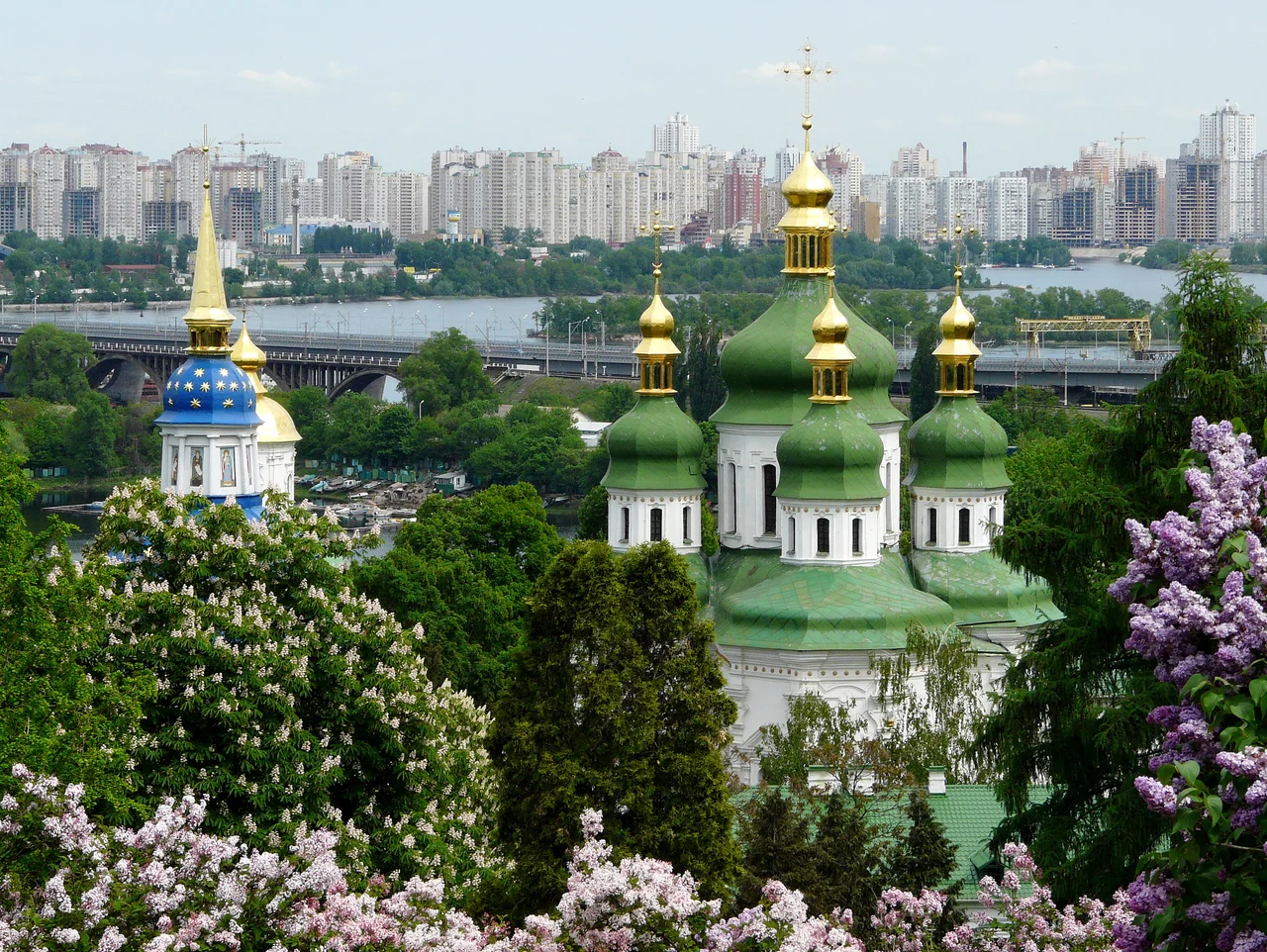

Vydubychi Monastery
According to legend, the people ran along the riverbank weeping. Their prince, Volodymyr the Great, had just converted his realm to Christianity, and as part of the mass baptism he ordered the wooden idols of the old gods thrown into the Dnipro. Chief among them was Perun, the thunder god. The newly baptized Kyivans accepted their new faith, yet they could not bear to watch the old one drown, and they chased the floating idol downstream, crying out for it to swim up and come back to them. The place where the god is said to have surfaced took the name Vydubychi, meaning to emerge from the water. On that spot, within a few generations, rose one of Kyiv's oldest monasteries.
A Prince's Cloister
The Vydubychi Monastery was founded between 1070 and 1077 by Vsevolod, a son of Yaroslav the Wise, in the great flowering of Kyivan Rus' when Kyiv was one of the largest cities in Europe. It became a family cloister of Vsevolod's line, including his son Vladimir Monomakh and his descendants, a private spiritual seat for the ruling dynasty. Perched above the Dnipro, the monastery ran the ferry across the river and drew some of the finest minds of the age. The chroniclers Sylvestr and Moisey worked within its walls, contributing to the Tale of Bygone Years, the founding chronicle of the East Slavs that recorded how this land became Christian. To sit at Vydubychi was to sit near the very sources of a civilization's memory.
Guarded by Hetmans
Through the centuries the monastery passed through turbulent hands. After the Union of Brest in 1596 it briefly served as the seat of the first three Greek Catholic metropolitans of Ukraine, before returning to the Orthodox Church in 1635. Its survival owed much to the Cossack hetmans who protected it. In 1695 Ivan Mazepa forbade the monastery's neighbors to do it any injustice and placed it under armed guard, and his ally Colonel Mykhailo Myklashevskyi funded the five-domed St. George Cathedral and the Transfiguration refectory, rising jewels of Ukrainian Baroque built between 1696 and 1701. Hetman Danylo Apostol paid for the bell tower, raised in the 1720s and 30s. These leaders understood that stone and faith outlast armies, and they poured their wealth into a place they wanted to endure.
The Sleeping and the Slipping Hill
Only a few of the monastery's churches have survived the centuries, and the ground itself has been part of the danger, since the slopes above the Dnipro are prone to sliding and have carried away buildings over time. Yet what remains is remarkable: the ancient Collegiate Church of Saint Michael, first built at Vsevolod's command, alongside the graceful Baroque cathedral and refectory. The monastery's necropolis holds an unlikely gathering of the notable dead. Here lies Vladimir Betz, the anatomist who discovered the giant neurons of the brain that now bear his name; Konstantin Ushinsky, the pedagogue who championed teaching in Ukrainian when the empire had banned it; and Bohdan Khanenko, the great art collector whose treasures became a Kyiv museum. Scholars, healers, and patrons rest together above the river.
Drawn by the Poet
The monastery has long stirred artists as much as pilgrims. In 1844 the poet Taras Shevchenko, himself trained as a painter, made a drawing of Vydubychi that now hangs in the National Art Museum of Ukraine, and his contemporary Mykhailo Sazhyn sketched it too. Under Soviet rule the cloister survived in an unexpected guise, housing the Institute of Archaeology, so that scholars of the deep past worked within walls nearly a thousand years old. Today the monastery belongs to the Orthodox Church of Ukraine, its choir renowned, its Baroque domes catching the light above the Dnipro. Stand on the riverbank below, where legend says the people once chased their drowning god, and the water slides past exactly as it did when Perun went under and Kyiv changed forever.
From the Air
Vydubychi Monastery sits at 50.4167 N, 30.5681 E on the wooded right bank of the Dnipro in Kyiv's Pecherskyi District, just south of the Botanical Garden. From 1,500 to 2,500 feet AGL, look for the cluster of Baroque domes and the tall bell tower on the green riverside slope, downstream of the Lavra and Mother Ukraine. Nearest airports are Kyiv Zhuliany (UKKK) about 9 km west and Boryspil International (UKBB) roughly 30 km east.
Nearby Stories
- Boryspil 1.5 km away
- Zalissia National Nature Park 31 km away
- Trakhtemyriv 32 km away
- Bila Tserkva 40 km away
- Malyn 46 km away
- Radomysl Castle 49 km away
- Nizhyn 81 km away
- Berdychiv 95 km away