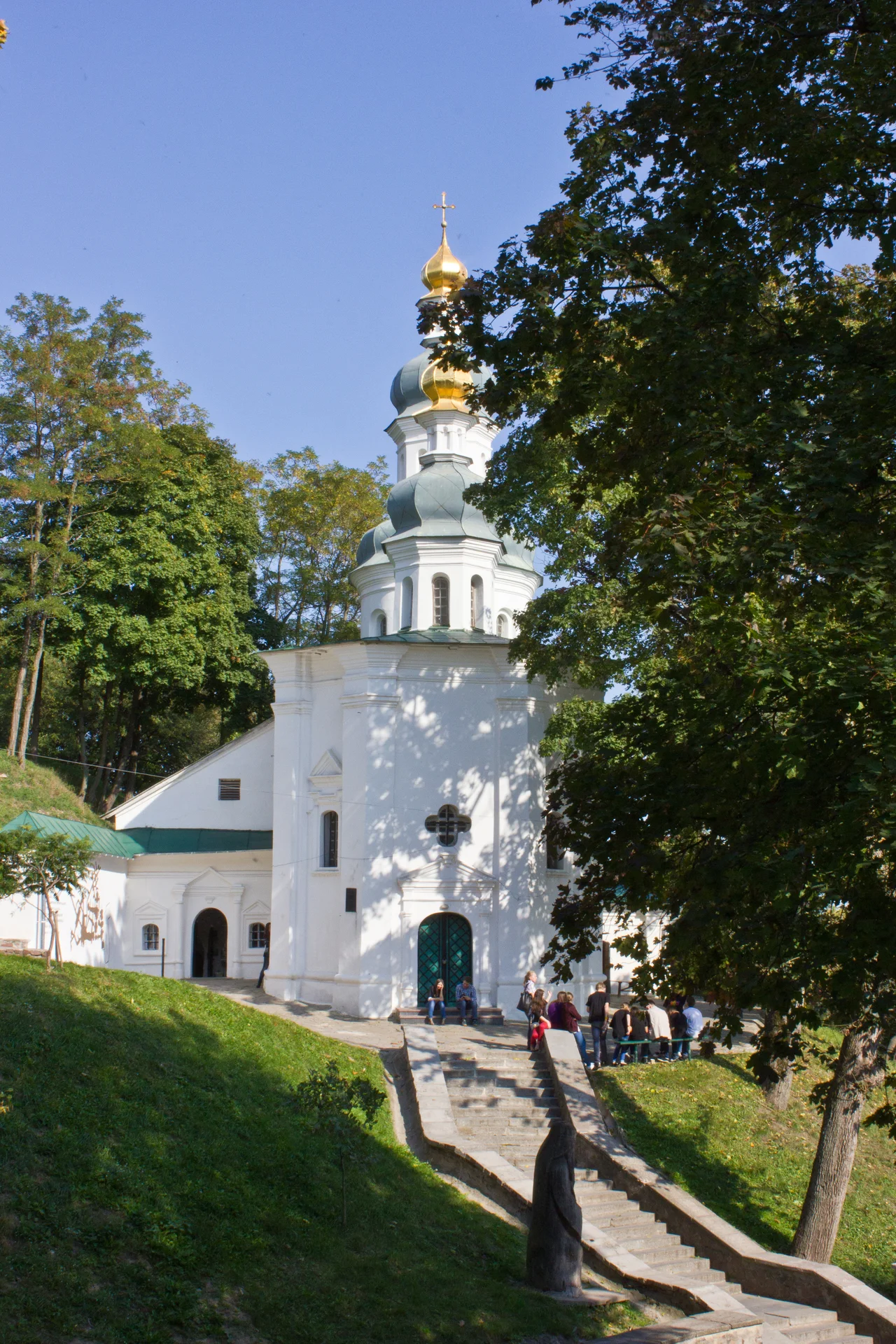

St. Elijah Church, Chernihiv
It is easy to walk past. Small, low, tucked against the slope of the Boldyni Hory at the mouth of the Saint Anthony Caves, the St. Elijah Church does not tower or dazzle. Yet this modest brick chapel is a genuine survivor. Raised in the twelfth century, it is the only single-nave church from the era of Kievan Rus' still standing anywhere in Ukraine, the last of its kind, weathered through eight centuries of invasion, decline, and rebuilding to reach the present day.
A Small Church With a First
When it was built in the 1100s, the St. Elijah Church was tiny and unusual, a rare three-part design for the Dnieper region, with a rectangular nave, an inner chamber, and a semicircular apse, and a small porch on the west. It began humbly, serving as a baptismal chapel beside the southern entrance to the caves the monk Anthony had dug into the hill. Together they founded the St. Elijah Monastery. What looks like a modest building was in fact an origin point: architects credit it with launching the three-part form that Ukrainian brick churches would develop across the following centuries. In a single small structure, a whole tradition begins.
Wounded and Rebuilt
The church's long life has not been peaceful. In the thirteenth century, during the Mongol invasion of the Rus' lands, it suffered serious damage, and it fell into a long decline after 1239. Only in the sixteenth century was it restored and enlarged, its walls crowned with a cornice and small domes raised over the apse and the women's chapel. When the cave monastery was revived in the mid-seventeenth century, the church was rebuilt again, this time in the flowing Ukrainian Baroque style that gives it its present look. In 1649 the Chernihiv colonel Stefan Podobail paid to remake the western end into a tall, faceted, multi-tiered form. Each age that touched the little church left its own signature, so that its walls now read as a layered record of the region's turbulent past.
The Icon and the Legend
Inside, most of the ancient decoration is gone. The old frescoes and the glazed ceramic floor have not survived the centuries. What remains is precious: a carved iconostasis from 1774 in the graceful Rococo style, interpreting the classical Corinthian order. And the church was long home to one of the treasures of Ukrainian painting, the icon known as the Illinska Theotokos, created in 1658 by the painter Hryhorii Dubensky. A miracle legend attached itself to the image, recorded in the old chronicle of Samiilo Velychko, and the monastery's associated Ilyinska icon of the Mother of God became famous across the region for its reported wonders. For centuries pilgrims climbed the hill to stand before it, drawn by faith to this small, ancient room.
The Last of Its Kind
Since 1967 the St. Elijah Church has been part of the National Architectural and Historical Reserve of Ancient Chernihiv, preserved and studied as a museum, and a careful restoration between 1969 and 1982 secured the fragile monument. A three-tiered bell tower, stone below and timber above, had been added just before that, in 1908 to 1910, and still crowns the ensemble with its Baroque cap. The church's rarity is its glory: of all the churches raised in Ukraine during the age of Kievan Rus', this is the sole surviving single-nave example, a direct architectural link to the eleventh and twelfth centuries. In 2025 its doors opened to visitors for the first time in five years, and once again people could step inside a building that has been standing, quietly, for the better part of a millennium.
From the Air
The St. Elijah Church stands at 51.48 N, 31.28 E on the slope of the Boldyni Hory in Chernihiv, just below the Trinity Monastery near the Desna River. View from 4,000 to 6,000 feet in clear weather; the church's small dome and its taller bell tower, set against the wooded ridge, mark the spot. Nearest airport is Chernihiv Shestovytsia (UKRR); Kyiv Boryspil (UKBB) lies to the southwest.
Nearby Stories
- Nizhyn 20 km away
- Principality of Chernigov 27 km away
- Oster 28 km away
- Battle of Listven 28 km away
- Battle of Chornobyl 30 km away
- Mezhyhirya Residence 60 km away
- Mezine 100 km away
- Mogilev Ghetto 210 km away