.JPG)
Phanagoria
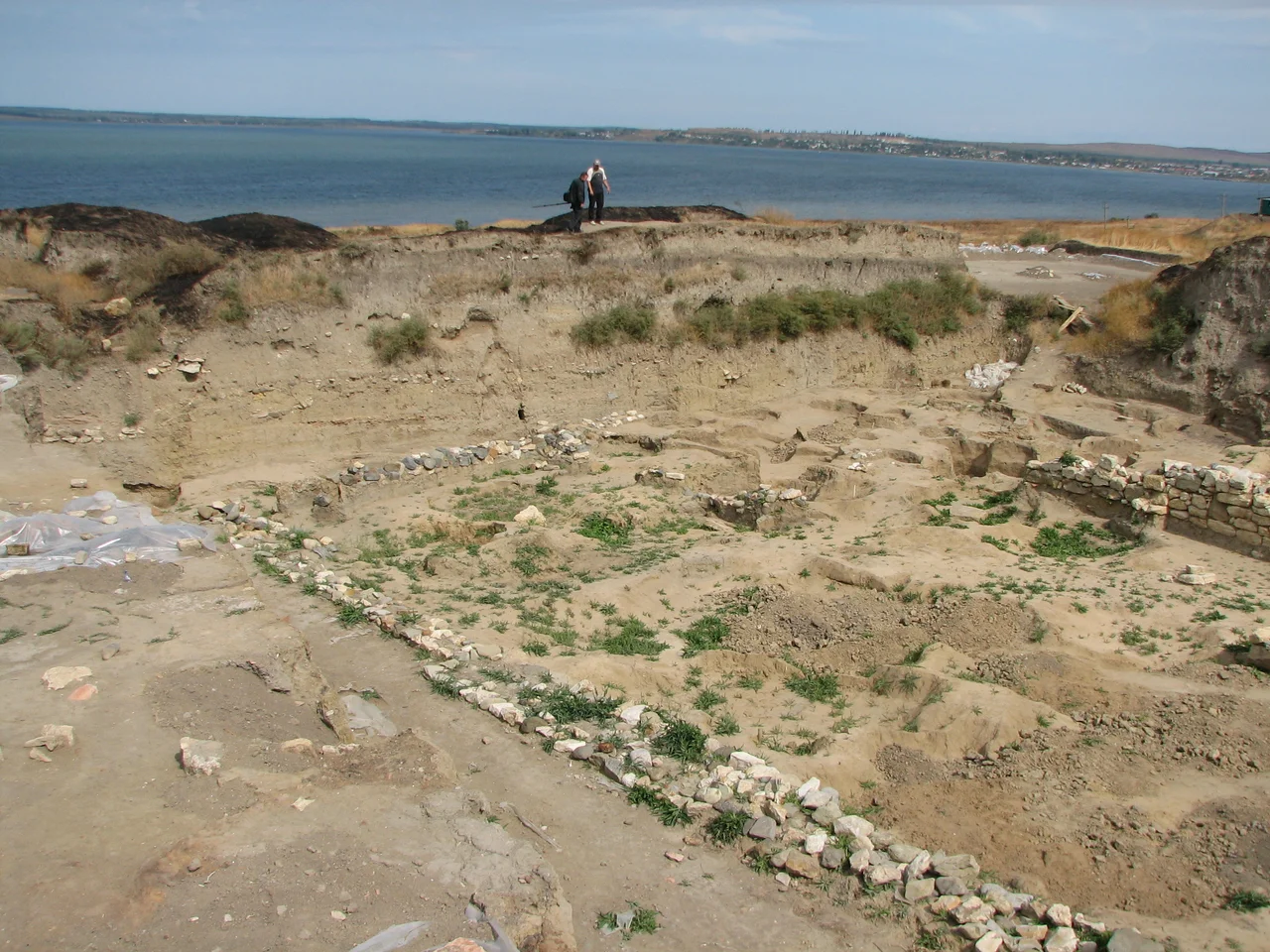
Phanagoria was born of flight. Around 543 BCE, Greek colonists from the city of Teos in Asia Minor fled their homeland rather than submit to the Persian king Cyrus the Great, and sailed north to the far edge of the Greek world. On a low island in a vanished archipelago between the Black Sea and the marshy Sea of Azov, they founded a new city and named it for one of their own, a man called Phanagoras. It became the largest ancient Greek city on the Taman Peninsula, spread across two plateaus, and the historian Yulia Ustinova has noted that its strange landscape of ravines, hills, and the low cones of active mud volcanoes must have astonished the colonists even more than it astonishes visitors today.
The Eastern Capital
Phanagoria grew into a great emporium, a clearinghouse for all the traffic moving between the steppe marshes and the lands south of the Caucasus. As the Bosporan Kingdom rose to dominate the strait, the city became its eastern capital, the counterpart to Panticapaeum across the water, and Strabo praised it as a place renowned for trade. Its wealth is written in its graveyards. A vast necropolis wraps around the old city on three sides, holding thousands of burials, many in cypress or marble sarcophagi, and one royal mound descends by a stone stairway into a painted burial chamber where four horses were entombed with harnesses of gold. The site was first identified in the eighteenth century when marble bases dedicated to Aphrodite surfaced, hinting at the great sanctuary of the goddess that Strabo called the largest in the whole Pontic region.
Where an Emperor Hid and a King Fell
History's tides washed remarkable figures onto these shores. During the Mithridatic Wars, Phanagoria threw in its lot with Rome and withstood a siege by the army of Pharnaces II, and it was here that the great revolt against Mithridates VI of Pontus first erupted, forcing the doomed king's own sons to surrender the citadel. Centuries later, in 704 CE, the deposed Byzantine emperor Justinian II took refuge in the city, then under a Khazar governor, and married Theodora, the sister of the Khazar khagan, before clawing his way back to the throne in Constantinople. The archaeology keeps pace with the drama: in 2009 excavators uncovered what they identified as the palace of Mithridates himself, the physical seat of one of Rome's most formidable enemies rising out of the Taman soil.
A Synagogue Beneath the Steppe
The deepest surprise came recently. In 2023, archaeologists announced the discovery at Phanagoria of what may be one of the oldest synagogues ever found anywhere outside Israel, built around the beginning of the first century BCE and standing for more than five hundred years. Among the remains lay menorahs, altars, and fragments of marble stele, and further digging revealed an entire Jewish quarter woven into the city, threaded by major streets and ringed by homes, a vineyard, a garden, and a water network. It was no isolated outpost but a rooted community, one thread in the astonishing weave of peoples, Greeks, Sarmatians, Anatolians, and Jews, who shared this crossroads. Around a third of ancient Phanagoria now lies drowned beneath the sea, so divers and archaeologists press on together, still lifting the layered past from land and water alike.
From the Air
Phanagoria lies at 45.28°N, 36.97°E on the Taman Peninsula, just west of the village of Sennoy on the shore of the Sea of Azov. From the air, orient on the broad shallow waters of the Sea of Azov and Taman Bay and the marshy, mud-volcano-dotted peninsula; roughly a third of the site is submerged. Nearest airports are Anapa-Vityazevo (URKA) and Krasnodar (URKK) to the east.
Nearby Stories
- Tuzla Island 1.1 km away
- Battle of Kerch Strait (1790) 13 km away
- Soviet Cruiser Mikhail Kutuzov 34 km away
- Novorossiysk 62 km away
- Koktebel 104 km away
- Arabat Spit 123 km away
- Byriuchyi Island 168 km away
- Beriev 208 km away