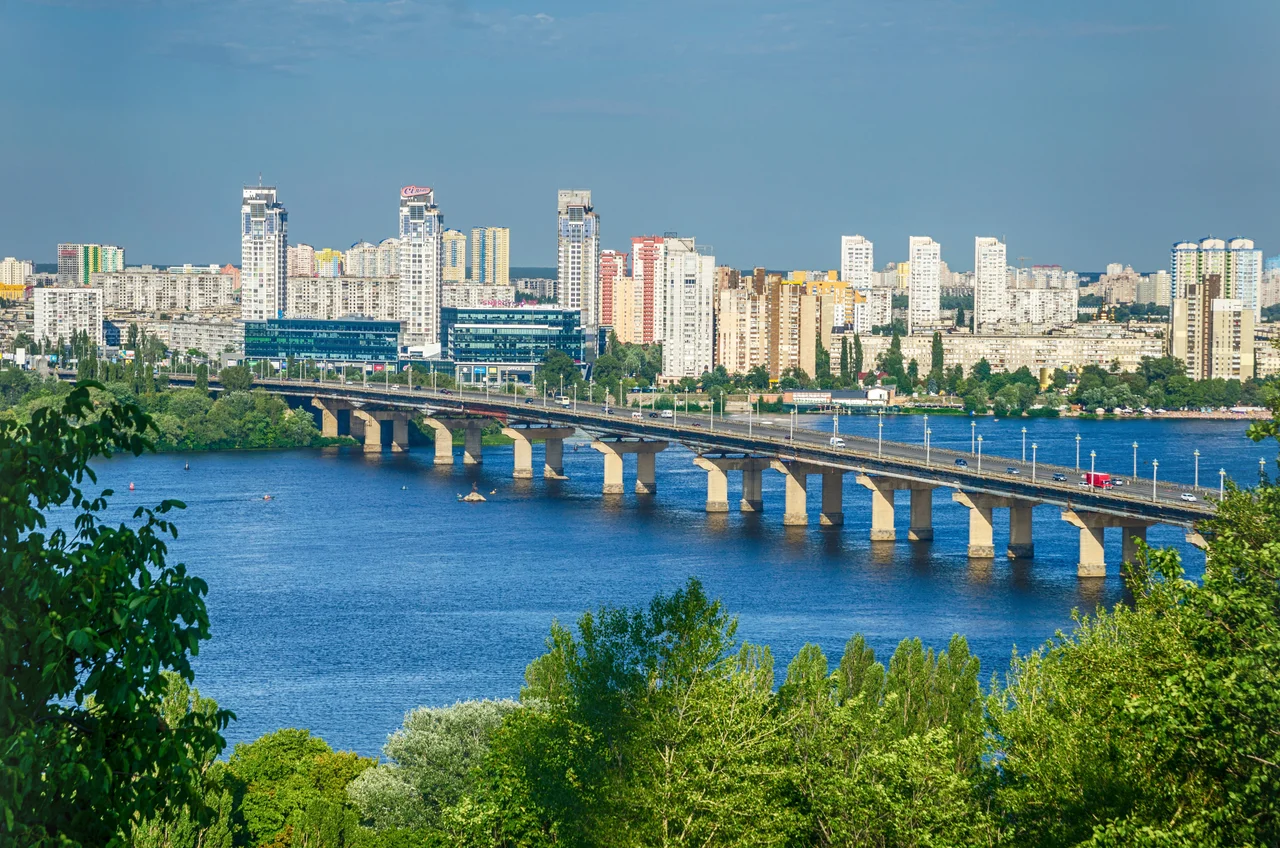

Paton Bridge
The engineer did not live to cross his own bridge. Evgeny Paton had spent his final years arguing for a heretical idea, that a great steel bridge could be held together not by hundreds of thousands of rivets but by welded seams alone, a technique his fellow engineers thought reckless for something so large. He won the argument, saw the work through two wars and a decade of setbacks, and then died on the twelfth of August 1953. Twelve weeks later, on the fifth of November, traffic first rolled across the 1,543-meter span over the Dnipro that would forever bear his name. It remains the longest bridge in Kyiv, and one of the first all-welded bridges the world ever built.
The Idea No One Believed
In the 1930s, welding an entire road bridge was close to unthinkable. The first such structure, Poland's Maurzyce Bridge, had opened only in 1928, and barely a couple dozen welded bridges existed anywhere before the Second World War. Paton, who had founded an electric welding institute in Kyiv in 1934, was certain that welding would make a bridge stronger and more reliable than the old riveted method. His colleagues were not convinced, and at first his idea found no support at all. What finally cleared the way was politics as much as engineering: Nikita Khrushchev, then head of the Ukrainian Communist Party, gave the go-ahead and personally oversaw the project. Construction of the first span began in early June 1941, a radical experiment in steel set against the calendar of catastrophe.
Built Twice
Within weeks, war swept it all away. The German invasion halted construction almost as soon as it began, and Kyiv fell under occupation. When the Red Army retook the city on the sixth of November 1943, they found that the retreating German forces had blown up every existing piece of the unfinished bridge. Paton and his teams had to start again, practically from nothing. Over the next decade they assembled the span from 264 identical steel blocks, each twenty-nine meters long, joined by welded seams that ran to a total of 10,668 meters, more than ten kilometers of weld. The whole structure weighs over ten thousand tonnes. It was completed deliberately in time for the tenth anniversary of Kyiv's liberation, a monument to endurance as much as to engineering.
Stronger Than They Knew
The bridge kept surprising the people who built it. Designed to carry ten thousand vehicles a day, it was put to a strength test in 1976 that suggested it could bear seven times that, as many as seventy thousand. Streetcar tracks laid across it let Kyivans ride the tram between the city's right and left banks, easing the pressure on crowded buses. In 1968 it gained guardrails separating pedestrians from cars, an arrangement not previously used anywhere in the Soviet Union. And in 1995 the American Welding Society honored it as the most unique all-welded structure in the world, a global salute to the risky idea a Kyiv engineer had championed against the doubts of his own profession.
The Working River-Crosser
Time has worn the bridge as time wears everything. The streetcar tracks came out in 2004 to make room for more traffic lanes, and a reversible center lane, meant to ease the choking rush-hour jams, brought a grim side effect in the form of head-on collisions. Engineers have long called for a deeper overhaul of its spans, seams, and foundations to meet modern standards. Yet the bridge still does its daily work, part of Kyiv's Small Ring Road, carrying the ordinary river of a city's commuters across the same wide water it has spanned since 1953. Most who cross it never think of Evgeny Paton, but every one of them trusts, without knowing it, the welded seams he insisted would hold.
From the Air
The Paton Bridge crosses the Dnipro at 50.4243 N, 30.5719 E in Kyiv, linking the right and left banks near Venetsiansky Island. From 1,500 to 2,500 feet AGL, it reads as a long, low steel span across the broad river, downstream of the city's central hills and the copper Monument to the Founders of Kyiv. Nearest airports are Kyiv Zhuliany (UKKK) about 9 km southwest and Boryspil International (UKBB) roughly 28 km east.
Nearby Stories
- Boryspil 1.5 km away
- Zalissia National Nature Park 31 km away
- Trakhtemyriv 32 km away
- Bila Tserkva 40 km away
- Malyn 46 km away
- Radomysl Castle 49 km away
- Nizhyn 81 km away
- Berdychiv 95 km away