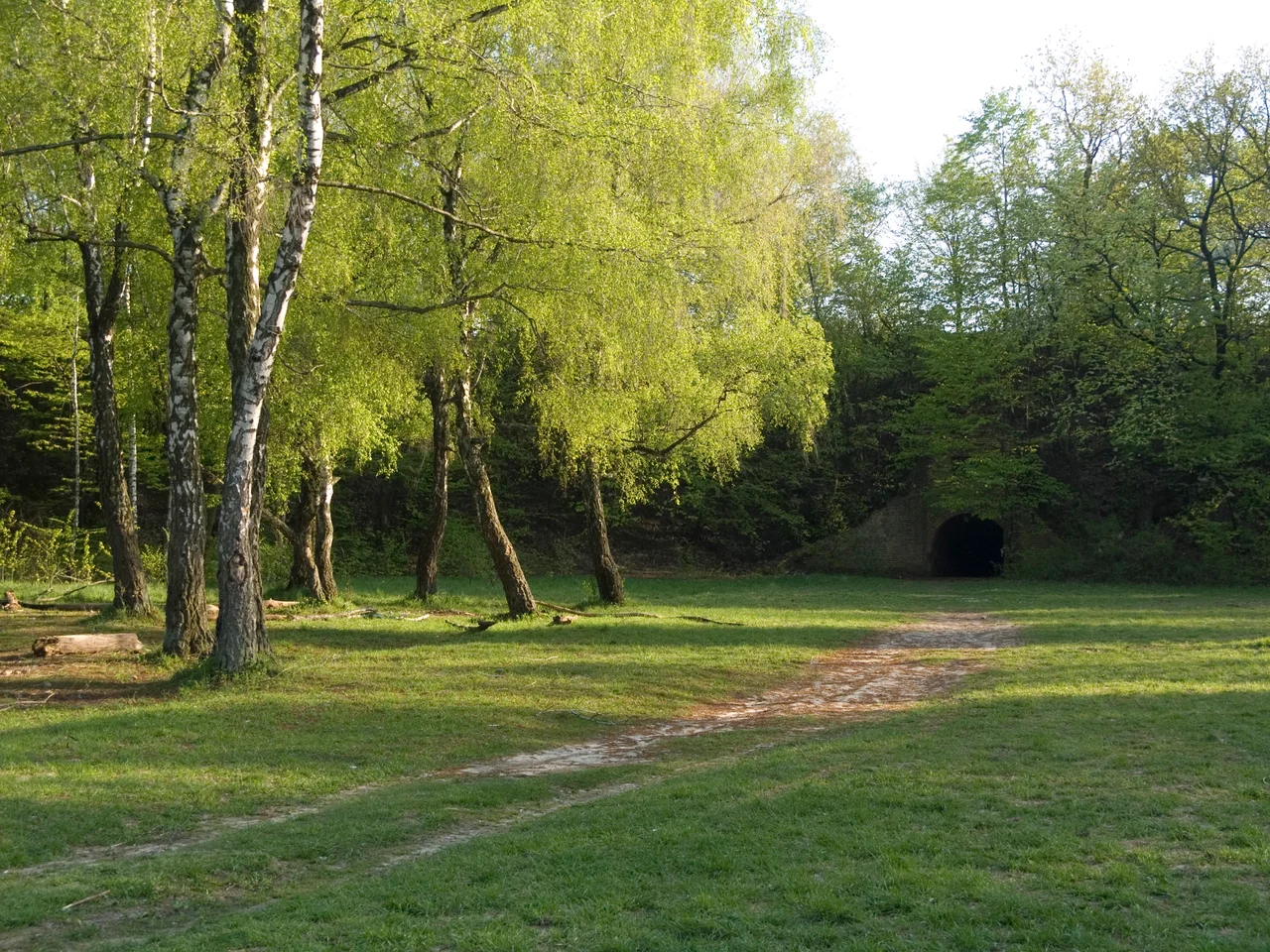

Lysa Hora
Every culture keeps a place where the ordinary rules are said to loosen, and for the Slavs, one of those places is Lysa Hora, the Bald Mountain rising above where the Dnipro meets the little Lybid river in Kyiv. Folk tradition made this wooded hill the most famous of all the mystical bald mountains, the gathering ground of witches in the old stories. Gogol wrote of such places; Mussorgsky set one to music in his thundering Night on Bald Mountain, where witches gather to summon Satan himself before a tolling church bell scatters them at dawn. The name itself is plain enough, barren or featureless mountain, drawn from the bare, treeless crown the hill once had. But the legends give it a shadow, and the hill's real history, when it finally arrived, proved darker than any folktale.
The Mountain of Legends
The name comes from the simplest of observations. The top of the hill was bald, unwooded, and some of its slopes remain bare to this day, and from that plain fact grew an outsized mythology. In Slavic folklore, a lysa hora was where witches convened, and this particular hill in Kyiv became the grandest of them all in the popular imagination. It is the kind of place a city tells stories about precisely because it stands apart, a wild rise of ground on the edge of settlement, wooded and shadowed and just remote enough to seem to belong to another order of things. The great artists of the region reached for it: the writer Nikolai Gogol drew on the tradition, and Modest Mussorgsky's 1867 composition made the witches' sabbath on the bald mountain into one of the most vivid pieces of music ever written about the supernatural.
A Fort With No Purpose
In 1872 the Russian army built a small fortress on Lysa Hora, one piece of the larger Kyiv Fortress ringing the city. It was a mistake, or at least a redundancy. On completion the fort was judged to have little military value, and it was quickly reduced to a military storehouse, a set of walls waiting for a use. The hill's very remoteness, the quality that had made it a place of legend, now recommended it for something else. Far from the city's eyes, the fort would find a purpose that had nothing to do with defending Kyiv, and everything to do with the state's need for a quiet place to do difficult things. What had been a mountain of stories was about to become a mountain of hard fact.
The Weight of What Happened Here
From 1906, the fort on Lysa Hora was used as an execution ground for political prisoners condemned by the tsarist government. Over two hundred people were hanged here between 1906 and 1917, among them Dmitry Bogrov, who had assassinated the imperial prime minister Pyotr Stolypin. These were real people, brought to a remote hilltop to die, and the number, more than two hundred, stands for that many lives ended in this wooded quiet. The hill saw violence again in the Second World War, when a unit of local defense volunteers fought hard here against the advancing Nazi forces. The Red Army later used the old fort for storage until 1980, and in that decade a radio beacon for aircraft navigation was raised on the summit. Today Lysa Hora is a nature reserve within the Kyiv Fortress museum complex, a green and peaceful hill that carries, beneath its legends, the memory of everything that truly happened on its ground.
The Hill Today
Now the mountain has settled into a gentler role. As a protected nature reserve, Lysa Hora has become a place where the people of Kyiv walk, wander its wooded trails, and trace the overgrown remains of the old fort among the trees. The bare crown that gave the hill its name still shows in places, but much of the slope has gone green, and the mood is one of quiet rather than dread. Yet the layers never quite fade. Visitors still come drawn by the folklore, half-seriously seeking the famous bald mountain of the witches' sabbath that Mussorgsky set to music and Gogol wove into his tales. Others come for the walk, or the view, or the strange peace of a place with so much behind it. Legend, execution ground, battlefield, and nature reserve, Lysa Hora holds all of these at once, a single Kyiv hill where the stories people tell and the things that actually happened have grown together beneath the same canopy of trees.
From the Air
Lysa Hora is a wooded hill at about 50.3945 N, 30.5449 E in southern Kyiv's Holosiiv district, near where the Lybid river approaches the Dnipro. From about 2,000 feet AGL, look for a distinct forested rise standing apart from surrounding development, its crown partly bare, with the river valley to the east. Nearest airport is Kyiv International (Zhuliany), ICAO UKKK, to the northwest; Boryspil International, UKBB, lies to the northeast.
Nearby Stories
- Boryspil 1.5 km away
- Zalissia National Nature Park 31 km away
- Trakhtemyriv 32 km away
- Bila Tserkva 40 km away
- Malyn 46 km away
- Radomysl Castle 49 km away
- Nizhyn 81 km away
- Berdychiv 95 km away