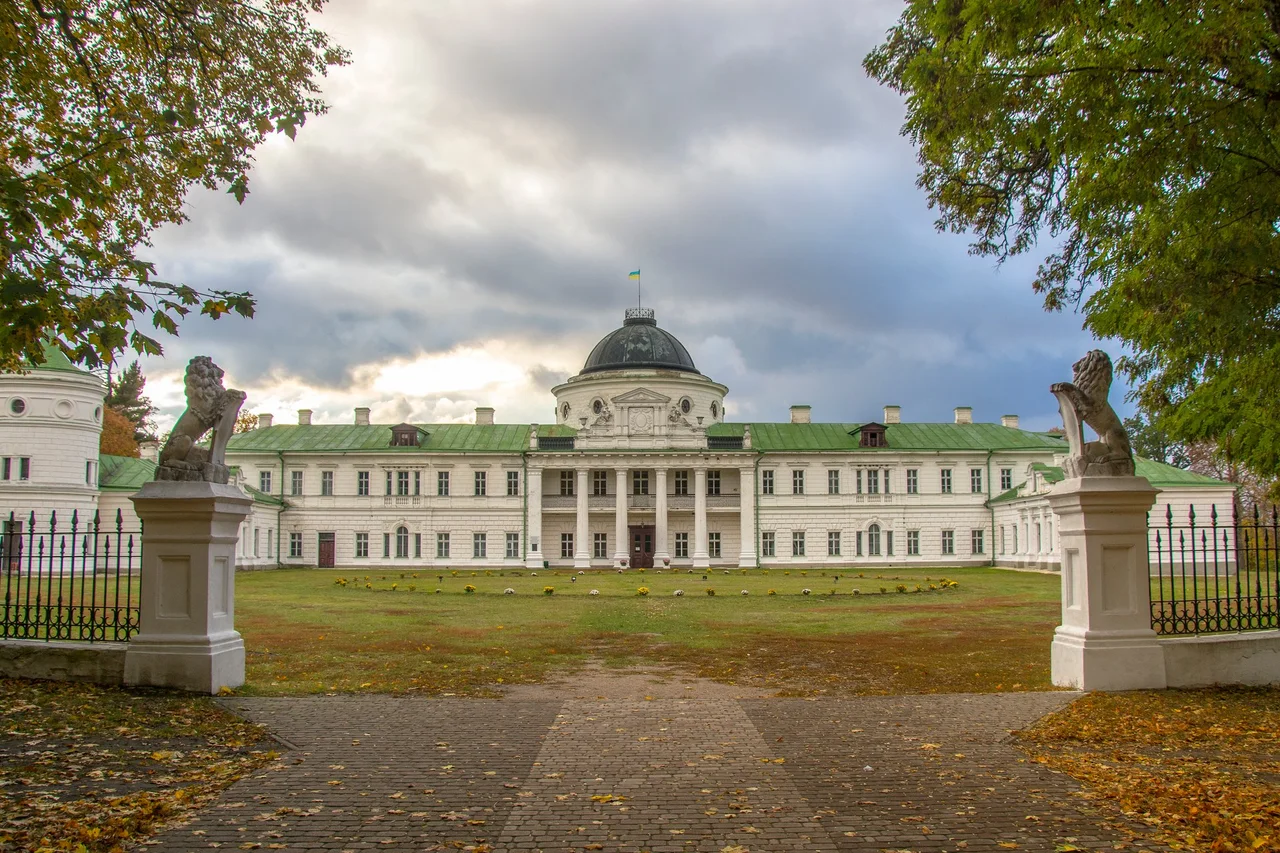

Kachanivka Palace
One summer in the 1830s, the composer Mikhail Glinka sat in a garden pavilion on this estate and worked on the opera that would make his name. He was only one of the extraordinary guests who passed through Kachanivka's gates. Nikolai Gogol read his prose here; the poet Taras Shevchenko recited his verses, and admirers planted an oak in his honour; the painter Ilya Repin wandered the grounds sketching Cossacks for one of his most famous canvases. Set on the bank of the Smosh River in Chernihiv Oblast, Kachanivka became, in its golden age, something close to a private academy of the Ukrainian and Russian arts.
A Viceroy's Country House
The palace began as a grand rural retreat. It was one of many estates built by Pyotr Rumyantsev, the field marshal who served as Catherine the Great's viceroy of Little Russia, and it rose in the 1770s to neoclassical designs by the architect Karl Blank. A church, an orangery, an aviary, and a water tower joined the ensemble over the following century, each adding to the sense of a small self-contained world. Around the buildings spread an English landscape park - one of the largest of its kind in Ukraine and in all of Europe - a designed wilderness of lawns, ponds, and carefully framed views that took generations to mature into the parkland visitors walk today.
The Tarnovskys and Their Salon
Kachanivka's soul was shaped less by its builder than by the family who later held it: the Tarnovskys, descended from Cossack officers. Vasyl Tarnovsky was passionate about the history of Ukraine, and he gathered a remarkable collection of relics, including weapons that had belonged to the hetmans of the old Cossack state. Under the Tarnovskys the estate became a magnet for creative talent. Glinka worked on his opera A Life for the Tsar in a Kachanivka summerhouse; Repin drew studies here for The Cossacks Writing a Letter to the Turkish Sultan; the painter Mikhail Vrubel came too. For a few decades this quiet corner of the Chernihiv countryside hummed with music, poetry, and paint.
Survival and Rediscovery
Like almost every great house in the region, Kachanivka fell under the shadow of the 20th century. The Soviets nationalized it and put it to grim uses - a penal colony, then a tuberculosis hospital - purposes about as far from a cultured salon as one could imagine. And yet, against the odds, the estate came through remarkably intact. The palace, the English park, and a scatter of outbuildings survived, and in 1982 the whole complex was made a national cultural preserve. Today Kachanivka is counted among the Seven Wondrous Castles and Palaces of Ukraine - a place where you can still stand in Glinka's garden, walk under Shevchenko's oak, and feel the ghost of a vanished golden age.
From the Air
Kachanivka lies at 50.8367 N, 32.6556 E on the Smosh River near Petrushivka, in Pryluky Raion of Chernihiv Oblast. From 2,000 to 4,000 feet, the site stands out as a large wooded landscape park with ponds and open lawns surrounding the pale palace and its outbuildings. Nearest airports are Chernihiv Shestovytsia (UKRR) to the north and Kyiv Boryspil (UKBB) about 130 km to the west.
Nearby Stories
- Battle of Konotop 11 km away
- Nizhyn 19 km away
- Battle of Bakhmach 22 km away
- Konotop 40 km away
- Chernihiv Museum of Ukrainian Antiquities 61 km away
- Treaty of Hadiach 73 km away
- Pereiaslav 73 km away
- Battle of the Alta River 100 km away