,_%D0%9A%D1%80%D1%8B%D0%BC.jpg)
Bilohirsk
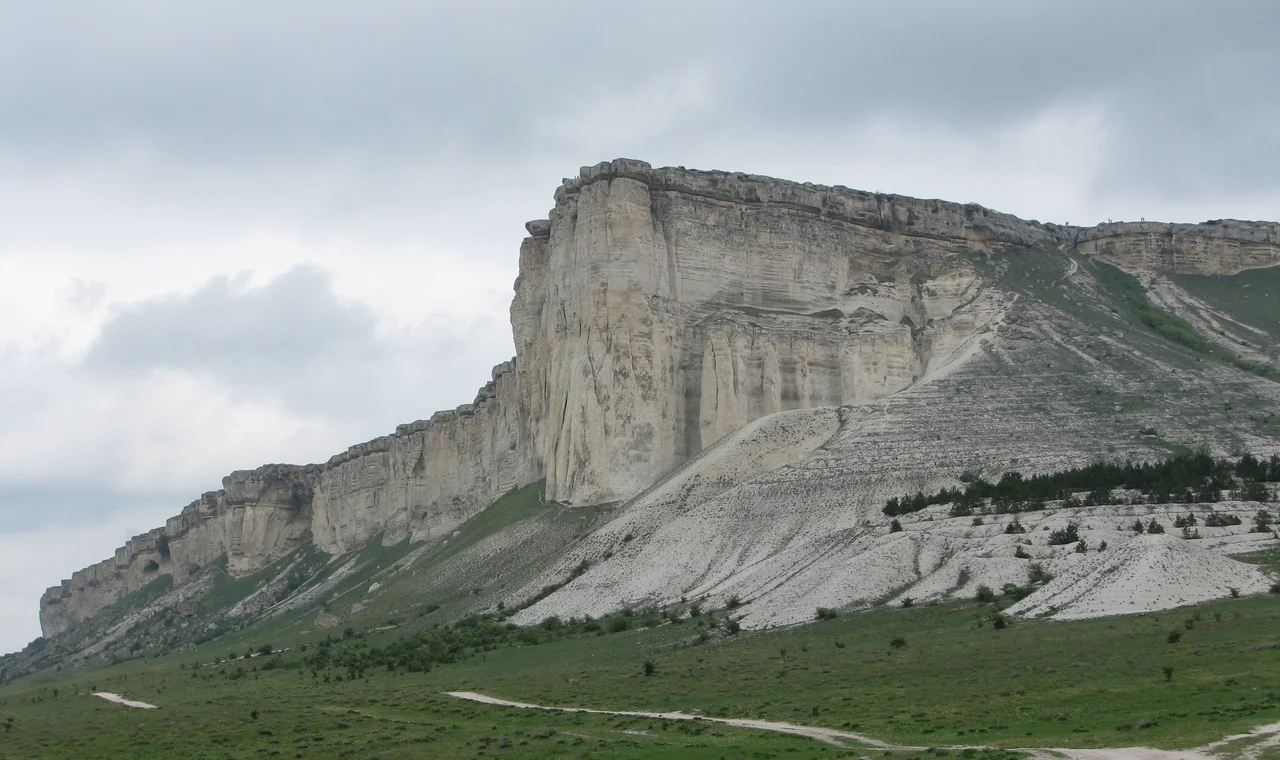
For most of its long life, this town went by another name entirely. Under the Crimean Khanate it was Karasubazar, the market on the Karasu, the black water, and for centuries it was the beating commercial heart of the peninsula, a crossroads on the high road between Simferopol and Kerch where merchants traded the cereals, fruit, and wine of a rich hinterland. Only in 1944 did it become Bilohirsk, white mountains, a name borrowed from the pale cliffs of nearby Aq Qaya. The change of name marked the end of one era and the violent beginning of another, and the town's history holds both its prosperity and its sorrows in the same breath.
The Market on the Black Water
Nestled in a low basin ringed by hills that shelter it from the north wind, Karasubazar grew into one of Crimea's most important cities. By the end of the sixteenth century it surpassed every other town on the peninsula in population, a bustling seat of commerce with a distinctly Crimean Tatar character. Caravans and traders filled its bazaars with grain and the produce of surrounding vineyards and gardens. But its markets also dealt in human beings: Karasubazar held one of Crimea's large slave markets, where captives taken in raids across the region were bought and sold. That trade drew violent response. Three times in the 1620s the Zaporozhian Cossacks stormed the town, and in 1675 a Cossack force under the ataman Ivan Sirko raided Karasubazar and freed a thousand prisoners from captivity.
A Capital, Briefly
In the turbulent eighteenth century, Karasubazar had a moment as the seat of Crimean power. In 1736 a Russian army under Field Marshal Munnich occupied and burned Bakhchisaray, the Khan's capital, and the Crimean Khan Fetih Giray moved his court here. The reprieve was short. The following year Russian troops captured, plundered, and burned Karasubazar in turn. Yet the town's name would be attached to a landmark document: in 1772 the Treaty of Karasubazar was signed here, formally defining the Crimean Khanate as an independent state, a fragile independence that would not outlast the decade before the peninsula was absorbed into the Russian Empire. The caves of nearby Aq Qaya, meanwhile, show that people had lived in this valley since deep antiquity, long before any khan or treaty.
The Weight of the Twentieth Century
The modern era brought the town its darkest chapters. As Soviet forces retreated in 1941, the NKVD shot a number of local people in the streets. The German army then occupied the town from 1941 to 1944, and during that occupation the Nazis murdered its Jewish community, executing them in an anti-tank trench; their loss is now recorded among the untold stories at Yad Vashem. Then came 1944 and the mass deportation of the Crimean Tatars from their homeland, an act that emptied the town of the people whose culture had defined it for centuries. It was in the aftermath of that expulsion that Karasubazar was renamed, its old Tatar name erased from the map under a Soviet policy of removing such names. To speak the town's history honestly is to hold all of this at once: the vibrant marketplace and the market in human lives, the prosperity and the exile.
From the Air
Bilohirsk lies at 45.05°N, 34.60°E on the Biyuk-Karasu river in inland Crimea, about 25 miles east-northeast of Simferopol. From roughly 3,000 feet the town sits in a low basin ringed by hills, with the white wall of Aq Qaya rising conspicuously just to the northeast as a navigation landmark. The nearest major airport is Simferopol (URFF), to the west-southwest.
Nearby Stories
- Aeroflot Flight 6515 9.1 km away
- Crimea 13 km away
- Gennadiy Borisov 13 km away
- Otlu Qaya 14 km away
- Valley of Ghosts 20 km away
- Arabat Spit 48 km away
- Swan Islands Nature Reserve 73 km away
- Soviet Destroyer Smyshlyony 126 km away