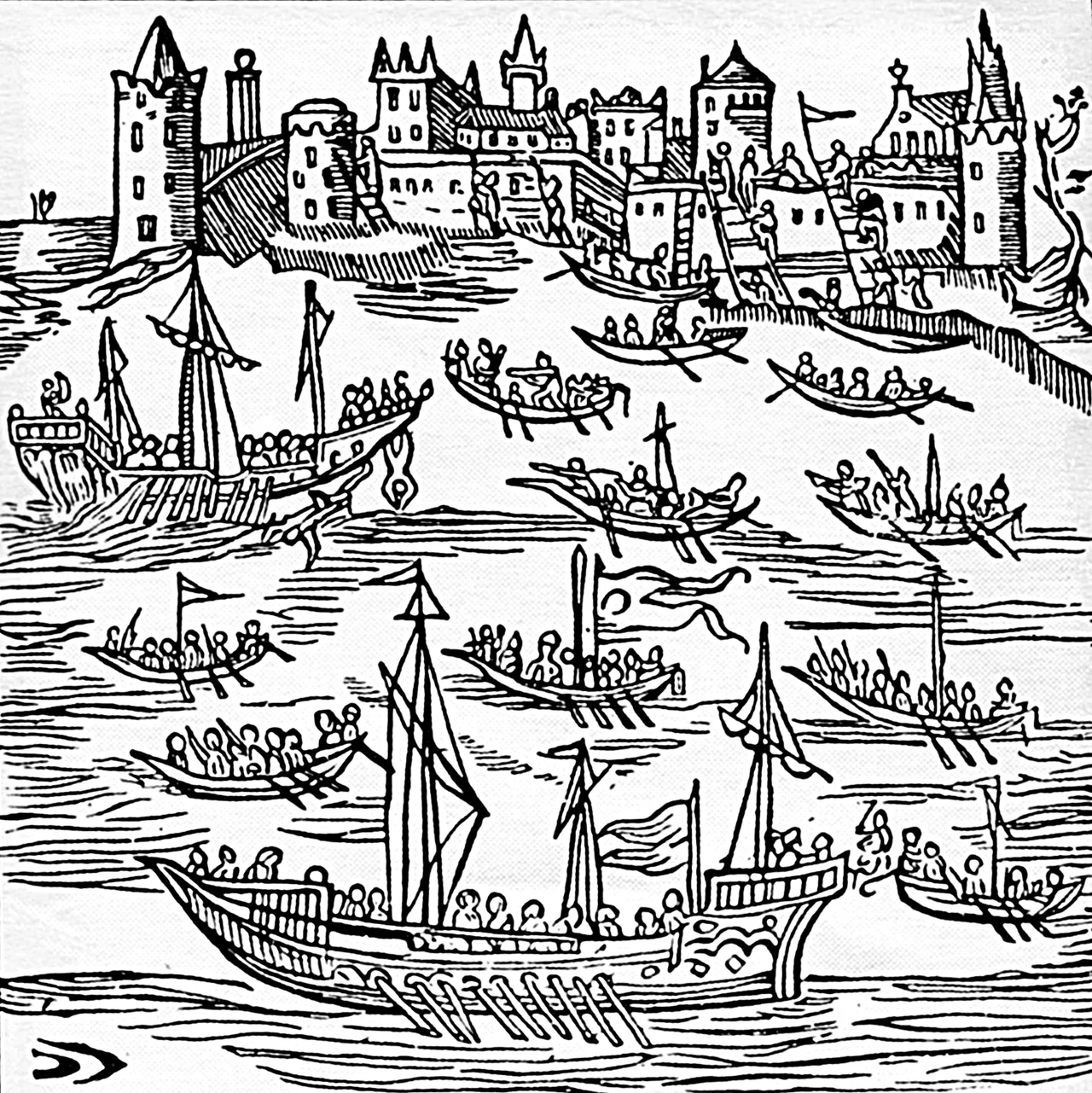

Battle of Kaffa (1616)
On a summer night in 1616, a fleet of low wooden longboats crept toward the walls of Kaffa, the fortified Crimean port the Ottomans called Kefe. Behind those walls lay the largest slave market in the northern Black Sea, where captives seized in raids on Ukraine and the lands around it were held and sold, thousands of them, torn from villages sometimes hundreds of miles away. The men in the boats had come to break it open. At their head was Petro Sahaidachny, hetman of the Zaporizhian Cossacks, one of the most capable commanders his people ever produced. What followed on 22 July would become one of the most celebrated feats in all of Cossack history: a raid that turned a market of human suffering, briefly, into a place of release, and that is still remembered in Ukraine four centuries on.
The Long Way Across the Sea
The expedition set out that July with around 6,000 Cossacks aboard 120 to 150 chaikas, the shallow, oar-driven boats built for exactly this kind of coastal war, low enough to hide in the swell and quick enough to outrun a galley. At the mouth of the Dnieper, in the Dnieper-Bug estuary, they collided with a squadron of Ottoman galleys and got the better of it, taking roughly half the enemy ships. Then Sahaidachny began to deceive. He sent part of his force home to the Sich in plain view, loaded with captured plunder, and lingered about a week near Ochakiv before dispatching still more men back, some two thousand in all. To the watching Turks it looked as though the Cossacks had come, raided, and gone home satisfied. In truth, Sahaidachny had pared his fleet down to the men he trusted for what came next, and quietly pointed their prows south, toward Kaffa and its walls.
The Trick at the Gate
Four thousand Cossacks reached the city and waited for dark. Under cover of night they landed on the shore and moved on the gates. Some among them spoke Turkish, and these men called up to the sentries with a plausible lie: they were an Ottoman unit bound for the war against Persia, nothing to fear here. While the guards hesitated, taken in by the ruse, others crept forward and set scaling ladders against the fortress walls and climbed. They overpowered the sentries at the top, threw open the gates from the inside, and the citadel fell in a single surprise rush. The garrison, expecting no attack at all, had no answer to men already among them. In the space of one night, the strongest Ottoman position on the Crimean coast had been taken from within by an enemy that had crossed a whole sea to reach it, and that had spent days convincing the defenders it was no longer there.
A Vow Kept in the Dark
What made this raid different from ordinary plunder was its purpose. The Cossacks had sworn, as they did before their campaigns, to free Christians held in captivity, and at Kaffa they made good on it. They freed the enslaved people held in the city, men, women, and children taken from their homes and awaiting sale, and to carry as many as possible in their boats they threw most of the looted goods overboard. It was a striking choice: to abandon treasure in order to save people. For the captives, many of them Ukrainians torn from villages hundreds of miles away, the sight of those boats must have been almost unimaginable. The raid is remembered in Ukraine to this day, celebrated in histories and even on a postage stamp bearing Sahaidachny's likeness, and even in Turkish accounts, told sparingly and without much detail, the storming of Kaffa under his command endures. It is the kind of episode that becomes legend precisely because it inverts the usual order of things: for one night, the raiders came not to take people but to give them back their freedom, and a fortress built to hold captives was opened to let them go.
From the Air
The events unfolded at Kaffa, modern Feodosia, at 45.02°N, 35.40°E on the eastern Crimean coast. From 3,000 to 6,000 feet the town and its wide bay resolve clearly; the surviving Genoese and Ottoman fortifications still trace the old walls Sahaidachny's men scaled. Look for Feodosia Bay opening onto the Black Sea. Nearest airport is Simferopol (UKFF) to the west.
Nearby Stories
- Aq Qaya 15 km away
- Aeroflot Flight 6515 16 km away
- Battle of the Kerch Peninsula 21 km away
- Valley of Ghosts 33 km away
- Myrmekion 52 km away
- Soviet Destroyer Smyshlyony 71 km away
- Alushta 76 km away
- Syvash 89 km away